AIMapy: The AI Travel Map Tool That Generates Personalized Itineraries in 30 Seconds

AIMapy uses AI and authoritative data to generate personalized travel itineraries in 30 seconds, with collaborative planning support.
AIMapy is an AI travel map and itinerary planning tool that generates personalized routes based on user interests in under 30 seconds, drawing from a database of 1.5 million+ locations enriched with recommendations from UNESCO, the Michelin Guide, and National Geographic. It also features built-in multi-person collaboration to ease group trip coordination. On its Product Hunt launch day, it earned 85 upvotes and 39 comments, ranking #16. Its authoritative data sourcing is its clearest differentiator, though the long-term viability will hinge on route quality and the ability to keep data consistently up to date.
Travel planning has always been a time-consuming headache — researching guides, comparing routes, coordinating with travel companions can easily eat up several evenings. AIMapy, a new arrival on Product Hunt, aims to compress that entire process to just 30 seconds using AI. As an AI-powered travel map and itinerary planning tool, it earned 85 upvotes and 39 comments on launch day, climbing to #16 in the rankings.
What Is AIMapy
AIMapy's positioning is clear: a travel tool that combines an AI Map with an itinerary Planner. Its core value proposition is automatically generating personalized travel routes based on user interests in under 30 seconds, covering attractions, restaurants, shopping spots, and local activities.
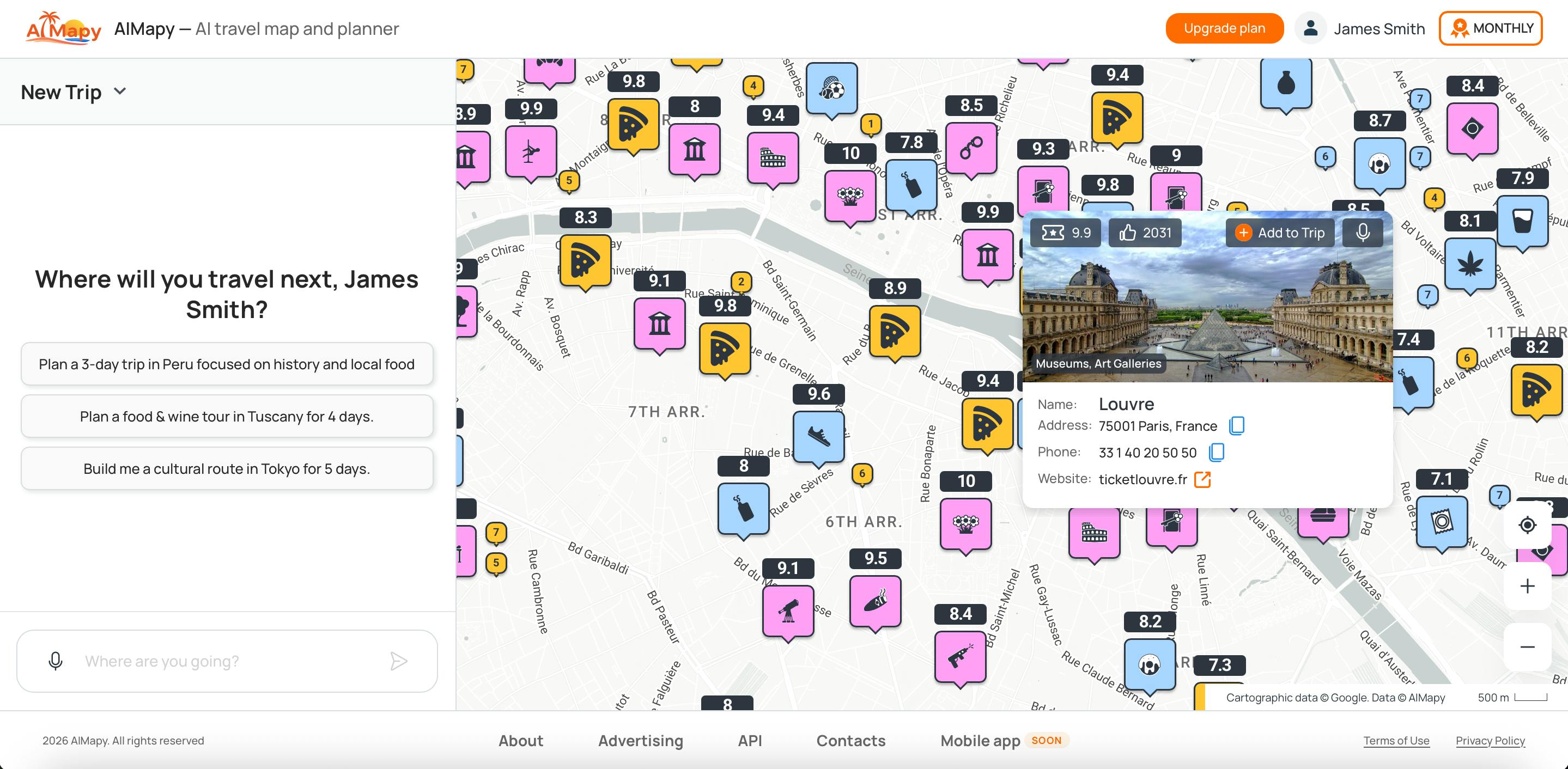
Unlike traditional map or travel guide platforms, AIMapy emphasizes "personalization" and "speed." Instead of searching one by one and manually piecing together an itinerary, users hand their preferences to the AI and let the algorithm assemble the route. For travelers who are pressed for time or prone to decision fatigue, this "one-click trip" experience has obvious appeal.
Data Scale and Authoritative Endorsements
AIMapy claims to have indexed 1.5 million+ locations — a substantial data footprint. Even more noteworthy is the credibility of its data sources: recommendations are drawn from institutions like UNESCO, the Michelin Guide, and National Geographic.
This kind of endorsement is critical for travel tools. Travel decisions are heavily trust-dependent. Ordinary crowdsourced reviews are vulnerable to manipulation and rating inflation, while incorporating official recommendations from authoritative institutions helps filter out noise and raises the quality floor for generated itineraries. For users who want to avoid disappointing experiences, this is a genuinely meaningful value point.
The Michelin Guide was founded in 1900, originally a travel handbook produced by a French tire company for motorists. Over more than a century of evolution, it has become the world's most authoritative rating system for dining and hospitality — its star ratings represent the highest honor a restaurant can receive. The UNESCO World Heritage List catalogs natural and cultural sites of outstanding universal value, with over 1,200 entries worldwide today. Structurally integrating this institutional data into AI-driven itinerary recommendations is essentially a pre-filtering layer built on trusted sources — grafting an expert curation layer onto an automated generation engine. This creates a meaningful differentiation from platforms that rely on user-generated content (UGC), which inherently struggle with quality consistency.
Social Trip Collaboration
Another standout feature of AIMapy is the ability to plan trips with friends. When traveling in groups, coordinating itineraries is often the biggest pain point: everyone has different interests, budgets, and preferred paces. AIMapy bakes collaborative planning directly into the product, meaning a group can discuss and adjust routes together on a shared map.
This design addresses a genuine need. Compared to primitive workarounds like screenshotting plans or sharing links in group chats, centralized map collaboration can significantly reduce communication overhead. That said, based on the product launch information available, the specific granularity of collaboration features — such as real-time editing, voting, or task assignment — hasn't been fully disclosed, and the actual experience remains to be validated.
Real-time multi-user collaboration typically relies on CRDT (Conflict-free Replicated Data Types) or OT (Operational Transformation) algorithms to ensure multiple users can edit the same map simultaneously without data conflicts — the same mechanisms used by Google Docs and Figma. For travel planning specifically, the complexity of collaboration is further amplified by the geospatial dimension: participants need to make shared decisions about the spatial arrangement of points of interest on a map and the ordering of routes, not just collaborate on plain text. While mainstream travel apps like Wanderlog and TripIt support itinerary sharing, truly smooth real-time co-editing remains a rare capability. If AIMapy can deliver on this front, it would represent a formidable technical and product barrier to entry.
Market Positioning and Observations
AIMapy's Product Hunt categories — Travel, Artificial Intelligence, and Maps — land squarely in one of the hottest tracks for applied AI. AI-powered travel planning tools have been proliferating rapidly, so competition is fierce. Whether AIMapy can stand out depends on a few key factors:
- Generation quality: A 30-second itinerary is compelling, but whether the routes are genuinely logical — sensible geographically and realistic time-wise — is what determines user retention.
- Data freshness: A 1.5 million-location database requires ongoing maintenance. Outdated information about restaurant hours or event schedules will directly hurt the user experience.
- Differentiation moat: Authoritative institutional recommendations are currently the biggest differentiator, but translating that data into unique user value — rather than simple information aggregation — is the key to long-term competitiveness.
The active discussion across 39 comments signals genuine interest among early users. For travelers who prefer to explore independently but don't want to spend hours on research, AIMapy is worth watching and trying out.
Summary
AIMapy compresses travel planning from "hours" to "seconds" using AI, combining a 1.5 million+ location database with authoritative recommendations from UNESCO, the Michelin Guide, and National Geographic, layered on top of multi-person collaboration capabilities — forming a comprehensive AI travel assistant solution. Its product logic is coherent and its pain point targeting is precise, making it a textbook example of AI finding traction in a vertical lifestyle use case. As for the actual quality of generated routes and the reliability of its data, that will ultimately require sustained feedback from real-world users over time.
Related articles

Chain of Thought Isn't Just for AI: How Humans Can Use CoT to Improve Thinking Quality
Chain of Thought isn't just a prompt trick for large models. Starting from a Hacker News discussion, this article analyzes why CoT works for human thinking too, breaks down actionable ways to transfer it, and highlights the key differences between human CoT and machine CoT.
Cloudflare Teams Up with OpenAI: Closi…
Cloudflare Teams Up with OpenAI: Closing the Loop from Vulnerability Discovery to Defense with AI
Cloudflare uses OpenAI Daybreak to investigate security vulnerabilities and generate reviewable remediation plans, while developers use Codex to boost coding efficiency and quality.

Orca Multi-Agent Orchestration in Practice: A Guide to Parallel Collaboration with Claude and Codex
Orca is Stable AI's free open-source agent workbench supporting 34 agents like Claude Code and Codex in parallel. Learn its Git worktree isolation, multi-model orchestration, and mobile management.