Air-Breathing Electric Propulsion: Letting Satellites Stay in Low Orbit Indefinitely Using the Atmosphere

ABEP technology uses thin atmospheric gas as propellant, potentially giving low-orbit satellites unlimited operational life.
LEO satellites have long been constrained by finite propellant reserves — once station-keeping fuel runs out, so does the mission. Air-Breathing Electric Propulsion (ABEP) offers a fundamental solution: at VLEO altitudes around 200 km, an intake collects trace nitrogen and oxygen molecules, ionizes them, and expels them via an electric field to generate thrust that counteracts atmospheric drag. With sufficient solar power, a satellite could theoretically maintain orbit indefinitely, shifting the lifespan bottleneck from fuel reserves to component aging. The technology also unlocks previously impractical VLEO orbits, enabling higher-resolution sensing and lower-latency communications. Key engineering challenges include intake efficiency, atomic oxygen corrosion resistance, and stable power supply. ESA and JAXA have achieved ground-based validation, but practical deployment remains some way off.
A Concept That Could Rewrite the Lifespan of Low-Orbit Satellites
Satellites in low Earth orbit (LEO) have always faced the same fate: the drag from thin atmospheric particles continuously saps their kinetic energy, and without periodic thruster burns to correct their orbit, they will eventually fall back into the atmosphere and burn up. The conventional solution is to carry onboard propellant for station-keeping — but propellant always runs out, and fuel reserves often directly determine how long a satellite can remain in service.
According to a report on Hacker News, a new type of satellite engine is attempting to fundamentally break this constraint. Rather than relying on an onboard fuel tank, it uses the thin Earth atmosphere itself as a propellant source, allowing a satellite to remain in low orbit theoretically indefinitely.
The Core Idea Behind Air-Breathing Electric Propulsion
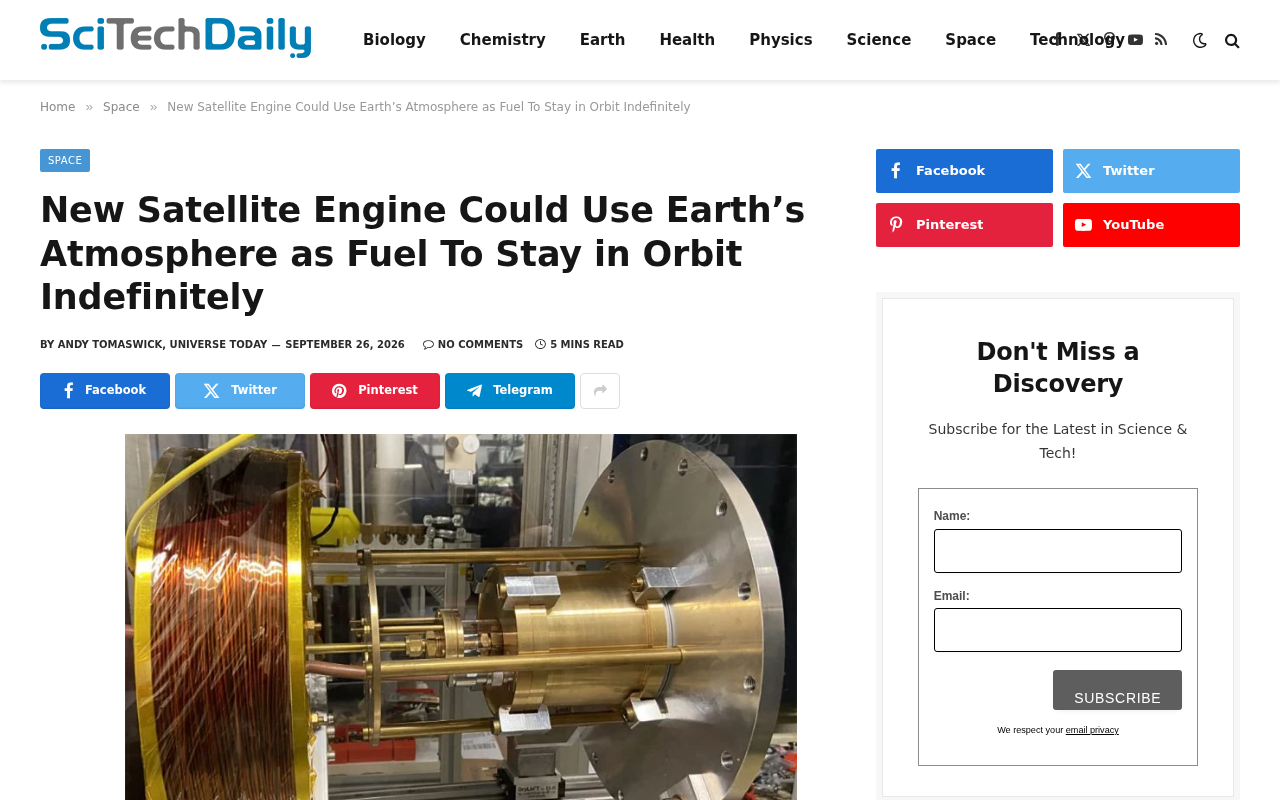
This class of technology is generally known as Air-Breathing Electric Propulsion (ABEP). The logic is straightforward: at very low Earth orbit (VLEO) altitudes around 200 km, while the atmosphere is extremely thin, neutral gas molecules such as nitrogen and oxygen are still present. As a satellite travels at high speed, it continuously collides with these molecules. An intake at the front collects them, ionizes them, and accelerates them through an electric field before expelling them at high velocity from the rear — generating thrust in the process.
In this way, the propellant needed to counteract orbital drag comes from the very same atmospheric layer that causes it. As long as the satellite has sufficient electrical power — typically from solar panels — the system can operate continuously, free from dependence on a finite fuel supply.
Why Very Low Earth Orbit Matters
VLEO holds natural appeal for applications like remote sensing and communications: the closer proximity to Earth means higher imaging resolution, lower signal latency, and reduced power requirements for ground terminals. But because atmospheric drag is so intense at this altitude, it has historically been very difficult to exploit for long durations. A mature air-breathing propulsion system would effectively open up a prime orbital band that has previously been too costly to use.
The ionization process typically employs methods such as radio frequency (RF) discharge or electron cyclotron resonance (ECR) to convert the collected neutral molecules into plasma, which is then accelerated and expelled via electrostatic or electromagnetic fields. Compared to conventional chemical propulsion, electric propulsion generally achieves specific impulse (Isp — a key measure of propulsion efficiency) several times higher, meaning the same propellant mass produces a greater velocity increment. The air-breathing approach combines this advantage with in-situ propellant collection. The European Space Agency (ESA) conducted ground-based validation of this technology pathway as early as 2021 through pre-research projects including GOCE follow-on missions, and JAXA in Japan has also published proof-of-concept results demonstrating that a net positive thrust can indeed be sustained under simulated VLEO atmospheric density conditions.
VLEO is typically defined as orbital altitudes between 150–450 km — below the deployment altitudes of most mainstream commercial constellations (such as Starlink, which operates at 540–570 km). Within this range, atmospheric density decreases exponentially with altitude; at 200 km, density is roughly one hundred-billionth of sea level, yet still sufficient to generate significant drag on a satellite. Precisely because of these ultra-low altitudes, optical satellites operating here can achieve near-airborne reconnaissance resolution without changing camera aperture size. Communications satellites also benefit from roughly 8 dB less free-space path loss compared to 500 km orbits, which is highly favorable for miniaturizing ground terminals.
The Real Engineering Hurdles
As elegant as the concept is, the engineering challenges are equally significant. First is intake efficiency — efficiently collecting neutral molecules in an extremely rarefied environment is no small feat, and intake duct design directly determines whether the engine can be adequately "fed." Second is the balance between thrust and drag: the collected gas is simultaneously both fuel and a source of drag, and the satellite can only maintain orbit if the engine continuously produces thrust greater than or equal to the drag it experiences.
Beyond that, the collected atmospheric gas has a complex composition — atomic oxygen is highly corrosive, posing a serious durability challenge for engine components over extended operation. The power system must also provide stable, sufficient wattage to sustain the ionization and acceleration processes.
The atomic oxygen (AO) corrosion problem is particularly difficult to address in engineering terms. At VLEO altitudes, atomic oxygen is present in high proportions and is extremely chemically reactive — it attacks polymers, carbon-based materials, and certain metal oxide layers, accelerating the degradation of thruster chamber walls and ion grids. Long-duration exposure experiments on the International Space Station have documented atomic oxygen erosion rates for various materials, providing reference data for engine material selection. Researchers currently favor iridium coatings, alumina ceramics, or specialty carbide materials to improve durability, but these approaches increase manufacturing cost and process complexity. Striking the right balance between corrosion resistance and fabrication feasibility remains a core challenge at the materials engineering level.
What This Means for the Satellite Industry
If air-breathing electric propulsion can be made practical, the implications are structural. Satellite lifespan would no longer be governed by propellant reserves but would depend more on the aging rate of electronics and structural components — potentially driving down cost per unit of service time significantly. For Earth observation constellations that require frequent revisit cycles and high resolution, long-term residency at VLEO means enhanced capability and a lower barrier to deployment.
It should be noted that the source information for this article is limited to a brief technology news post, lacking specific experimental data, performance metrics, and details about the research teams involved. This technology is currently closer to the frontier research stage and remains some distance from large-scale engineering application. Readers should treat it as a direction worth tracking rather than a mature, deployed solution.
Conclusion
Turning an "enemy" into "fuel" — that is the elegance of air-breathing electric propulsion. It attempts to solve the most fundamental endurance problem facing low-orbit satellites, while also opening up imaginative possibilities for the commercial exploitation of very low Earth orbit. Whether the technology can deliver on its promise of indefinite orbital residency will ultimately come down to real-world breakthroughs in intake efficiency, material durability, and power supply.
Related articles

@ai-sdk/vue 3.0.306 Patch Release Syncs with [email protected] Update
@ai-sdk/vue 3.0.306 released, synced with [email protected]. A routine patch release for the Vercel AI SDK ecosystem with no public API changes; the Vue adapter layer stays version-aligned with the core package.

Gemini 4 Argon API Launches: The Era of Million-Token Output Begins
Google launches Gemini 4 Argon with sparse MoE architecture, up to 1M output tokens, and a 68.90% Vals Index score, available across API, AI Studio, and the Gemini app.

DukaanAI: Turning Product Photos into Inventory Lists with Open-Source AI
DukaanAI is an AI inventory tool for small retailers that turns product photos into inventory entries using the open-source Gemma 3 model, with local inference, editable fields, and CSV export.