Airbnb Introduces AI Search and Social Features to Reshape the Travel Experience

Airbnb adds AI search, social features, and lifestyle services to become a full-journey travel platform.
Airbnb has rolled out a series of major updates: AI-powered search replaces traditional keyword filtering so users can find listings using natural language; new social features aim to boost platform stickiness by turning low-frequency bookings into higher-frequency content engagement; and pilots for meal delivery and laundry services extend the platform beyond accommodation. All three threads point toward the same strategic direction — evolving from a single-purpose booking tool into a comprehensive travel services ecosystem. The real-world impact and scale of these features remain to be seen.
Airbnb's AI Transformation Signal
Airbnb recently announced the addition of AI-powered search to its platform, alongside expanded social features and pilot programs for meal delivery and laundry services in select regions. These moves send a clear signal: the home-sharing platform is attempting to evolve from a simple property booking tool into a comprehensive service ecosystem covering the entire travel journey.
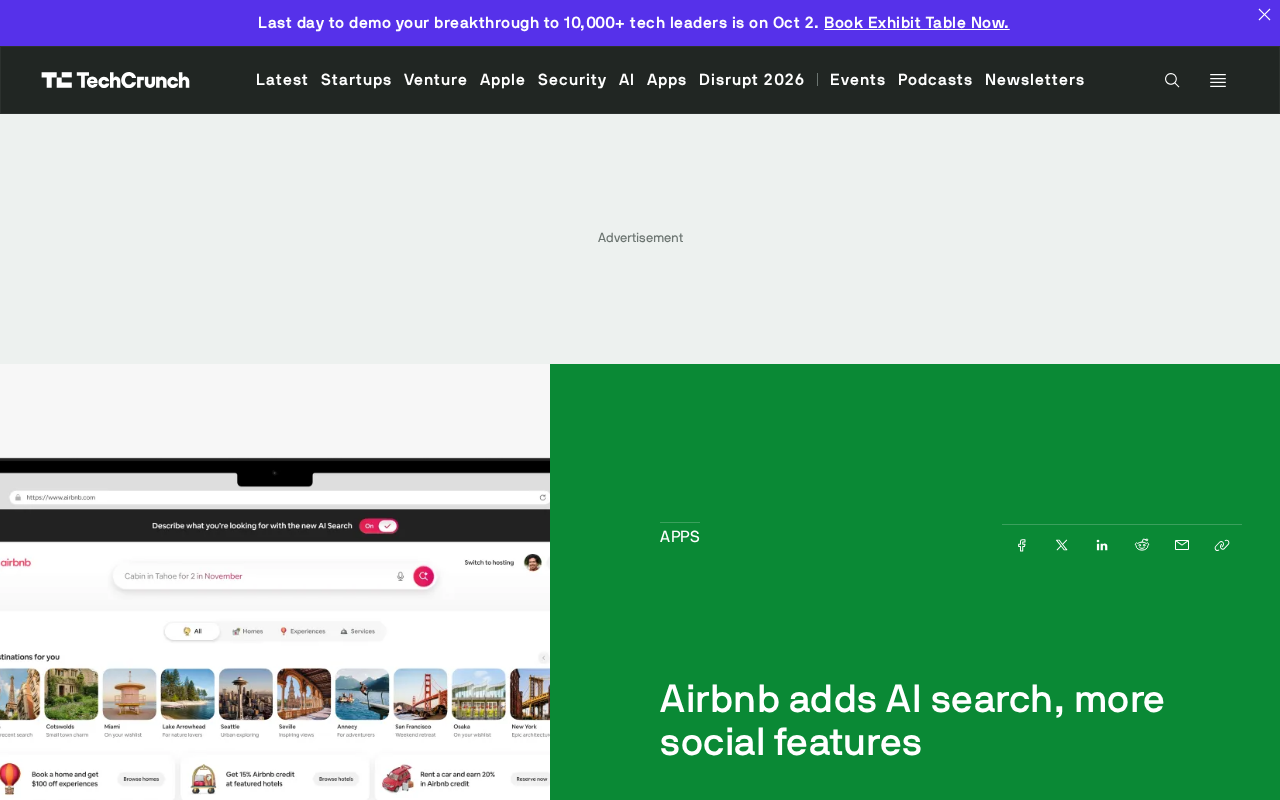
The introduction of AI search is the centerpiece of this update. Traditional property filtering relies on structured inputs like keywords, dates, and price ranges, whereas AI search can theoretically understand more natural expressions — allowing users to find the right listing through conversational or descriptive language. For a platform with a massive inventory of listings, helping users cut through information overload and make faster decisions is precisely where AI technology can deliver the most value.
The fundamental difference between AI-powered search and traditional keyword search lies in semantic understanding. Traditional search depends on exact matching — users must know the right words to find what they want. AI search built on large language models (LLMs), however, can interpret intent. For example, if a user types something like "a quiet beachside cabin that's good for dogs, preferably with a fireplace," the system can decompose that into multiple dimensions — pet-friendly, quiet environment, coastal location, fireplace amenity — and match all of them simultaneously. This capability is especially well-suited to listings, where attributes are complex and personal preferences carry significant weight. Similar approaches are already being tested in the industry — Booking.com and Expedia are both piloting conversational travel planning assistants — but striking the right balance between recall and precision remains a shared challenge.
The Stickiness Logic Behind Social Features
The newly added social features reflect Airbnb's desire to boost user engagement and platform stickiness. In the travel decision-making process, firsthand experience sharing, recommendations, and interactions from real users are often more persuasive than official descriptions. By strengthening social elements, Airbnb can accumulate more user-generated content and relationships beyond the booking transaction itself, thereby reducing dependence on search engines and external traffic.
This thinking aligns with the direction many platforms have evolved — moving beyond completing a single transaction toward building a community that users are willing to return to and engage with repeatedly. Social features can both improve conversion rates and provide richer behavioral data to fuel AI-driven recommendations.
In business models, platform stickiness is typically measured by user retention rates, visit frequency, and the share of direct traffic. For Airbnb, travel bookings are inherently low-frequency behavior — the average user may only book once or twice a year — which means the platform must continuously invest in advertising and user re-engagement. The strategic value of social features lies in transforming this low-frequency transactional context into higher-frequency content consumption and community interaction. Even when users have no immediate travel plans, they may stay active by browsing friends' trip stories or following destination updates. This logic resonates with the content-driven discovery models of Pinterest and Xiaohongshu — the core idea is to fill the gaps between transactions with content consumption, so that when purchase intent does arise, the platform is top of mind.
From Accommodation to Full-Journey Services
Another notable development is Airbnb's pilot of meal delivery and laundry services in select regions. This marks the platform extending its reach into travel lifestyle scenarios beyond accommodation. For long-stay guests or families traveling together, food and laundry are genuine pain points, and addressing these needs can significantly enhance the completeness of the overall stay experience.
This also follows the classic horizontal expansion logic of platform economics: leveraging the user base and trust built through a core business to extend into adjacent, higher-frequency services — and in doing so, increasing the overall value generated per user. That said, operationally intensive services like delivery and laundry require local supply and fulfillment capabilities. The decision to pilot in select regions rather than roll out broadly suggests Airbnb is proceeding cautiously on the path to scale.
Horizontal expansion in platform economics typically follows one of two paths: building capabilities in-house to directly offer new services, or adopting an open platform model to bring in third-party supply. Meal delivery and laundry are fulfillment-heavy businesses involving local logistics coordination, supplier management, and service quality control — far more operationally complex than the information-intermediary model of property booking. Airbnb's choice to run regional pilots rather than launch globally is both a way to manage expansion risk and a means of gathering data to validate demand and profitability. Relevant industry parallels include Meituan's expansion from food delivery into hotels and in-store services, and Grab's construction of a ride-hailing + food + financial services super-app ecosystem across Southeast Asia — cases that demonstrate how extending service boundaries requires robust local operational capabilities as a foundation.
Summary and Observations
Taken together, this round of Airbnb updates revolves around three main threads: using AI to improve search and matching efficiency, using social features to strengthen user stickiness, and using lifestyle services to expand the business's boundaries. The three threads reinforce one another and collectively point toward a vision of a more comprehensive travel services platform.
Given the limited public information available at this stage, the real-world effectiveness of AI search, the specific form social features will take, and the coverage scope of new services all remain to be seen. Whether these features genuinely improve user experience — and the extent to which they translate into commercial growth — will be the key questions worth tracking going forward.
Related articles

Hands-On with the Gemini 4 Argon API: Thinking Levels and Background Mode Explained
A Free Code Camp crash course on the Gemini 4 Argon API: from getting a key and sending your first request to controlling reasoning costs with thinking levels, enabling multi-turn chat with previous_interaction_id, and generating a Breakout game in background mode—plus a Google engineer's take on the model's capabilities.

Reinforcement Learning Takes On Getting Over It: Distributed Training Strategies Behind 63% Progress
A developer uses deep reinforcement learning to tackle Getting Over It. The agent climbs from the bottom to 63% progress but gets stuck at the anvil. The project is open-sourced, using divide-and-conquer training and CPU-only training, seeking community collaboration to break the bottleneck.

Sigma FP2 Released: The World's Smallest Full-Frame Camera Gets Sensor and Screen Upgrades
Sigma launches the FP2 full-frame camera, retaining its smallest-and-lightest design with three key upgrades: improved sensor, articulating LCD screen, and longer battery life—built for portable video creators.