AIstatLab BraTS-GoAT 2026: Quality-Controlled Consensus Pseudo-Labels and Dense Expert Adaptation

AIstatLab achieved DSC 0.834 on BraTS-GoAT 2026 Task 3 with quality-controlled consensus pseudo-labels, a nested-region objective, and a four-expert adapter.
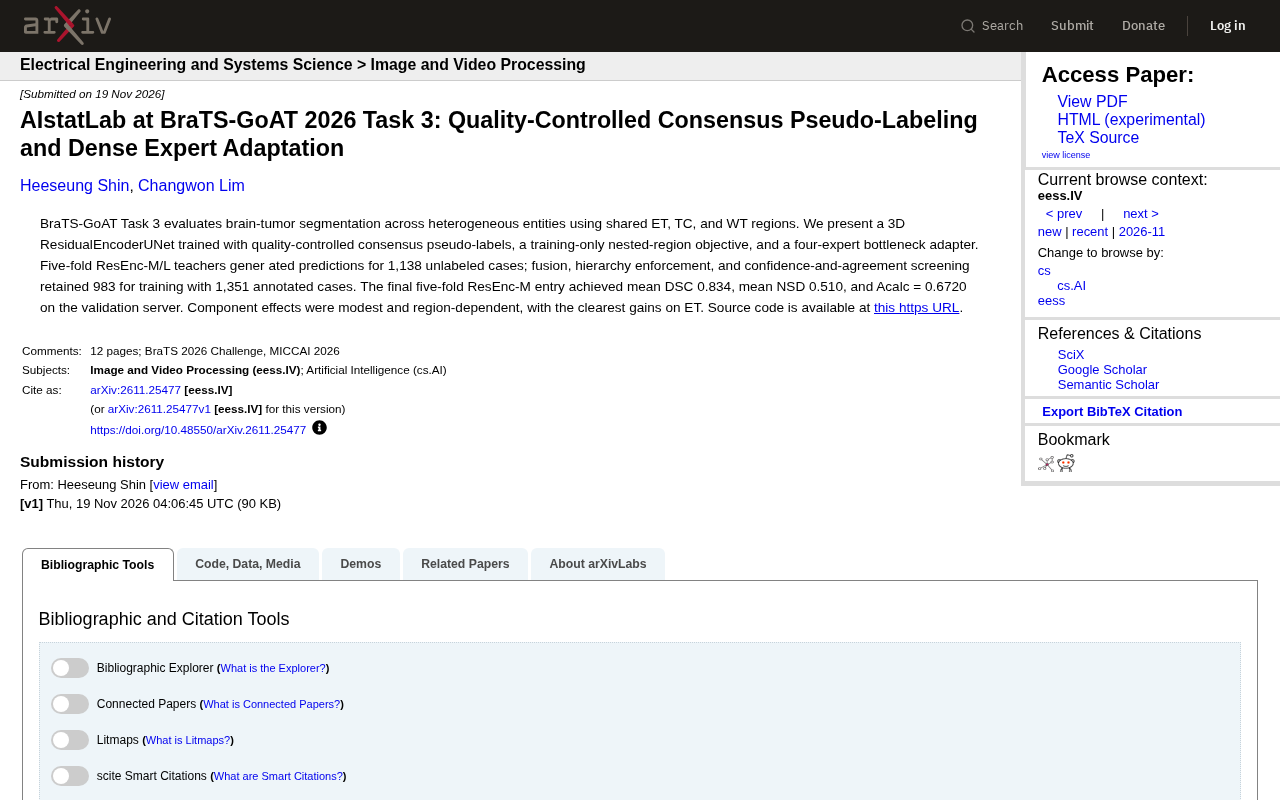
For BraTS-GoAT 2026 Task 3 heterogeneous brain tumor segmentation, AIstatLab combines quality-controlled consensus pseudo-labels, a training-only nested-region objective, and a four-expert bottleneck adapter. Five-fold ResEnc-M/L teachers generate pseudo-labels for 1,138 unlabeled cases; after fusion, hierarchy enforcement, and confidence-consistency filtering, 983 are kept and jointly trained with 1,351 labeled cases on 3D ResidualEncoderUNet. The final five-fold ResEnc-M scores DSC 0.834, NSD 0.510, and Acalc 0.6720; ablations show moderate, region-dependent gains, largest in ET.
Introduction
In medical image analysis, brain tumor segmentation has long been a highly challenging task, especially when tumor types are heterogeneous and annotated data is limited. BraTS-GoAT 2026 Task 3 is a benchmark evaluation established precisely for this problem, requiring models to achieve accurate segmentation on the shared ET (enhancing tumor), TC (tumor core), and WT (whole tumor) regions. The AIstatLab team proposed a solution combining quality-controlled consensus pseudo-labels with dense expert adaptation, achieving an average DSC of 0.834, NSD of 0.510, and Acalc of 0.6720 on the validation server. This article provides an in-depth analysis of the technical details and design rationale of this solution.
Task Background and Challenges
The core of BraTS-GoAT Task 3 lies in handling brain tumor segmentation of heterogeneous entities. Unlike conventional segmentation tasks, this task requires the model to simultaneously output segmentation results for three regions—ET, TC, and WT—and these regions have nested hierarchical relationships (e.g., ET is a subset of TC, and TC is a subset of WT). This hierarchical structure has clear anatomical significance, but traditional segmentation models often predict each region independently, ignoring the constraints among them, leading to inconsistent predictions.
In addition, the scarcity of annotated data is another major challenge of this task. Although 1,351 annotated cases were provided, the amount of unannotated data is larger (1,138 cases). How to effectively leverage this unannotated data to improve model generalization is a key problem that participating teams need to solve.
DSC, NSD, and Acalc Metrics
DSC (Dice Similarity Coefficient) is the most commonly used overlap metric in segmentation tasks. It is computed as twice the intersection of the predicted region and the ground truth region divided by the sum of their volumes, with values ranging from 0 to 1; the closer to 1, the better the overlap. NSD (Normalized Surface Distance) evaluates from a boundary perspective, computing the normalized matching degree between the predicted surface and the ground truth surface within a given tolerance. It is more sensitive to boundary errors and is suitable for evaluating targets such as tumors with irregular boundaries. Acalc is a comprehensive metric specific to the BraTS-GoAT task, typically obtained by weighting multiple aspects of error (such as region-level overlap and boundary distance) to reflect overall segmentation quality in a single number. The three are complementary: DSC reflects volumetric overlap, NSD reflects boundary accuracy, and Acalc provides a comprehensive perspective, which is why the paper reports all three metrics simultaneously.
Method Overview: A Three-Pronged Approach
The AIstatLab solution revolves around three core components: quality-controlled consensus pseudo-labels, a nested-region objective used only during training, and a four-expert bottleneck adapter. The overall architecture is based on 3D ResidualEncoderUNet, a backbone commonly used in medical image segmentation, but the team fully exploited its potential through carefully designed training strategies and adaptation modules.
Quality-Controlled Consensus Pseudo-Labels
Pseudo-labeling is widely used in semi-supervised learning, but the quality of pseudo-labels directly determines model performance. The team used five-fold ResEnc-M/L teacher models to generate predictions for 1,138 unannotated cases, then applied fusion, hierarchy enforcement, and confidence and consistency filtering, ultimately retaining 983 cases for training. This filtering process ensured the reliability of pseudo-labels and avoided misleading the model with noisy labels.
Interestingly, the fusion strategy may have combined predictions from multiple teacher models to reduce single-model bias; hierarchy enforcement ensured that pseudo-labels satisfy the anatomical constraint ET ⊆ TC ⊆ WT; and confidence and consistency filtering further removed low-quality samples. This multi-level quality control pipeline reflects the team's emphasis on pseudo-label quality.
Five-Fold Teacher Models and Consensus Pseudo-Labels
Five-fold means dividing the annotated data into five parts, training on four parts in turn while validating on the remaining part, thereby obtaining five teacher models. For unannotated data, each teacher model produces one prediction, and these predictions are then fused (e.g., by averaging probability maps or majority voting) to obtain "consensus" pseudo-labels. Multi-model ensembling can significantly reduce random bias and overfitting noise from a single model, bringing pseudo-labels closer to the true distribution. The so-called "consensus" means that only regions where multiple teacher models agree are trusted, while regions with large disagreement are often marked as low-confidence. Combined with subsequent confidence thresholds and consistency filtering, unreliable samples can be further removed—which is exactly why this solution retained only 983 out of 1,138 cases.
Training-Only Nested-Region Objective
The nested-region objective is another design that exploits the regional hierarchy. This objective function enforces the nested constraints among the regions output by the model during training, but introduces no additional computational overhead at inference time. This design both improves model consistency and maintains inference efficiency.
From the ablation results, the component's effect is moderate and varies by region, with the most notable gain in the ET region. This may be because the ET region has clearer boundaries, so the hierarchical constraint brings greater benefit; while the TC and WT regions are larger and easier for the model to learn, leaving limited room for improvement.
Four-Expert Bottleneck Adapter
To further enhance the model's adaptability to different data distributions, the team introduced a four-expert bottleneck adapter at the bottleneck layer. This is a parameter-efficient fine-tuning strategy that captures different feature patterns through multiple expert modules and then dynamically fuses them. Although the original text does not detail the specific structure of the expert modules, it can be inferred that it draws on the idea of Mixture of Experts (MoE) to enhance model expressiveness under limited parameters.
Parameter-Efficient Fine-Tuning and Mixture of Experts (MoE)
Parameter-Efficient Fine-Tuning (PEFT) refers to training only a small number of newly added modules to adapt to downstream tasks while freezing most pretrained parameters; common forms include Adapter and LoRA. A bottleneck adapter typically inserts a small "dimension reduction—nonlinearity—dimension expansion" module into network layers, introducing task-specific capability with very few parameters. The four-expert adapter builds on this by introducing the Mixture of Experts (MoE) idea: four parallel expert submodules are set up, and a gating network dynamically assigns weights based on input features, enabling the model to invoke different experts for different data distributions or tumor morphologies. Compared with a single adapter, multiple experts improve expressiveness and adaptability with only a limited increase in parameters, consistent with the paper's emphasis on "adapting in a parameter-efficient manner."
Experimental Results and Analysis
The final submitted five-fold ResEnc-M model achieved an average DSC of 0.834, NSD of 0.510, and Acalc of 0.6720 on the validation server. DSC measures segmentation overlap, NSD measures surface distance, and Acalc is a comprehensive metric specific to this task. These metrics indicate that the model performs well in overall segmentation accuracy, but there is still room for improvement.
Ablation analysis of component effects shows that the gains from each component are not evenly distributed. The ET region benefits most obviously, while improvements in other regions are relatively modest. This suggests that in brain tumor segmentation, the difficulty of different subregions varies significantly, and future improvements should design more targeted strategies for the difficult regions.
Conclusion and Insights
The AIstatLab solution demonstrates how to fully leverage limited annotated data through quality-controlled pseudo-labels and hierarchical constraints, while improving model adaptability through lightweight adapters. Its core ideas—injecting anatomical priors during training, strictly filtering pseudo-labels, and adapting in a parameter-efficient manner—offer reference value for medical image segmentation and even broader semi-supervised learning tasks.
Of course, the method also has limitations: the component gains are limited, indicating room for optimization; the pseudo-label filtering process may discard some useful samples; and the specific mechanism of the four-expert adapter is worth further exploration. The source code has been open-sourced on GitHub, and interested readers can study it in depth.
One-line Summary
AIstatLab achieved DSC 0.834 on BraTS-GoAT 2026 Task 3 using quality-controlled consensus pseudo-labels, a nested-region objective, and a four-expert adapter.
Paragraph Summary
For the heterogeneous brain tumor segmentation task of BraTS-GoAT 2026 Task 3, AIstatLab proposed a solution combining quality-controlled consensus pseudo-labels, a training-only nested-region objective, and a four-expert bottleneck adapter. The team used five-fold ResEnc-M/L teacher models to generate pseudo-labels for 1,138 unannotated cases, retaining 983 after fusion, hierarchy enforcement, and confidence-consistency filtering, and jointly trained a model based on 3D ResidualEncoderUNet with 1,351 annotated cases. The nested-region objective enforces the anatomical constraint ET⊆TC⊆WT during training with no extra overhead at inference; the four-expert adapter enhances bottleneck-layer adaptability in a parameter-efficient manner. The final five-fold ResEnc-M achieved an average DSC of 0.834, NSD of 0.510, and Acalc of 0.6720 on the validation server. Ablation shows that component gains are moderate and vary by region, with the ET region improving most noticeably.
Related articles

Michael Nielsen Takes Down His Classic Neural Network Textbook, Sparking Community Discussion
Michael Nielsen's classic free textbook Neural Networks and Deep Learning has been taken offline, sparking discussion on Hacker News about the reasons and impact.

Inside the AI Training Data Market: The Trade-off Between Exclusivity and Discounts
G2i founder Gabe Greenberg reveals the dual-track pricing of the AI training data market: labs pay a premium for exclusive data or accept discounts that allow others to buy it.

SessionGraph: Unifying All Coding Agent Sessions in One Interactive Graph
SessionGraph aggregates coding agent sessions into an interactive graph, helping developers review, debug, and manage AI coding workflows across sessions. This article examines its positioning, value, and open questions.