Aleph Alpha Opens Free Online Trial for Kolibri 78B

Aleph Alpha's Kolibri 78B LLM is now free to try online via a third-party platform.
Aleph Alpha's Kolibri 78B large language model is now available for free online testing through third-party platform tesseracted.com, with no local deployment or API key needed. At 78 billion parameters, it targets a balance between performance and inference cost, and stands as a flagship product of Europe's homegrown generative AI ecosystem. Aleph Alpha, based in Germany, differentiates itself through data sovereignty, European language support, and regulatory compliance — positioning that carries increasing weight under the EU AI Act. Technical details such as training data, benchmarks, and context length have not been fully disclosed; users are advised to test it against their own use cases and avoid entering sensitive information on the third-party platform.
Kolibri 78B Now Available for Free Online Trial
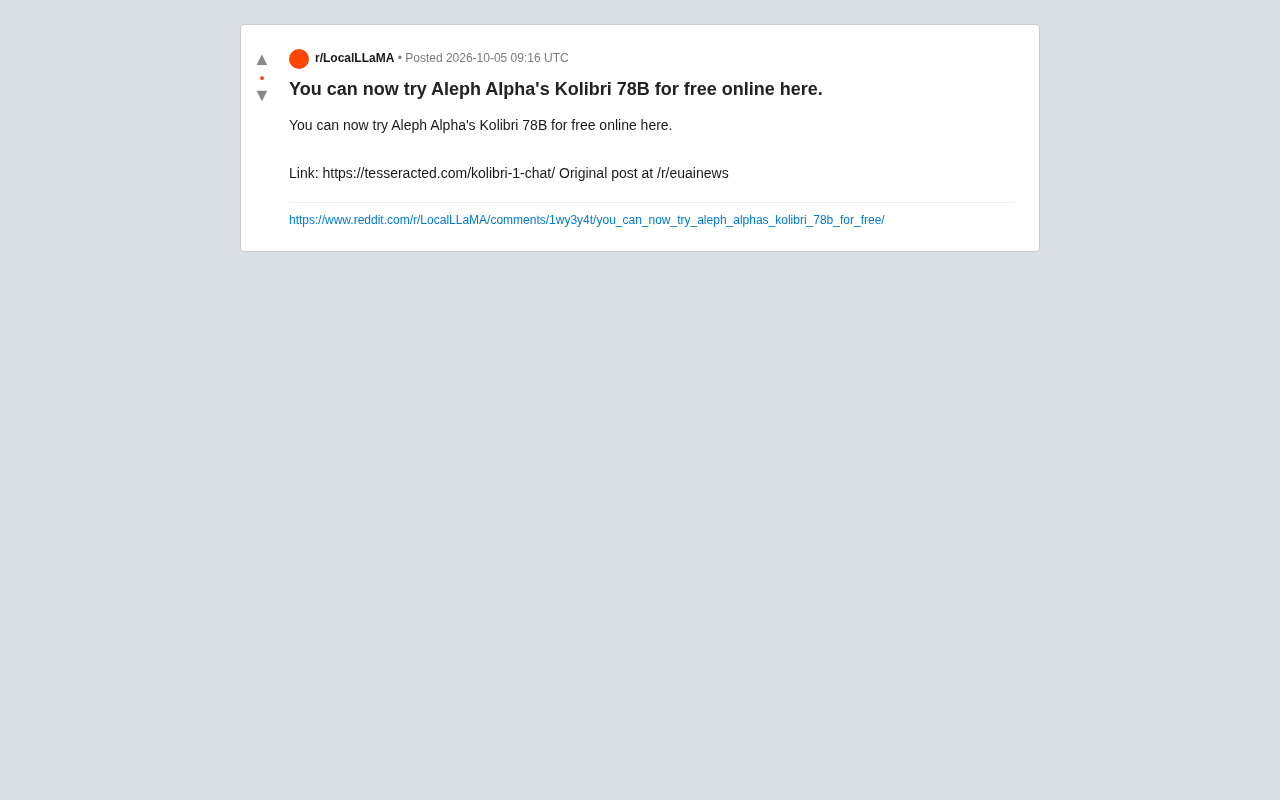
Aleph Alpha's large language model Kolibri 78B is now open for free online access. Users don't need to deploy it locally or obtain an API key — they can interact with this 78-billion-parameter model directly through a web interface. The news was first shared on Reddit's European AI news community (/r/euainews), with the trial hosted by third-party platform tesseracted.com.
For those following the European AI ecosystem, this is a noteworthy development. Aleph Alpha has long been regarded as Europe's answer to US-based AI players like OpenAI and Anthropic, with its models positioned around data sovereignty, multilingual support, and regulatory compliance.
Why Kolibri 78B Is Worth Your Attention
A Representative Effort in European AI Autonomy
In today's competitive LLM landscape, the vast majority of leading models come from US and Chinese tech companies. Aleph Alpha, headquartered in Heidelberg, Germany, has consistently worked to build a model ecosystem that meets European data regulation requirements. The open trial of Kolibri 78B lowers the barrier for everyday users to experience a European-native large model, while also giving the industry a useful reference point for side-by-side comparison.
Founded in 2019, Aleph Alpha was once one of Europe's highest-valued AI startups, backed by the German federal government and several European institutional investors. Its earlier Luminous model series demonstrated notable strengths in German and other European languages. Worth noting: Aleph Alpha underwent a strategic pivot in 2024, shifting its focus from general-purpose LLMs toward AI infrastructure and a trusted AI platform for government and enterprise use (PhariaAI). The Kolibri series is the model product line launched under this new strategic direction. With the EU AI Act now in effect, domestically built models that comply with European regulations hold a clear narrative advantage in high-compliance procurement scenarios — public sector, healthcare, finance — which explains why Aleph Alpha continues to emphasize its data sovereignty positioning.
What the 78B Parameter Scale Means
At 78 billion parameters, Kolibri sits between mid-size and large model tiers. Compared to flagship models with hundreds of billions of parameters, this scale strikes a balance between inference cost and performance, making it more practical for real-world deployment. The free online trial lets users directly assess its capabilities in conversational understanding and text generation — without incurring any compute costs.
In the LLM space, parameter count is a baseline measure of model scale, but it doesn't directly translate to real-world performance. At 78B parameters, Kolibri is in the same ballpark as Meta's Llama 3.1 70B and Mistral's Mixtral series — a mainstream tier in the open-source ecosystem that balances capability and deployment cost fairly well. In terms of inference requirements, loading a 78B model at full precision typically requires around 160GB of VRAM, which drops to roughly 40–80GB after quantization — making it feasible on cloud single-node setups or multi-card consumer GPUs. Beyond parameter count, actual performance depends heavily on training data quality, alignment strategies (RLHF/DPO, etc.), and the rigor of instruction fine-tuning — details that Aleph Alpha has not yet fully disclosed.
How to Try It
The trial is accessible via the Kolibri Chat page hosted on tesseracted.com. Users can open the link and jump straight into the conversation interface to start testing. Since the trial is hosted on a third-party platform, we recommend avoiding any sensitive or private inputs during testing, and be aware of potential access limits or queuing.
It's worth noting that publicly available information remains limited. Official details about Kolibri 78B's training data, benchmark results, context length, and commercial licensing terms have not been fully disclosed in this release. Users looking to dig deeper should consult Aleph Alpha's official documentation.
Summary
The free online trial of Kolibri 78B gives users a hands-on opportunity to evaluate a European-native large language model. In an environment where model capabilities are increasingly converging and vendors are racing to open up access, low-friction trial interfaces like this help users build genuine intuition about how different models perform. We encourage interested readers to test it out for themselves and assess its suitability against their own use cases.
Related articles

Felix Rieseberg Personal Homepage
Felix Rieseberg's personal homepage sparks attention on Hacker News. This article covers the Slack engineer's technical background, the rise and fall of nativefier, and the value of a developer homepage as a tech calling card.

@ai-sdk/vue 3.0.306 Patch Release Syncs with [email protected] Update
@ai-sdk/vue 3.0.306 released, synced with [email protected]. A routine patch release for the Vercel AI SDK ecosystem with no public API changes; the Vue adapter layer stays version-aligned with the core package.

Gemini 4 Argon API Launches: The Era of Million-Token Output Begins
Google launches Gemini 4 Argon with sparse MoE architecture, up to 1M output tokens, and a 68.90% Vals Index score, available across API, AI Studio, and the Gemini app.