Aleph Alpha Releases German-English Bilingual Model: A Look at the Technical Report and Open Science Practices
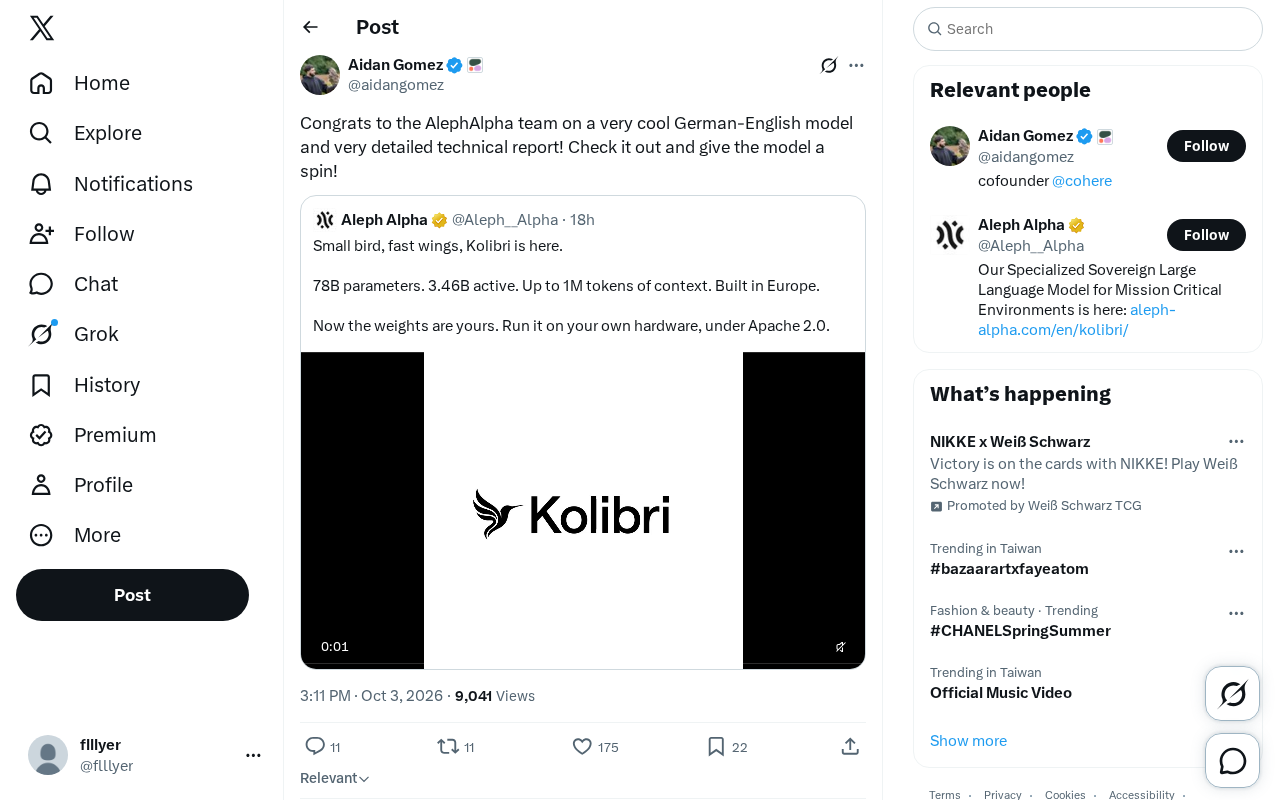
Aleph Alpha releases a German-English bilingual LLM with a transparent technical report, advancing European sovereign AI.
German AI company Aleph Alpha has released a large language model optimized for German-English bilingual capability, accompanied by a highly transparent technical report that earned public praise from independent AI practitioners. The model addresses the linguistic complexity of German — including its compound words and case system — where English-centric models typically fall short. The detailed technical report reflects open-science principles and lowers the bar for reproducibility. With external access available for testing, evaluation is placed squarely in the community's hands. Overall, the release signals Aleph Alpha's continued strategic commitment to European-sovereign AI infrastructure.
The Open-Source Signal Behind a Tweet
Recently, an AI practitioner publicly congratulated the German AI company Aleph Alpha on social media, praising the release of an impressive German-English bilingual model along with a remarkably detailed technical report. The message was short and direct: "Congrats to the Aleph Alpha team for making a really cool German-English model and a very detailed tech report — go check it out and give it a try!"
Peer endorsements like this are not uncommon in the AI community, but they often reflect a model's genuine standing among professionals. Two things stand out here: the bilingual focus, and the transparency of the technical report. Both touch on two central issues in today's large language model landscape — the quality of support for non-English languages, and the reproducibility of model development.
Why a German-English Bilingual Model Matters
Most mainstream large language models are trained with English at their core, and support for other languages — especially morphologically complex ones like German, with its rich compound word system — often falls short. A model specifically optimized for German-English bilingual capability offers distinct value in European markets, localization use cases, and contexts where data sovereignty is a concern.
Aleph Alpha, as a German-native AI company, has long positioned "European-sovereign AI infrastructure" as a core strategic direction. Building a German-optimized model is both a technical choice and a reflection of its differentiated positioning. For enterprises, government agencies, and research institutions that handle German-language content, a model with native-level comprehension is often far more practical than a general-purpose English-centric one.
Linguistically, German is a highly inflected and synthetic language. Its compounding mechanism — which fuses multiple roots into a single word — causes vocabulary to expand dramatically, posing challenges for large models that rely on subword tokenization. The same semantic content in German typically requires far more tokens than in English, directly affecting context window efficiency and inference costs. On top of that, German's case system (nominative, accusative, dative, genitive) and grammatical gender require models to maintain long-range syntactic dependencies. General-purpose models trained primarily on English corpora tend to produce grammatical errors or semantic drift in these structures. A model specifically optimized for German can address these shortcomings through targeted choices in pretraining data ratios, vocabulary design, and evaluation benchmarks.
The Technical Report Is Valuable Beyond the Model Itself
The original post specifically highlighted how "detailed" the technical report is. In an era where model capabilities are increasingly converging, the level of transparency in a technical report is itself a scarce resource.
A high-quality technical report typically discloses the composition of training data, architectural choices, engineering trade-offs made during training, and evaluation methodology. This information is enormously valuable to the research community: it allows other teams to understand the reasoning behind design decisions, verify the reliability of results, and build further improvements on that foundation. Releasing technical details openly reflects the spirit of open science far more than simply publishing a black-box model.
Transparency in technical reporting has become an important dimension for assessing model credibility in recent years. As a counterexample, the GPT-4 technical report drew widespread criticism from the research community for deliberately omitting training data scale, parameter count, and architectural details — widely regarded as a case study in opacity. By contrast, open-source models such as Meta's LLaMA series, Mistral, and Falcon all published detailed reports covering data sources, mixture ratios, training compute (in FLOPs or GPU hours), and multi-dimensional evaluation results, significantly lowering the barrier to reproducibility. For enterprise buyers, technical reports also serve a compliance function — disclosing training data provenance helps assess copyright risk and data bias, while the EU AI Act's transparency requirements for high-risk systems are turning comprehensive technical documentation from a nice-to-have into a necessity.
What Peer Recognition Signals
In the AI field, unsolicited recommendations from independent practitioners are often more persuasive than a vendor's own marketing. The author of the tweet not only offered congratulations but also encouraged readers to "give it a try" — implying the model is accessible for external testing, rather than existing only as a paper.
The ability to try it yourself is critical. It places the power of evaluation in the hands of the community and reflects the team's confidence in their own work. For developers looking to assess this model, combining a close read of the technical report with hands-on testing is the best way to judge whether it fits a specific use case.
Takeaways
Given the limited information in the original post, specific parameters, performance benchmarks, and licensing terms for this German-English model cannot be detailed here. But from this peer recommendation, a few clear signals emerge: Aleph Alpha continues to invest in non-English large model development, prioritizes technical transparency, and is opening the model up for community evaluation. For readers interested in multilingual AI and the European AI ecosystem, this is a project worth following closely. Those curious are encouraged to consult the official technical report directly and test the model firsthand to form their own judgment.
Aleph Alpha has previously released the Luminous series of models and has built a solid market presence among European government and enterprise clients. Its business model emphasizes data processing within the EU and GDPR compliance. The newly released German-English bilingual model is a continuation of the company's "Sovereign AI" narrative — the idea that local institutions should control training data and inference infrastructure to manage the legal and security risks of cross-border data transfer. This trend is not unique to Aleph Alpha in Europe: France's Mistral, the UK's Stability AI, and others are building regional AI capabilities with similar logic. For observers tracking AI governance and geopolitics, the institutional identity and data sovereignty commitments behind a model often matter just as much as its technical performance.
Related articles

Workbuddy for Absolute Beginners: How a Desktop AI Agent Fits Into Real Workflows
A beginner's guide to the Workbuddy desktop AI agent: installation, claiming credits, file management, and building automated workflows—compared with CodeX for fit and cost, helping professionals shift from AI question-askers to AI managers.

OpenAI's New Agent Stack: Computer Use, Decisions API, and Ultra-Fast Workflows
OpenAI Dev Day unveiled a new agent stack: Computer Use outperforms humans, Decisions API delivers ultra-low-latency classification via Luna, Agents API opens the same Computer Use capabilities, and GPT-6.1 Sol costs only one-seventh of Astra. Core updates, benchmark data, and developer insights.

Liang Wenfeng Open-Sources DeepInfo Inference Framework, Takes On U.S. Ban
DeepSeek open-sources its DeepInfo inference framework after its models, featuring GPU/CPU cross-pipelining, small-model prediction with large-model verification, and full Huawei Ascend and NVIDIA chip support—facing the U.S. federal ban head-on. This article analyzes its significance for AI deployment and open-source strategy.