Alexa Photo Frame: The Subtraction Philosophy of Cutting the Echo Show's Excess Features

Alexa Photo Frame returns to photo display through subtraction design, attempting to solve the family memory dilemma of the digital hoarding era.
The article uses Alexa Photo Frame to discuss the counter-correction to feature bloat in smart home devices. The Echo Show series keeps adding video calls, streaming, and shopping entry points, leading to low usage and privacy unease. Alexa Photo Frame cuts the camera and video calls to focus on photo display. The author cites his experience as a "digital hoarder" to highlight the gap between exploding photo counts and low viewing rates. Subtraction design has privacy and usability advantages but faces risks such as long replacement cycles and demanding display expectations. As screen devices diverge, Alexa Photo Frame belongs to the converged-function camp, and its success depends on willingness to pay for a photo-only screen.
Feature bloat in smart home devices is no longer a secret. The Echo Show series has gradually evolved from an initial screen-equipped speaker into an all-in-one terminal combining video calls, streaming playback, smart home hub, and even a shopping entry point. But the more features there are, the less users actually use, and the unease of being watched by cameras and microphones only grows stronger. The arrival of Alexa Photo Frame feels like a counter-correction to this trend.
When a Frame Returns to Being a Frame
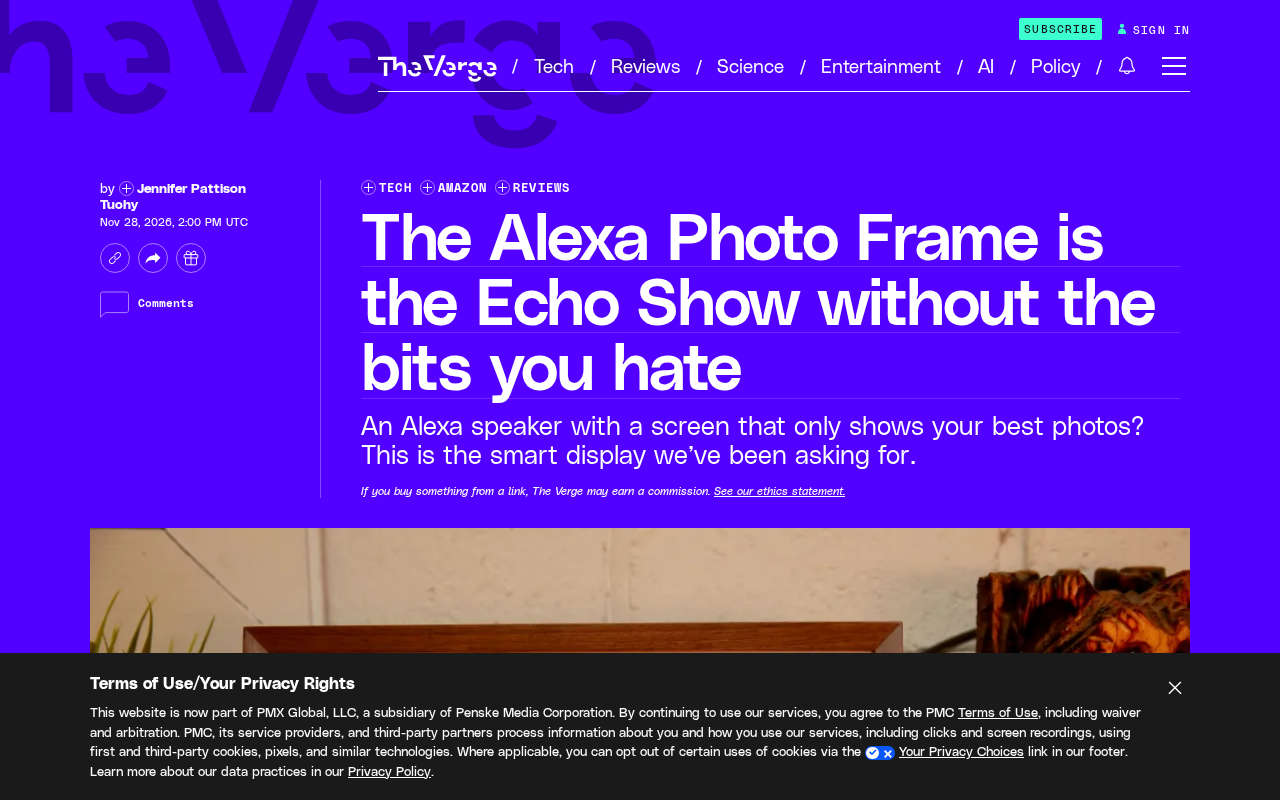
According to the original title from the RSS source, Alexa Photo Frame is defined as "the Echo Show without the parts you hate." This statement itself makes the product logic clear: retain the core experience of displaying photos on a screen, and remove the features that make users hesitate about whether to put the device in the bedroom.
The contradiction that Echo Show users generally face is that screen-equipped devices are naturally suited to displaying family photos, but their video-call cameras, always-on microphone arrays, and recommendation cards that pop up from time to time make "hanging a family portrait on the living room wall" feel awkward. Alexa Photo Frame chooses subtraction—it does not try to become a smart hub, nor does it emphasize video calls, but instead focuses on one thing: letting digital photos return to family spaces in a more natural way.
This shift in product positioning is worth noting. Against the backdrop of slowing growth in the smart speaker market, manufacturers have begun looking for more segmented scenarios, and the seemingly old product form of the "digital photo frame" has regained appeal precisely because of falling screen costs and the spread of cloud albums.
Echo Show is a line of screen-equipped smart speakers launched by Amazon since 2017, with screen sizes ranging from 5 inches to 15 inches. Its core hardware includes a camera, a far-field microphone array, and a touchscreen; at the software level, it is deeply integrated with the Alexa voice assistant and serves as the control entry point for Amazon's smart home ecosystem. For this reason, Echo Show has been designed from the outset to play the role of a "home hub" rather than a mere display device. This product DNA determines its tendency toward feature stacking: video calls, Prime Video playback, smart home panels, and even shopping recommendations all revolve around the same screen. Only by understanding this can one appreciate how significant a product logic shift it is for Alexa Photo Frame to choose to cut these features.
The Family Memory Dilemma in the Age of Digital Hoarding
A personal account from the original author provides another perspective for understanding the value of this product. The author describes himself as a "digital hoarder." When his son graduated from high school this year, he made a scrapbook chronicling 12 years of school life. His son's reaction was unexpected: most of the photos he had never seen before.
This detail reveals a common problem in contemporary families: the number of photos has exploded, but the proportion that is truly viewed, shared, and remembered is extremely low. Phone albums have become a storage black hole, and family memories are sealed in the cloud rather than placed in the living room to be repeatedly examined. The author mentions that his own childhood was fully documented by physical photos, while the next generation's growth images, though more numerous, are touched far less.
Alexa Photo Frame attempts to address precisely this gap. It pulls cloud albums back into physical space, returning photos from a state of "storage" to a state of "display." From this perspective, its competitor is not other smart speakers, but the forgetting curve of phone albums.
"Digital hoarder" refers to people who habitually save large amounts of digital files but rarely organize or revisit them. The concept was first proposed in information management research in the 2010s. Similar to physical hoarding disorder, its core features are anxiety about deletion and a loss of control over saving behavior. In photo scenarios, the cheapness of cloud storage and the convenience of phone photography exacerbate this phenomenon: users generate thousands of photos each year but rarely actively filter or display them. Research shows that people revisit their phone albums far less often than expected, and most photos are no longer opened within days of being taken. This behavioral pattern is exactly the demand gap that digital photo frame products attempt to tap—turning "saving" into "displaying."
The Gains and Losses of Subtraction Design
Cutting features sounds simple, but execution requires restraint. Although many Echo Show features are not heavily used, they are entry points into Amazon's ecosystem. By giving up these entry points, Alexa Photo Frame is more pure in its business model, but also more dependent on the appeal of the hardware itself and the album service.
For users, this trade-off may be worthwhile. A frame that does not require worrying about the camera being hacked, repeatedly turning off the microphone, or dealing with push ads carries far less psychological burden when placed on a bedside table or in an entryway. Especially at a time when privacy awareness is generally rising, "fewer features" can sometimes be a selling point.
The risks are equally real. The replacement cycle for photo frame products is much longer than that of smart speakers, and users are more demanding about display quality and album synchronization experience. If Alexa Photo Frame is not smooth enough in photo color, automatic slideshow logic, or cross-platform import, it could easily be categorized as "yet another failed smart hardware experiment."
Privacy risks for smart home devices mainly come from two aspects: first, always-on microphone arrays may be falsely triggered or remotely accessed; second, cameras may become surveillance entry points when devices are compromised. Amazon's Echo series has repeatedly sparked controversy over recording retention and third-party access, and in 2019 it was reported that Amazon employees would listen to some Alexa recordings to improve the service. For private scenarios such as bedrooms and bathrooms, users' resistance to camera-equipped devices is especially pronounced. By removing the camera and video call features, Alexa Photo Frame essentially eliminates such attack surfaces at the hardware level rather than relying on software switches. This "physical subtraction" builds trust better than "turning it off in settings" and is the technical basis of its privacy selling point.
Can Segmented Scenarios Support a Product Category
The smart home industry has long had an inertia: every device wants to become the center. But Alexa Photo Frame's approach is to become the background—it does not compete for attention, but is only responsible for quietly displaying family memories in a corner. This positioning is closer to the philosophy of traditional photo frames than to the ambitions of smart speakers.
From the perspective of industry trends, screen-equipped devices are diverging. At one end are smart hubs with continuously stacking features; at the other end are scenario devices with highly converged functions. Alexa Photo Frame belongs to the latter. Whether it can succeed depends on how many users are truly willing to pay for "a screen that only shows photos."
The original title implies a user sentiment: people do not hate the Echo Show's screen; they hate the features they do not need but are forced to accept. If this judgment holds, then subtraction design is not just a product strategy, but a response to users' real needs. The digitization of family memories needs a less distracting carrier, and Alexa Photo Frame is an attempt in this direction.
The divergence trend of screen-equipped smart devices has become increasingly obvious since 2023. At one end are large-screen hubs represented by Echo Show 15 and Google Nest Hub Max, emphasizing multitasking and ecosystem integration; at the other end are single-function devices such as robot vacuums, smart doorbells, and thermostat panels, pursuing low interference and long standby time. Digital photo frames sit precisely in the blank space between the two: they have screens but do not assume the role of interaction hubs. Historically, Digital Photo Frame briefly became popular in the mid-to-late 2000s and then declined due to the spread of phones and tablets. Today, falling costs of cloud albums, e-ink screens, and low-power LCDs have made this form commercially viable again. Whether Alexa Photo Frame can revive this category depends on whether it can make the "display" experience good enough, rather than relying merely on the differentiation of "fewer features."
One-line Summary
Alexa Photo Frame returns to photo display through subtraction design, attempting to solve the family memory dilemma in the age of digital hoarding.
Paragraph Summary
Using Alexa Photo Frame as an entry point, the article discusses the counter-correction after feature bloat in smart home devices. The Echo Show series keeps adding video calls, streaming, and shopping entry points, resulting in low actual usage and strong privacy unease. Alexa Photo Frame chooses to cut cameras and video calls, focus on photo display, and reduce psychological burden. Citing his own experience as a "digital hoarder," the author points out the family memory gap in which the number of photos explodes but viewing rates are extremely low. The article argues that subtraction design has advantages in privacy and usability, but also faces risks such as long replacement cycles and demanding display experience requirements. Screen-equipped devices are diverging into feature-stacking hubs and feature-converging scenario devices; Alexa Photo Frame belongs to the latter, and its success depends on how many users are willing to pay for "a screen that only shows photos."
Related articles

Bin's Live Stream Highlights: Hilarious Interactions from "You Came at the Right Time" to "I'll Support You From Now On"
Bin's hilarious live stream highlights: from "You came at the right time" to "I'll support you from now on," featuring Championship skins, wigs, and other game memes that showcase Bilibili's unique streaming culture.

Hunter Rescues Educated Youth: The Mountain-Chasing System Launches a New Warm-Hearted Viral Drama Formula
Bilibili's early-access period short drama *Everyone Thinks I'm a Poor Hunter* opens with a snowy-night rescue of an educated youth. Hunter Chen Shan activates the mountain-chasing system, using realistic hypothermia first-aid details and mutual-probing character dynamics to deliver a warm-hearted period drama without the sleaze.

Riemann Hypothesis Proven by AI? The Truth Has Nothing to Do With Your Reality
34-year-old mathematician Levent Alpöge claims to have proven the Riemann Hypothesis and Generalized Riemann Hypothesis with Claude, releasing 17 million lines of formal verification code. This article sorts out the facts, debunks myths about RSA collapse and new material revolutions, and analyzes the true significance of mathematics-AI collaboration.