Alexa Tablet 12 Pro Review: That Screen Almost Defines a New Direction for Android Tablets

Amazon's Alexa Tablet 12 Pro bets on Nanomatte screen tech for experience differentiation, close to ideal but not yet crossing the ecosystem threshold.
Amazon's Alexa Tablet 12 Pro is a 12-inch, 2800x1840 resolution Android tablet featuring Nanomatte, a self-developed screen technology designed to reduce glare and enhance visual presence. The article argues that with Android tablet specs constantly upgrading but experience gains limited, Amazon's focus on the screen users face daily is the right direction. Nanomatte balances clarity and anti-glare, and this 'invisible upgrade' is exactly the differentiation tablets need most. However, the product is only 'almost' the ideal Android tablet—ecosystem, large-screen app adaptation, accessories, and long-term software support remain uncrossed thresholds. Overall, it points to a direction worth following for a heavily homogenized market.
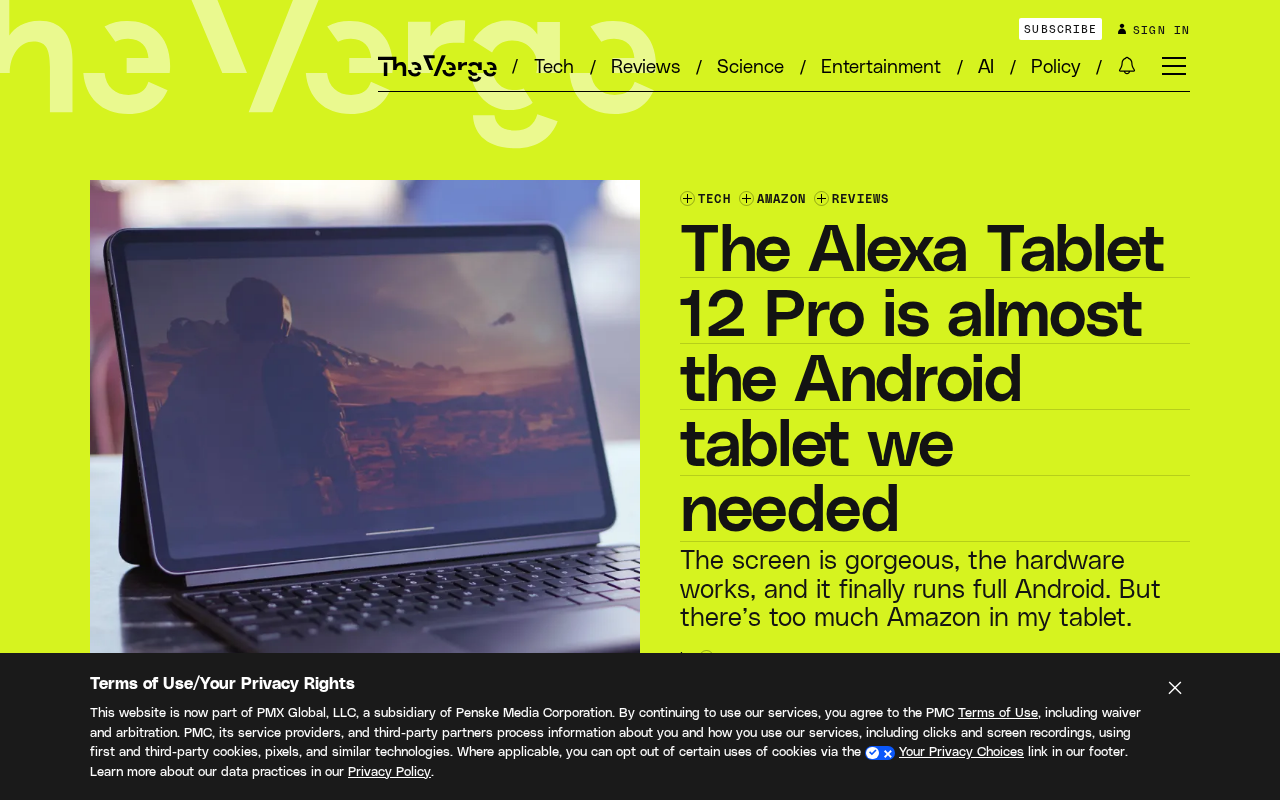
Amazon's newly released Alexa Tablet 12 Pro may be one of the most genuinely worth-discussing Android tablets in recent years. It didn't take the usual route of stacking specs, instead betting almost all of its attention on a single screen.
A screen you can't ignore
The Alexa Tablet 12 Pro features a 12-inch display panel with a 2800 x 1840 resolution, and adopts a brand-new technology Amazon calls "Nanomatte." According to the official description, the goal of this technology is to reduce screen glare while enhancing a "within-reach" sense of visual presence—making you feel as though the content in the image could be touched with an outstretched hand.
In terms of actual perception, this is indeed not an ordinary tablet screen. The high resolution combined with the large 12-inch size keeps both text and images exceptionally sharp; and the Nanomatte coating's performance in suppressing reflections is clearly better than most glossy-screen tablets. It doesn't go fully matte, but rather finds a delicate balance between clarity and anti-glare.
Background on screen anti-glare technology
Glare on tablet screens stems from specular reflection on the glass cover surface. When ambient light hits a smooth surface, it creates high-brightness reflective spots that directly interfere with the readability of screen content. Traditional solutions fall into two main categories: one is increasing peak screen brightness, using stronger backlight to "overpower" reflected light; the other is using matte etching or anti-glare coatings to convert specular reflection into diffuse reflection. But the former has limited effectiveness outdoors and increases power consumption, while the latter, though effective at suppressing glare, tends to make the image look washed out and reduces contrast and sharpness.
Technologies like Nanomatte attempt to find a compromise between the two, typically involving nanoscale surface microstructures or multi-layer optical coatings that scatter reflected light across a wider angle while preserving the transmission quality of light as much as possible. Similar approaches have been applied in high-end monitors, medical imaging screens, and aviation instruments, but remain rare in consumer tablets. Its actual effectiveness largely depends on the consistency of the coating process and long-term durability, which is one of the reasons such technologies have previously been difficult to mass-produce.
Why this screen may matter more than specs
The Android tablet market has long faced an awkward reality: hardware specifications keep upgrading, but the experience improvements users actually perceive are increasingly limited. A slightly faster processor or a bit more RAM is nearly imperceptible in daily use. But the screen is the component users face every time they unlock the device or swipe.
Amazon's choice to focus on the screen is the right direction. The change brought by Nanomatte isn't something benchmark scores can capture—it shows in how you actually feel when reading by a window, binge-watching under a lamp, or checking maps outdoors. This kind of "invisible upgrade" is precisely the differentiation that tablet products lack most.
"Almost the Android tablet we need"—the emphasis in this phrase is on "almost." It indicates that this product is very close to the ideal form, but there are still factors preventing it from fully crossing the threshold.
What's still missing from the "perfect Android tablet"
The original wording reveals a subtle reservation. The screen is the highlight, but whether a tablet can truly become "the Android tablet we need" also depends on a series of factors including system ecosystem, app adaptation, accessory experience, and long-term software support.
The 12-inch large-screen form factor is naturally suited for split-screen multitasking and stylus scenarios, which places higher demands on the system's multi-window capabilities and large-screen app adaptation. Android tablets carry no small historical baggage in this regard. Whether Amazon's Alexa ecosystem can compensate for these shortcomings is the key variable determining the final verdict on this product.
The large-screen adaptation dilemma for Android tablets
Android was originally designed for phones, and its app ecosystem has long defaulted to portrait orientation and single-window form. When screen size reaches the 12-inch level, many apps' layouts don't automatically adapt—they either get stretched and distorted, or display as a narrow strip in phone proportions in the center of the screen. In recent years, Google has introduced dedicated large-screen optimization frameworks through Android 12L and subsequent versions, including improved split-screen, resizable windows, and a taskbar, but third-party app adaptation progress has been uneven.
By comparison, iPadOS has accumulated more mature solutions for split-screen multitasking and stylus integration, which is one of the reasons Android tablets have long been at a disadvantage in productivity scenarios. Additionally, large-screen tablets have far higher requirements for stylus latency, pressure sensitivity levels, and accessory ecosystems than phones, all of which require manufacturers to invest simultaneously at both hardware and software levels. Therefore, while screen quality is an important differentiation direction, it cannot single-handedly solve the structural shortcomings of Android tablets at the system ecosystem level.
What it means for the Android tablet category
The arrival of the Alexa Tablet 12 Pro sends a signal: in an era of excess performance, tablet manufacturers need to redistribute their efforts toward experience dimensions users can directly perceive. Screen quality, anti-glare capability, visual comfort—these are where the real gaps can be created.
If Nanomatte technology can truly deliver on its promises in actual use, it may push more manufacturers to re-examine their design orientation for tablet screens. For a long time, glossy screens plus high brightness have been almost the industry default, and the Alexa Tablet 12 Pro offers a different approach.
It may not yet be the ultimate answer, but at least it points to a direction worth following. For an Android tablet market struggling with homogeneous competition, this kind of attempt is valuable in itself.
One-line Summary
Amazon's Alexa Tablet 12 Pro bets on experience differentiation with Nanomatte screen technology, approaching the ideal but not yet crossing the ecosystem threshold.
Paragraph Summary
Amazon's Alexa Tablet 12 Pro is a 12-inch, 2800x1840 resolution Android tablet whose core highlight is a self-developed screen technology called Nanomatte, designed to reduce glare and enhance visual presence. The article argues that against the backdrop of continuously upgrading Android tablet hardware specs but limited experience improvements, Amazon's choice to focus on the screen users face every day is the right direction. Nanomatte achieves a balance between clarity and anti-glare, and this "invisible upgrade" is precisely the differentiation that tablet products lack most. However, the article also points out that the product is "almost" the ideal Android tablet, with system ecosystem, large-screen app adaptation, accessory experience, and long-term software support still being thresholds not yet crossed. Overall, the Alexa Tablet 12 Pro points to a direction worth following for the heavily homogenized Android tablet market.
Related articles

Chain of Thought Isn't Just for AI: How Humans Can Use CoT to Improve Thinking Quality
Chain of Thought isn't just a prompt trick for large models. Starting from a Hacker News discussion, this article analyzes why CoT works for human thinking too, breaks down actionable ways to transfer it, and highlights the key differences between human CoT and machine CoT.
Cloudflare Teams Up with OpenAI: Closi…
Cloudflare Teams Up with OpenAI: Closing the Loop from Vulnerability Discovery to Defense with AI
Cloudflare uses OpenAI Daybreak to investigate security vulnerabilities and generate reviewable remediation plans, while developers use Codex to boost coding efficiency and quality.

Orca Multi-Agent Orchestration in Practice: A Guide to Parallel Collaboration with Claude and Codex
Orca is Stable AI's free open-source agent workbench supporting 34 agents like Claude Code and Codex in parallel. Learn its Git worktree isolation, multi-model orchestration, and mobile management.