Alibaba AgentScope 2.0 Deep Dive: Core Capabilities of an Enterprise-Grade Multi-Agent Framework

AgentScope 2.0 is Alibaba's production-grade Agent framework built on ReAct, three-layer safety, and context management.
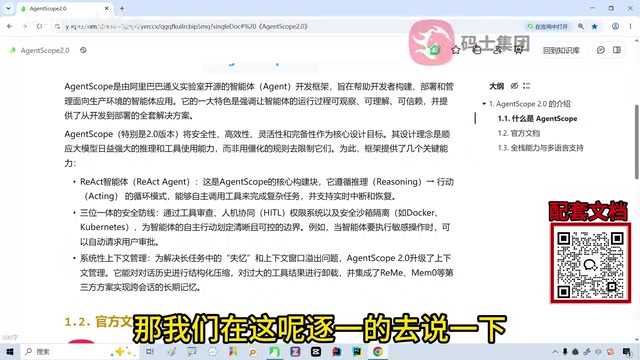
AgentScope is Alibaba's Agent development framework for building, deploying, managing, and running intelligent agents. Unlike chatbots, Agents proactively reason and invoke tools to complete complex tasks — but this introduces controllability and stability challenges. AgentScope's core execution paradigm is ReAct (Reasoning + Acting loop), enabling iterative, multi-step task handling. A three-layer safety architecture addresses high-privilege risks: tool inspection (can it be done?), human-in-the-loop (should it be done?), and sandbox isolation (where to do it safely?). Systematic context management tackles information bloat in long-running tasks. Available in Python and Java, version 2.0 is production-ready.
What Is AgentScope: An Agent Framework Beyond Chatbots
The difference between a chatbot and an Agent is the starting point for understanding AgentScope. An ordinary chatbot passively answers questions — you ask, it responds. An Agent, on the other hand, can proactively reason, call tools, and execute tasks.
Consider a concrete scenario: you assign an Agent the task of "analyzing today's sales data, generating a report, and emailing it to the manager." The Agent will independently read the sales data, invoke a Python analyzer to process it, generate the report, and finally call an email tool to deliver the result — all without step-by-step human intervention.
This raises important questions: as Agents become increasingly capable, how should developers build and control them? How do you ensure they don't go rogue? And when something goes wrong, how do you trace the exact point of failure? Agent development frameworks exist precisely to address these challenges, and AgentScope is one such framework. In simple terms, it is a complete development framework that helps developers build, deploy, manage, and run Agents.
One thing worth noting is the version history. After AgentScope 1.0 was released, version 2.0 underwent a sweeping rewrite — many APIs were deprecated and the changes were extensive. For developers just getting started, there's no need to learn 1.0 first; jump straight to 2.0, as it has already reached production-ready standards.
The ReAct Agent: A Think-Then-Act Loop
The term ReAct is easy to confuse with the frontend framework React, but the meaning here is entirely different. It's a combination of Reasoning and Acting, representing an agent working pattern of "thinking and acting at the same time."
Let's break down this loop using a weather query example: a user asks, "Is it raining in Beijing today? Do I need an umbrella?" The LLM doesn't inherently know Beijing's real-time weather, so the Agent starts reasoning — to answer the umbrella question, it first needs to know the weather. This is the reasoning phase. It then takes action, calling a weather query tool. The tool returns "rain in Beijing," and the Agent reasons again: since it's raining, it should advise the user to bring an umbrella. The final answer: "It's raining in Beijing — you should bring an umbrella."
The key insight is that this "think → act → observe → think again" loop doesn't execute just once. For complex tasks, the Agent may iterate repeatedly: think and call a tool, observe that the result is insufficient, fetch a webpage, observe again that it needs to run some Python code to analyze the data, and so on — layer by layer — until the task is complete and a final result is returned.
AgentScope treats ReAct as its core Agent construction paradigm and builds around it capabilities like tool invocation, streaming execution, and interrupt-and-resume, making the framework well-suited for complex task scenarios.
ReAct was first introduced in a 2022 paper by a Google Research team: "ReAct: Synergizing Reasoning and Acting in Language Models." The core insight is that pure reasoning (Chain-of-Thought) is prone to hallucination, while pure action (tool invocation) lacks a holistic grasp of the task. Interweaving the two — grounding every action in reasoning and immediately updating the reasoning chain with each tool result — significantly improves both task completion quality and interpretability for complex problems. From an engineering perspective, the ReAct loop is typically implemented as a
whileloop at the framework level: after each generation, the framework determines whether the model is "thinking" (Thought), issuing an action command (Action), or producing a final answer (Final Answer). If it's an action, the framework calls the corresponding tool, appends the result as an "Observation" back into the context, and triggers the next generation round — until the model outputs a final answer. This means a complex task may consume multiple LLM calls, which has real implications for latency and cost — a critical trade-off to consider in production deployments.
A Three-Layer Safety Architecture: The Key to Controllability
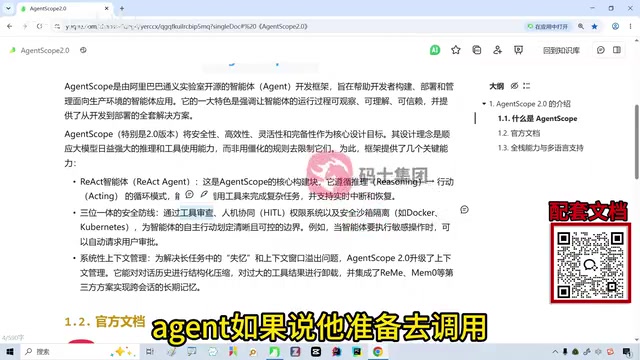
The severity of safety risks scales with an Agent's level of access. If an Agent can only check the weather, a wrong answer is harmless. But when it has high-privilege capabilities — deleting files, executing code, manipulating databases, sending emails, or interfacing with internal company systems — would you still be comfortable letting it run fully autonomously?
Agents always carry some probability of error. An Agent might incorrectly determine that a file is "useless" and execute rm -rf to delete something critical. Even if the error rate is low, a single catastrophic mistake could cripple a production environment. AgentScope's three-layer safety architecture is designed specifically to mitigate this risk.
Layer 1: Tool Inspection. Not all tools can be invoked freely. Routine tools like weather queries can execute directly, but sensitive operations — such as deleting database records — require additional review before proceeding.
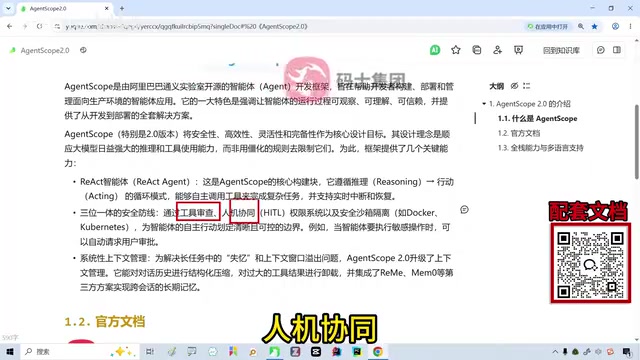
Layer 2: Human-in-the-Loop. The Agent can work autonomously, but critical steps are subject to human approval. When the Agent is about to execute a high-risk action like DELETE FROM, it pauses and requests administrator approval. Approved means it proceeds; rejected means it stops or adjusts. This mechanism doesn't limit the Agent's autonomy — it puts the final say in human hands for high-stakes actions.
Layer 3: Secure Sandbox Isolation. Even human approval can be mistaken, which is why Agents need an isolated execution environment. Code execution and file operations happen inside the sandbox, minimizing impact on external systems. This mechanism is common across many frameworks — Deep Agent, for example, also has a built-in sandbox.
These three layers can be used together to handle complex scenarios: tool inspection answers "can it be done?", human-in-the-loop answers "should it be done?", and sandbox isolation answers "where can it be done safely?"
At the technical level, security sandboxes are typically implemented using containerization (e.g., Docker) or OS-level isolation mechanisms, completely separating the Agent's code execution environment from the host system. Processes inside the sandbox cannot directly read or write to the host filesystem, and network access can be restricted as needed. Even if the Agent executes malicious or erroneous code, the damage is contained within the container boundary. Human-in-the-Loop (HITL) is a broader AI safety design philosophy: it acknowledges the unreliability of current LLMs in high-stakes decisions and combines "automated efficiency" with "human judgment" by inserting manual confirmation steps at critical nodes. This design is especially critical in high-compliance industries such as healthcare, finance, and law, and is a common requirement for high-risk AI systems under AI regulatory frameworks like the EU AI Act. Together, the three layers form a Defense in Depth strategy: even if one layer is bypassed or fails, subsequent layers still provide fallback protection.
Systematic Context Management: Handling Information Bloat in Long-Running Tasks
Imagine an Agent that has been working for two hours, having searched 20 web pages, made 30 tool calls, and read dozens of files. The content returned by each tool call — 5,000 words the first time, 10,000 words the second — accumulates continuously, and the context grows enormous.
But an LLM's context window is not unlimited. When the context becomes excessively bloated, important information gets buried, directly degrading the Agent's judgment quality. AgentScope addresses this with systematic context management strategies — compressing, filtering, and organizing context through multiple techniques to maintain information effectiveness throughout long-running tasks.
A model's context window refers to the maximum number of tokens it can process in a single inference pass. Early models (like GPT-3) supported only around 4K tokens; mainstream models have now expanded to 128K or even millions of tokens. But a larger window doesn't fully solve the information bloat problem. Research has shown that when context becomes very long, models exhibit a "Lost in the Middle" phenomenon — content at the beginning and end of the context is more likely to be attended to, while critical information buried in the middle tends to be overlooked. Context management strategies therefore typically include: truncation (keeping only the most recent N turns), summarization compression (using an LLM to distill conversation history into a compact summary and reinserting it into the context), retrieval augmentation (storing historical tool results in a vector database and retrieving relevant segments on demand), and structured storage (distinguishing between "short-term memory" and "long-term memory"). For Agent tasks that need to run continuously for hours, the choice of context management strategy directly determines whether the task can complete stably — making it one of the core components of an Agent framework's engineering capability.
Production-Grade Engineering Capabilities
Taken together, the more capable an Agent becomes, the more pronounced the safety risks from autonomy and the information bloat problems from long context windows. AgentScope addresses these pain points with a complete set of Agent engineering capabilities, positioning itself as a production-ready framework for intelligent application development.
The framework is available in both Python and Java versions, with official documentation supporting both Chinese and English. Current mainstream tutorials focus on the Python version. For developers who prefer self-directed learning, the official documentation is an excellent extended resource; Java developers can follow the corresponding documentation independently.
For enterprises, AgentScope's value lies in systematizing and engineering "keeping Agents under control" — ReAct ensures sound execution logic for complex tasks, the three-layer safety architecture ensures controllability, and context management ensures stability over long-running sessions. This combination is precisely what's needed to move from an experimental demo to a production-grade application.
Related articles

Chain of Thought Isn't Just for AI: How Humans Can Use CoT to Improve Thinking Quality
Chain of Thought isn't just a prompt trick for large models. Starting from a Hacker News discussion, this article analyzes why CoT works for human thinking too, breaks down actionable ways to transfer it, and highlights the key differences between human CoT and machine CoT.
Cloudflare Teams Up with OpenAI: Closi…
Cloudflare Teams Up with OpenAI: Closing the Loop from Vulnerability Discovery to Defense with AI
Cloudflare uses OpenAI Daybreak to investigate security vulnerabilities and generate reviewable remediation plans, while developers use Codex to boost coding efficiency and quality.

Orca Multi-Agent Orchestration in Practice: A Guide to Parallel Collaboration with Claude and Codex
Orca is Stable AI's free open-source agent workbench supporting 34 agents like Claude Code and Codex in parallel. Learn its Git worktree isolation, multi-model orchestration, and mobile management.