Alibaba, Baidu, and 5 Other Major Model Vendors Adjust Pricing Simultaneously as LLM Price War Escalates

Alibaba, Baidu, and 5 other vendors adjust LLM API pricing simultaneously, with competition shifting from unit price to overall capabilities.
Recently, seven vendors — Alibaba, Baidu, Chutes, Decart, Inceptron, Reka, and StreamLake — adjusted LLM API pricing within the same period, spanning cloud giants, AI startups, and inference platforms across China and the US. The drivers have shifted from early architecture optimization and inference efficiency gains to inference cost pressure and open-source competition. Inference costs are rapidly rising as a share of total model costs, becoming the key differentiator. Developers using either domestic or overseas APIs should watch for accompanying changes to rate limits and free quotas, while teams without a settled tech stack can use this window for fresh comparisons. Price wars no longer build lasting moats — competition is moving to inference speed, context window, and ecosystem integration.
The LLM API market is undergoing another round of密集 pricing adjustments. According to RSS feed monitoring, seven vendors — Alibaba, Baidu, Chutes, Decart, Inceptron, Reka, and StreamLake — have all seen LLM pricing changes recently.
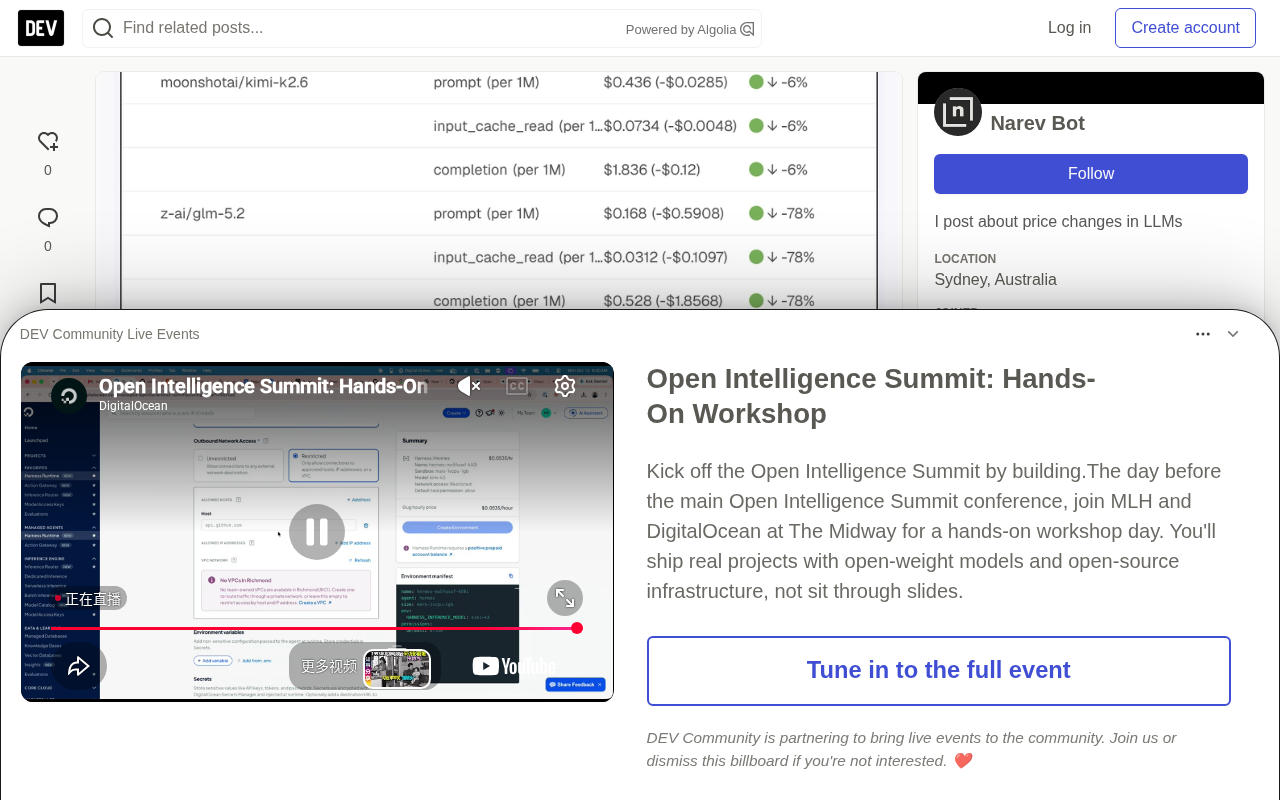
Vendors Involved in Pricing Changes
The vendors adjusting prices this time span both China and the US, covering three major categories: cloud giants, AI startups, and inference service platforms.
On the domestic front, Alibaba and Baidu, as the two core players in China's large model market, see their API pricing adjustments for the Tongyi Qianwen and ERNIE Bot series as industry bellwethers. Price changes from these two tend to trigger chain reactions among other domestic vendors within weeks.
On the overseas front, Reka is an AI company founded by former Google and Meta researchers, focused on multimodal large models; Chutes and StreamLake represent pricing dynamics in inference services and video AI respectively; the inclusion of Decart and Inceptron indicates that the pricing wave has spread to more niche technical tracks.
Seven vendors showing pricing changes within the same announcement cycle — that density alone is worth paying attention to.
Understanding Common LLM API Pricing Models
Current mainstream LLM API pricing systems typically consist of several dimensions: per-token billing (distinguishing input/output), per-call billing, tiered pricing (lower unit prices at higher volumes), and cache hit discounts. Some vendors also offer discounted rates for batch requests (Batch API), which can significantly reduce costs for tasks that don't require real-time responses.
Additionally, free quotas are an important tool for acquiring developers. Most platforms offer a certain amount of free tokens or a trial period, but the terms of free quotas are often modified alongside pricing adjustments — such as lowering the free quota cap, shortening the validity period, or restricting free quotas to low-priority queues. These implicit changes may have a greater impact on early-stage projects and prototype validation than unit price adjustments.
For enterprise customers, vendors typically offer customized contract pricing, including options like Provisioned Throughput. Price changes for such contracts won't appear on public pricing pages, but they will substantially affect the cost structure of mid-to-large customers.
Understanding these pricing models helps developers make more accurate cost estimates during horizontal comparisons, rather than simply comparing the surface-level per-million-token unit price.
Why This Round of Pricing Changes Deserves Attention
Over the past two years, LLM API prices have generally trended downward, but the driving factors are changing.
Early price cuts were mainly driven by model architecture optimization and inference efficiency improvements — running the same model with less compute naturally reduces costs. This round of pricing changes may reflect more complex market signals: on one hand, open-source models are continuously approaching the performance of closed-source solutions, putting pressure on commercial API pricing; on the other hand, when top vendors compete for developers and enterprise customers, price remains the most direct competitive weapon.
Another background factor that cannot be ignored is that inference costs are rising rapidly as a proportion of total model costs. As scale effects on the training side gradually peak, engineering optimization and pricing strategy on the inference side become the key to vendors differentiating themselves.
Why Inference Costs Have Become a Key Variable
In the lifecycle of a large model, costs can be roughly divided into training costs and inference costs. Training costs are a one-time investment (albeit a massive one), while inference costs grow linearly with call volume — every API request consumes compute. As model parameter sizes balloon from billions to hundreds of billions, the GPU memory and computation required for a single inference surge dramatically, while user call volume growth often far exceeds expectations. This means that even if the training side reduces per-training overhead through architectural innovations like sparsification and Mixture of Experts (MoE), the inference-side bill can still spiral out of control.
Specifically, inference costs are affected by multiple factors: context window length directly determines memory usage — in long-context scenarios, KV Cache memory overhead can be several times that of the model weights themselves; output tokens are more expensive than input tokens because autoregressive generation requires computing token by token; concurrent request volume affects GPU utilization and queuing latency. Vendors typically price input and output separately, with output prices often 3-5x those of input — this is why.
This also explains why inference-side engineering optimizations — such as quantization, speculative decoding, and PagedAttention — are becoming the core means by which vendors differentiate their costs.
Practical Impact on Developers
For developers who are selecting APIs or have already deeply committed to a particular API, this round of pricing changes needs to be viewed on a case-by-case basis.
If you're currently using Alibaba's or Baidu's API, it's advisable to keep an eye on updates to their official pricing pages and assess whether there's room to switch model versions or adjust calling strategies. Domestic vendors' pricing changes typically coincide with the release of new model versions or capability upgrades to existing models.
If you're using overseas services like Reka or Chutes, you'll need to watch whether price changes come with adjustments to terms of service or rate limits. Some inference platforms modify free quotas or concurrency limits alongside pricing changes — these details may have a greater impact on actual usage costs than unit prices.
For teams that haven't yet settled on a tech stack, now is a window to redo horizontal comparisons. Multiple vendors adjusting prices simultaneously means the cost-effectiveness rankings in pricing tables may have already shifted, and previously excluded options are worth re-evaluating.
The Next Phase of the Price War
A question worth pondering: how much lower can LLM API prices go?
Looking at the current competitive landscape, a pure price war can hardly form a lasting barrier. Vendors are shifting the focus of competition to dimensions like inference speed, context window, tool-calling capabilities, and ecosystem integration. Price is just the entry ticket — true differentiation lies in who can help developers turn models into usable products faster.
For developers, this means that when selecting APIs, unit price alone isn't enough — latency, stability, documentation quality, and community support matter equally. A single API price change may only affect costs by a few percentage points, but a single service outage or interface change can delay an entire project by weeks.
We recommend following official announcements from each vendor for specific pricing adjustment details. This article will continue to track subsequent changes.
One-line Summary
Alibaba, Baidu, and five other vendors adjust LLM API pricing in the same period, as competition shifts from unit price to overall capabilities.
Paragraph Summary
Recently, seven vendors — Alibaba, Baidu, Chutes, Decart, Inceptron, Reka, and StreamLake — have all seen LLM API pricing changes within the same cycle. The vendors span cloud giants, AI startups, and inference service platforms, covering both China and the US. The driving factors behind this round of pricing changes have shifted from early model architecture optimization and inference efficiency improvements to inference cost pressure and open-source model competition. The article notes that inference costs are rising rapidly as a proportion of total model costs, becoming the key to vendor differentiation. For developers, whether using domestic or overseas APIs, they need to watch whether pricing changes come with adjustments to service terms like rate limits and free quotas. Meanwhile, teams that haven't settled on a tech stack can use this window to redo horizontal comparisons. A price war can hardly form a lasting barrier — competition is shifting to dimensions like inference speed, context window, and ecosystem integration.
Related articles

How Big Can Stars Really Get? The Physical Limits of the Largest Stars
Red supergiants are the largest stars by volume, with radii up to 2,000 times the Sun, engulfing the inner solar system. But there is no precise upper limit on stellar size—models predict up to 15,000 solar radii. The most massive blue stars are far smaller than red supergiants—biggest and heaviest are two different things.

Apple HomeView Smart Display Full Feature Breakdown: Wall-Mount or Desktop, $299
Apple launches HomeView, a $299 smart display with wall-mount and desktop options, 12MP camera for facial recognition, smart home control, music playback, and recipe step-by-step cooking. Full breakdown of watch faces, apps, privacy, and cooking integration.

Where Did the Promised New Studio Go? Craft Computing Answers After Five Years
Craft Computing's host responds to viewer questions: the new studio promised five years ago was shelved as construction costs soared from $30,000 to $75,000, and was replaced by a 168-square-foot garage conversion.