Alibaba Bans Claude Code: The Battle Over AI Coding Tool Security and Data Sovereignty

Alibaba's ban on Claude Code highlights the growing tension between AI coding efficiency and data sovereignty.
Alibaba banned Claude Code internally over security risks, igniting debate on Hacker News. This article analyzes the data leakage risks of cloud AI coding tools, the technical rise of local AI deployment, cross-border data compliance challenges, and the industry's shift from a capability race to trust building.
Alibaba's Internal Ban on Claude Code Sparks Debate
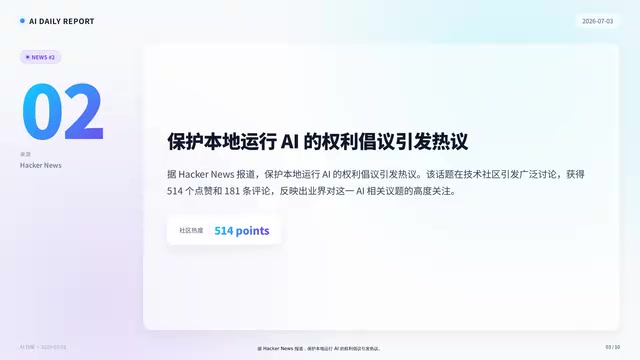
Recently, news that Alibaba had banned Claude Code internally due to security risks quickly gained traction on Hacker News. The topic garnered 324 upvotes and 274 comments—with the number of upvotes nearly matching the number of comments, a rarity among similar tech news—demonstrating that this issue struck at the core concerns of the developer community.
This incident triggered heated debate, essentially reflecting the dilemma enterprises face between embracing AI coding tools and protecting data security. Claude Code is a command-line AI coding assistant launched by Anthropic that can directly read and modify local codebases.
Claude Code's Working Mechanism and Security Risks: The core way Claude Code works is by reading contextual information from the local code repository, then packaging relevant code snippets, file structures, and even the entire project's dependency relationships and sending them to Anthropic's cloud servers for inference.
To understand why this mechanism raises such heightened security concerns, we need to start with the underlying architecture of large language models (LLMs). Modern LLMs are based on the Transformer architecture, whose core component—the self-attention mechanism—requires the model to interact and compute with all other tokens within the context window when processing each token. This means the model must "see as complete a context as possible all at once" to establish global semantic understanding and achieve optimal performance. From a computational complexity standpoint, self-attention computation grows quadratically with sequence length, which severely constrained window size in the early days. Over the past two years, however, the Flash Attention algorithm significantly reduced peak memory usage through block-wise computation, improvements in positional encoding (schemes like RoPE and ALiBi replace absolute positions with relative position representations, enabling models to generalize better to lengths not seen during training), and continued optimization of inference engineering—together pushing the context windows of mainstream models from an early 4K tokens rapidly to hundreds of thousands. The Claude 3 series' context window has expanded to 200,000 tokens (roughly 150,000 words or several thousand lines of code).
Claude Code fully leverages this capability: it serializes the entire local codebase content and transmits it in its entirety to cloud inference servers, rather than retrieving only relevant snippets. This differs fundamentally from the traditional RAG (Retrieval-Augmented Generation) architecture—RAG is a framework that combines information retrieval with language model generation, using vector databases and semantic retrieval to feed only a small number of the most relevant code snippets into the model, greatly limiting the amount of data transmitted per query. Claude Code, by contrast, is closer to feeding the entire code repository directly as part of the prompt, with a single session potentially encompassing tens of thousands or even hundreds of thousands of lines of core business code. This "global code awareness" capability makes it far superior to comparable tools when handling complex tasks like refactoring, debugging, and feature expansion—but at the cost of potentially sending an enterprise's most core technical assets (complete business logic, algorithm implementations, and system architecture) entirely to overseas servers in a single conversation.
While this capability dramatically boosts development efficiency, it also means that an enterprise's core code may be uploaded to a third-party cloud for processing.
Why Cloud AI Coding Tool Security Risks Became a Focal Point
For a tech company of Alibaba's scale, the codebase itself is an incalculable core asset. Using cloud AI coding tools means code context must be sent to external servers for inference, creating two categories of risk: first, intellectual property leakage risk, and second, uncertainty at the data compliance level.
The Deep Constraints of Compliance Law: Alibaba's cautious decision is also backed by deeper compliance logic. China's Data Security Law, which officially took effect in 2021, manages data by hierarchical importance and requires that cross-border transfer of "important data" undergo a security assessment organized by the national cybersecurity authorities. In many legal contexts, core technical code can be classified as such important data. The Measures for Security Assessment of Data Exports, issued in 2022, further refined the quantitative thresholds and scenarios that trigger a security assessment—for example, stipulating that data processors handling the personal information of more than one million people cumulatively must apply for an assessment when providing data overseas, while the export of "important data" is subject to assessment regardless of quantity. Notably, the criteria for identifying "important data" still contain considerable gray areas: various industry regulators have yet to fully complete their important data catalogs. This uncertainty itself constitutes a major compliance risk for enterprises—because once data is classified as important, a violation involving overseas export can face fines of up to 1 million yuan or even revocation of the business license.
From a more macro perspective of cross-border data governance, the layering of laws across multiple jurisdictions further amplifies this complexity. The EU's GDPR stipulates that personal data transfers to third countries must satisfy an "adequacy decision" or adopt standard contractual clauses (SCCs); the US CCPA grants users the right to know about and object to a company's data processing practices; and China's Data Security Law and Personal Information Protection Law construct an independent compliance system from a data sovereignty perspective. For large tech companies operating internationally, once code is uploaded to overseas cloud servers, questions like which jurisdiction the data resides in, what laws protect it, and whether it can be accessed at regulators' request remain without clear answers at the legal level—and this very uncertainty is precisely the risk exposure that large enterprise legal teams find hardest to bear. Different countries' data localization requirements and government data access powers (such as the US CLOUD Act, which grants law enforcement the power to obtain data across borders) may directly conflict with one another. An enterprise complying with one country's laws may violate another's, and this "compliance dilemma" is especially pronounced in the scenario of cross-border transfer of code assets.
When a tool can access an entire code repository, even if the vendor explicitly commits to not retaining data, enterprises struggle to eliminate concerns about where their data flows. Alibaba's decision, to some extent, represents an overall shift in large enterprises' attitude toward cloud AI tools—from enthusiastic embrace to cautious evaluation.
Local Deployment of AI: A New Trend Amid Rising Data Sovereignty Awareness
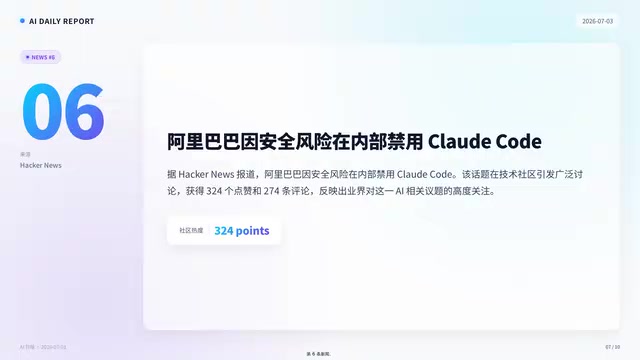
Interestingly, on the same day's AI community trending list, topics related to "local deployment" appeared consecutively. The "Protect the Right to Run AI Locally" initiative ranked second in daily popularity with 514 upvotes, while "A Practical Guide to Running SOTA Large Models Locally" also drew significant attention with 333 upvotes.
The Technical Feasibility of Deploying SOTA Models Locally: This trend has moved from theory to practice over the past year, driven by several key technical developments.
The first is the full maturation of model quantization technology. Quantization is the process of compressing neural network weights from high-precision floating-point numbers to low-bit integers—essentially trading acceptable precision loss for a substantial reduction in storage and computational requirements. From an information-theoretic perspective, after training converges, neural network weights often exhibit a near-normal distribution, with a large number of weight values clustered near the mean, meaning that representing weights with fewer bits results in limited information loss. Specifically, in FP16 format each parameter occupies 2 bytes, while in INT4 format it occupies only 0.5 bytes—theoretically achieving a 4x compression ratio. The GGUF format (introduced by the llama.cpp project, its predecessor being GGML) supports mixed-precision quantization, allowing different precision strategies for different layers of the model—typically retaining higher precision for embedding and final output layers while more aggressively compressing intermediate Transformer layers. This differentiated strategy is based on research findings that a model's sensitivity to quantization error varies significantly across layers. AWQ (Activation-aware Weight Quantization), meanwhile, determines the quantization scaling factor for each channel by analyzing activation value distributions, protecting the "salient weights" that most affect output from quantization damage—significantly reducing perplexity loss compared to naive INT4 quantization. Both approaches can compress the storage footprint of a 70-billion-parameter model from around 140GB in FP16 to around 35-40GB in INT4, enabling it to run fully on consumer-grade hardware like a single RTX 4090 (24GB VRAM) with CPU offloading, typically keeping precision loss within 1-3%.
The second is the widespread adoption of local inference frameworks like Ollama, LM Studio, and Jan, which encapsulate the complex processes of model loading, quantization configuration, and API serving into one-click operations, greatly lowering the deployment barrier for non-expert users. Ollama has even achieved full compatibility with the OpenAI API format, allowing existing applications to switch to local models with almost no modification. This API compatibility carries important ecosystem significance: it means that toolchains, IDE plugins, and automation scripts built on the OpenAI SDK can seamlessly connect to local models by simply changing an endpoint URL, reducing migration costs to nearly zero. This design strategy draws on the "interface stability" principle from software engineering—by keeping external interfaces unchanged while allowing the underlying implementation to be freely replaced, it enables gradual migration of the technology stack without disrupting the existing ecosystem.
The third is the leap in open-source model quality. Models like Meta's Llama 3.1 series, DeepSeek-V3, and Alibaba's Qwen2.5-Coder have significantly narrowed the gap with GPT-4-level models on code generation benchmarks like HumanEval and SWE-bench, and in some vertical scenarios have even surpassed them. Among these, SWE-bench is currently one of the most convincing evaluations of code capability, requiring the model to autonomously complete code modifications starting from a real GitHub Issue and pass the corresponding test cases—which is closer to real engineering scenarios than HumanEval's function-level completion. SWE-bench evaluation covers complex capability dimensions such as bug localization, cross-file dependency understanding, and test-driven development, more accurately reflecting a model's actual ability to solve engineering problems in production environments. For enterprises, this means no longer having to choose between "capability" and "security"—private deployment has become genuinely feasible.
This is by no means a coincidence. Alibaba's ban on cloud coding tools and the community's enthusiasm for local AI point to the same underlying logic: data sovereignty and privacy control are becoming core considerations in AI tool selection. As more and more open-source models approach or even match closed-source frontier models in performance, enterprises and individual developers now have a brand-new option—deploying AI capabilities entirely within a local environment under their own control.
From Depending on the Cloud to Controlling the Local: Redrawing Security Boundaries
The most core advantage of local AI deployment is that data never leaves the local environment, fundamentally avoiding leakage risks in the transmission and storage stages. This is especially critical for scenarios with highly sensitive data, such as finance, healthcare, and large tech enterprises. From a technical architecture perspective, local deployment also brings additional security benefits: the inference process executes on the enterprise's own hardware, and the attack surface is limited to the internal network boundary. Compared to cloud inference, attackers would need to breach multiple lines of defense—the cloud provider's network isolation, the transmission encryption between enterprise and cloud, and the access controls on the inference server—and a vulnerability in any single line of defense could lead to data exposure. Local deployment shortens this complex attack chain to the single line of defense of internal enterprise network security, which, combined with the already-mature enterprise intranet security systems, can provide more predictable security guarantees.
The reason the "Protect the Right to Run AI Locally" initiative resonated so widely also reflects the community's wariness of potential future regulatory restrictions—developers want to ensure that the freedom to autonomously run AI models locally is not stripped away. The debate over "where AI should run" is evolving into a major industry issue.
The AI Coding Tool Ecosystem: Booming Expansion Alongside a Trust Crisis
On the same day, another piece of news in the AI coding field also drew attention: the Timmy K2.7 code model was officially integrated into GitHub Copilot, garnering 415 upvotes. This indicates that the ecosystem of mainstream AI coding tools is still rapidly expanding, with an increasingly diverse selection of models.
Since its launch in 2021, GitHub Copilot has evolved from a single code-completion tool into an AI coding platform supporting multi-model switching. From a technical architecture standpoint, its underlying foundation uses the Microsoft Azure OpenAI service, addressing security concerns through enterprise-grade SLAs (Service Level Agreements) and data isolation commitments: the enterprise version of Copilot promises not to use customer code for model training and ensures that inference requests from different tenants remain mutually invisible through network-layer isolation. However, this has not entirely dispelled large enterprises' concerns, because code still needs to leave the local environment for cloud inference—and from an enterprise security audit perspective, there is a fundamental difference between "committing not to retain" and "being technically unable to retain." The former relies on contractual constraints and vendor reputation, while the latter fundamentally eliminates the possibility of retention through technical architecture design (such as homomorphic encryption inference and Trusted Execution Environments, TEE). The latter, however, still faces significant challenges in terms of performance overhead and has yet to be deployed at scale in production environments. Timmy K2.7's integration continues Copilot's strategic evolution toward a "model marketplace," where developers can flexibly choose the most suitable underlying model based on task characteristics (for example, selecting a lightweight model for rapid completion and switching to a high-parameter model for complex refactoring). This is quite similar to the app ecosystem logic of Apple's App Store—the platform provides the distribution channel and quality control, while model providers focus on differentiated capability competition.
Combined with topics like "New AI Coding Methods: Practices in Short-Prompt Guided Code Generation," the day's trending list collectively paints a complex picture of the AI coding field: on one hand, tool capabilities continue to strengthen and the ecosystem flourishes; on the other hand, the security and trust crisis becomes increasingly prominent.
How to Strike a Balance Between Efficiency and Security
Alibaba's choice poses a sharp question to the entire industry: how exactly should enterprises find the balance point between the efficiency dividends AI brings and the potential security risks?
In the short term, two paths may coexist: for non-core, open projects, developers will continue to leverage cloud AI tools to enjoy development convenience; while for scenarios involving core assets, enterprises will tend to adopt local deployment or private solutions. It's worth noting that some vendors have begun exploring hybrid deployment architectures—the core idea of which is to run a "security gateway" layer within the enterprise's local environment or private cloud, performing sensitive information identification and desensitization on code requests before deciding which parts can be forwarded to cloud models and which must be inferred locally. From an implementation standpoint, sensitive information identification typically combines three layers of filtering: regular expression rules, named entity recognition (NER) models, and context-based semantic classification, applying differentiated handling strategies to different types of sensitive information such as API keys, database connection strings, and business logic identifiers. This architecture needs to solve two core challenges: latency accumulation (the serial wait of local processing plus cloud inference) and desensitization integrity (ensuring business logic isn't inadvertently leaked after desensitization), and it remains in an early exploratory stage.
AI coding tool vendors must also produce more convincing data isolation and security assurance mechanisms, such as third-party audits of zero-data-retention commitments, end-to-end encryption of code processing, and enterprise-grade security features like BYOK (Bring Your Own Key)—which allows enterprises to manage their own encryption keys so that even if a cloud vendor is subject to legal demands or experiences a security incident, it cannot decrypt data without customer authorization, safeguarding data sovereignty at a technical level rather than merely relying on contractual commitments. From a key management implementation perspective, enterprises typically store the master key in a Hardware Security Module (HSM), with the cloud vendor holding only encrypted ciphertext; key derivation, rotation, and revocation are entirely controlled by the enterprise—meaning that even if the cloud server is breached, attackers only obtain undecryptable ciphertext. Only in this way can vendors regain the trust of large enterprise customers.
From Capability Race to Trust Building: The AI Industry Enters a Rational Deep-Water Zone
The day's trending list also included an intriguing piece of news: "AI Industry Over-Hype Prompts Reflection." This forms a subtle echo with Alibaba's ban on Claude Code—after the frenzied AI boom, the industry is entering a more rational and pragmatic phase.
Enterprises no longer blindly chase every new tool, but instead begin to seriously weigh its real value against its potential costs. This shift from "FOMO-driven adoption" (Fear of Missing Out, i.e., blindly following new technology out of fear of missing out) to "cautious evaluation" is precisely a hallmark of a technology reaching maturity. From the perspective of the Technology Adoption Lifecycle, AI coding tools are penetrating from the "early majority" to the "late majority" user segments. This theory was proposed by sociologist Everett Rogers in 1962 and later deepened by Geoffrey Moore in "Crossing the Chasm" for high-tech products: the core demands of early geeks (innovators and early adopters) are technological cutting-edge and differentiated capabilities, while early- and late-majority users place greater value on stability, auditability, and compliance guarantees. The current AI coding tool market is undergoing the "chasm"-crossing period Moore described—whether a tool can provide security features that meet enterprise IT governance requirements, whether it can pass third-party security certifications like SOC 2 Type II, and whether it can specify clear data processing boundaries at the contractual level are becoming key thresholds determining whether a tool makes it onto large enterprises' procurement lists. This shift in demand structure will inevitably push AI tool vendors to migrate their R&D focus from "pushing capability boundaries" to "enterprise-grade trust infrastructure."
Meanwhile, Japan's Supreme Court ruling that AI cannot be listed as a patent inventor also draws new coordinates for AI's boundaries at the legal level—this ruling aligns with judicial practice in the West, signaling a convergence trend in AI's legal status globally.
Taken together, this batch of AI news collectively reveals a core trend: the development of AI technology is gradually shifting from a "capability race" to "trust building." Whoever can provide powerful capabilities while properly addressing security, privacy, and compliance issues will truly win long-term recognition in the enterprise market.
Key Takeaways
Key Takeaways
Related articles
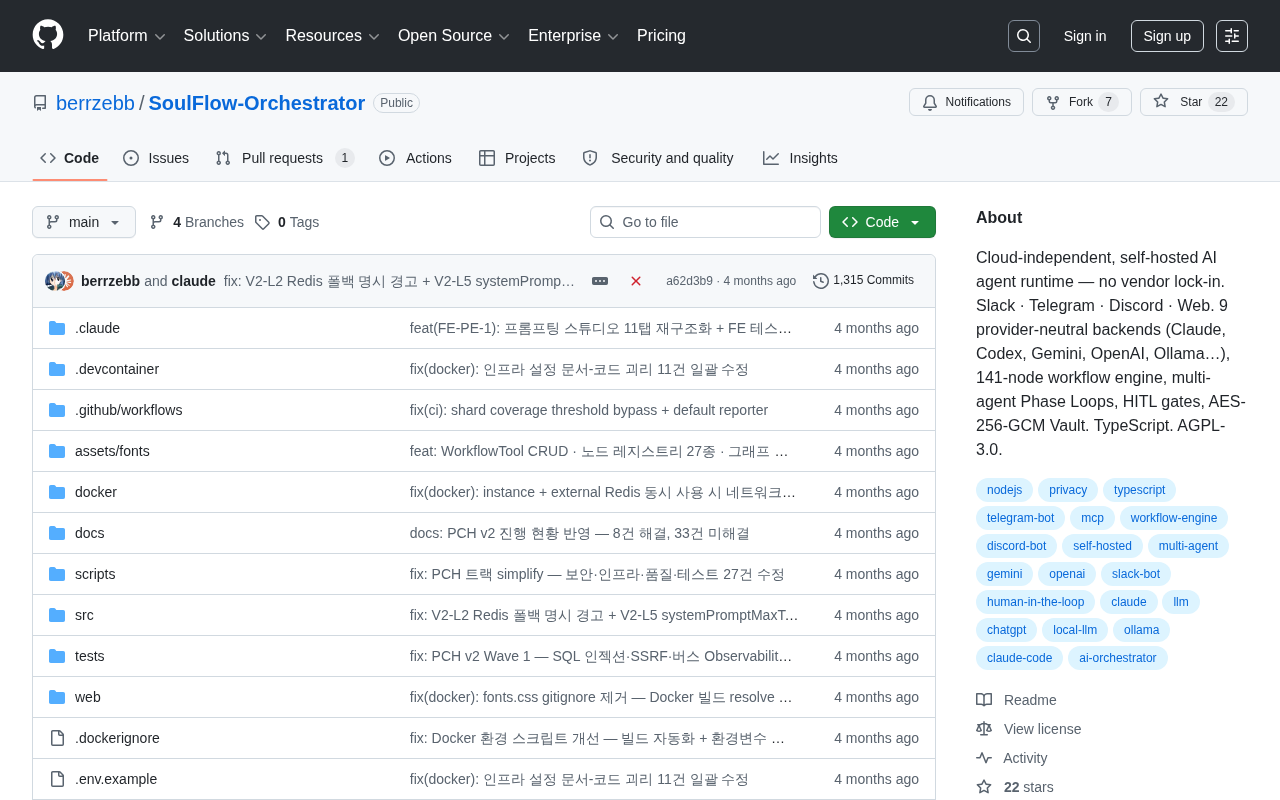
SoulFlow-Orchestrator: A Self-Hosted, Vendor-Lock-In-Free AI Agent Runtime
SoulFlow-Orchestrator is an open-source, self-hosted AI agent runtime with no vendor lock-in. Supports 9 neutral backends (Claude, OpenAI, Ollama), 141-node workflow engine, multi-agent loops, and HITL gates.
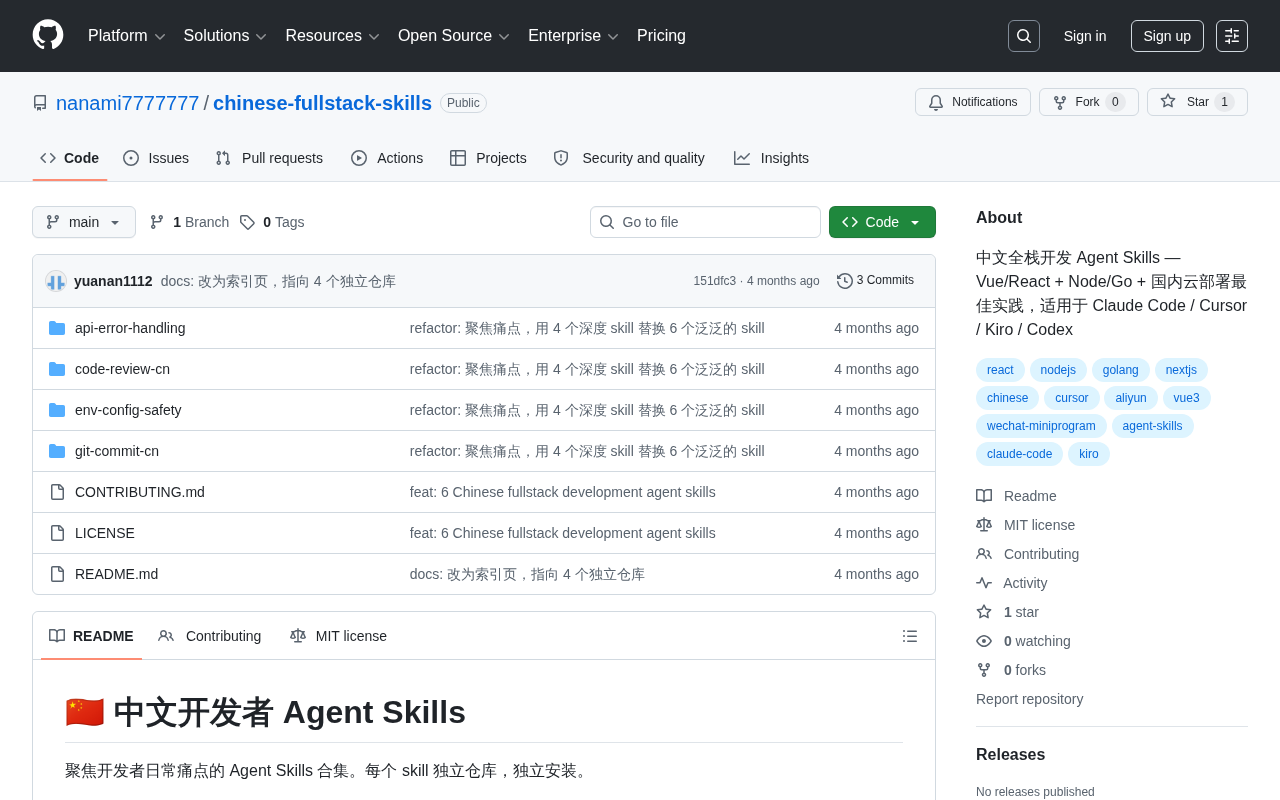
Chinese Full-Stack Agent Skills: A Skill Library Tailored for Domestic AI-Assisted Development
chinese-fullstack-skills is an Agent Skills library for Chinese full-stack development, covering Vue/React, Node/Go, and domestic cloud deployment best practices. Compatible with Claude Code, Cursor, Kiro, and Codex.
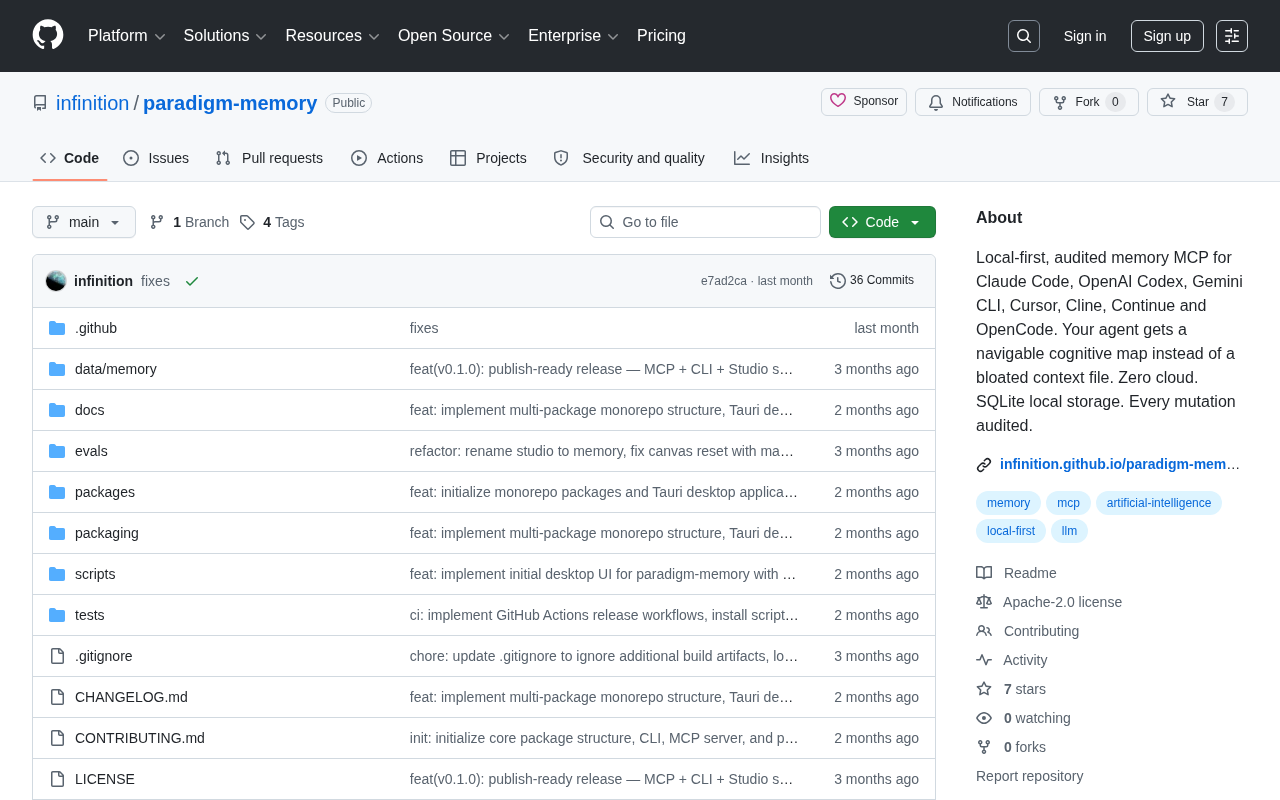
Paradigm Memory: A Local-First Memory System for AI Coding Assistants
paradigm-memory is a local MCP memory tool for Claude Code, Cursor, and Cline. It uses SQLite local storage, zero cloud, full audit trails, and a navigable cognitive map instead of bloated context files.