Alibaba Cloud Wanxiaozhi Hands-On Review: Full Workflow from AI Generation to Website Launch

Wanxiaozhi solves the full-workflow "last mile" problem from AI generation to website launch.
This article reviews Alibaba Cloud's AI website builder Wanxiaozhi through a real test case of building a website for an AI training business. It uses an "ask first, build later" interaction model to precisely gather requirements, demonstrates excellent content understanding during page generation (90% auto-filled and accurate), offers dual conversational + visual editing modes, and most critically achieves full-workflow automation for domain binding, DNS resolution, SSL certificates, and compliance filing — truly solving the "last mile" problem in AI website building.
The "Last Mile" Problem in AI Website Building
Generating a good-looking webpage with AI is something almost any tool can do today. But the real question is — what happens after generation?
How do you register a domain? How do you handle filing/compliance? Who configures the server? These "last mile" problems keep most AI website builders' output stuck at the "screenshot for social media" stage. Today, we'll put Alibaba Cloud's AI website building tool "Wanxiaozhi" through a complete real-world business scenario test to see whether it can truly solve the full workflow from generation to going live.
Industry Context: The rise of AI website building tools stems from the combination of Large Language Models (LLMs) and frontend code generation capabilities. Early tools like Wix ADI and Squarespace achieved semi-automated website building through template matching, while the new generation of AI website builders leverage models like GPT-4 and Claude to enable direct conversion from natural language to HTML/CSS/JavaScript. However, a massive engineering gap exists between "generation" and "going live": DNS resolution configuration, SSL certificate application, server environment deployment, ICP filing (required by Chinese mainland regulations) — each step can become a roadblock for non-technical users. Tools can generate beautiful static pages but fail to deliver a truly accessible website — this is the industry's widespread "last mile" dilemma.
Requirements Gathering: Asking the Right Questions Like a Product Manager
The test scenario was building an official website for an AI course training business, with core requirements including: showcasing the curriculum, handling client inquiries, and collecting sales leads. Following the traditional route would mean either having the tech team work overtime for two weeks, or outsourcing at a cost of thousands or even tens of thousands of yuan.
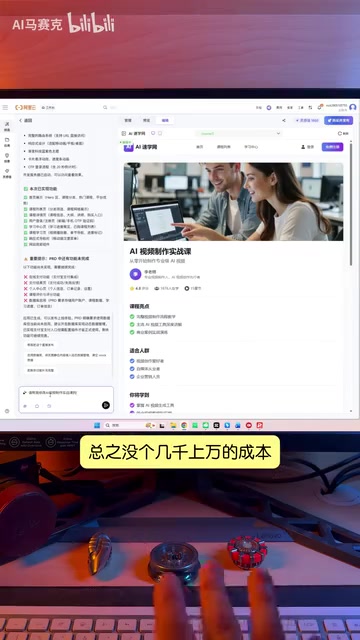
Wanxiaozhi's first differentiating experience appeared in the initial interaction phase. After entering "Help me generate a course showcase and student inquiry system," it didn't immediately throw out a template. Instead, like a product manager, it first asked several key questions:
- What's your course name? What are the main topics?
- Who is your target audience?
- Do you have any reference websites?
This "ask first, build later" logic seems simple but solves a core pain point. With other AI website builders, they generate a template right away, and after a dozen rounds of revisions you're still unsatisfied — the root cause is that requirements weren't clarified from the start.
Requirements Engineering Perspective: The "ask first, build later" interaction model corresponds to the core philosophy of Requirements Engineering in software development. In traditional software development, the requirements analysis phase often occupies over 30% of the total project timeline because rework costs from vague requirements are extremely high. In AI product design, this philosophy has evolved into a "Clarifying Prompts" strategy — proactively collecting contextual information before generating content to improve output accuracy and relevance. Research shows that prompts with sufficient context can improve content usability by 40%-60% compared to vague prompts. Wanxiaozhi productizes this engineering practice by collecting key variables — business scenarios, target users, reference cases — through structured questionnaires, essentially constructing a more precise System Prompt.
After confirming requirements, Wanxiaozhi also automatically generates a professional requirements document for user confirmation, and only begins building after approval.
Page Generation: Content Understanding Is the Real Moat
After requirements confirmation, a complete page was generated within minutes. Homepage banner, course highlights, case studies, student results, instructor profiles — everything was included.
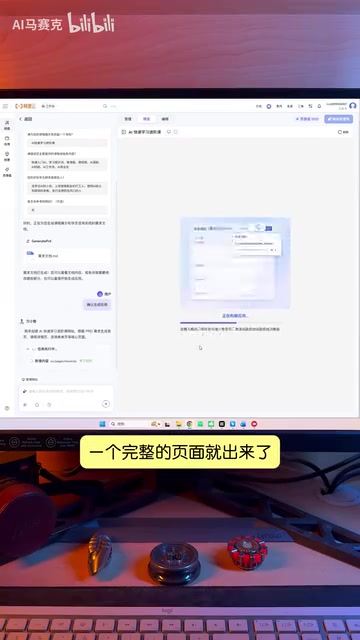
But what was truly surprising wasn't the page structure — it was the precision of content population. Take the pricing module as an example: the pricing structure Wanxiaozhi auto-generated was highly reasonable, perfectly aligned with current AI knowledge-payment industry pricing logic. More importantly, it accurately understood this was a "sales-oriented website" — designed to handle client inquiries and convert leads, not a course delivery platform. It made this distinction correctly on its own.
Why This Distinction Matters: A sales-oriented website (Landing Page) is designed around the conversion funnel: attention capture → value proposition → trust building → call-to-action (CTA), with page structure serving lead collection goals. A course delivery platform (like Teachable or MOOC platforms) requires user authentication, progress tracking, content permission management, and other functional modules. These two product types differ significantly in information architecture, interaction design, and technical implementation. The AI's ability to automatically make this distinction relies on the vast amount of website design patterns and business logic knowledge accumulated in its training data — this is why "content understanding" is considered the true technical moat of AI website building tools. It's not template stacking; it's semantic reasoning about business intent.
Key Differences Between Wanxiaozhi and Other AI Website Builders
The typical problem with traditional AI website builders is: they give you a framework, but the content inside is either empty or filled with irrelevant information, requiring users to manually replace everything one by one. With Wanxiaozhi, 90% of the content is already filled in, and it's accurate. This means the user's workload shifts from "filling from scratch" to "fine-tuning and optimizing" — an order-of-magnitude efficiency improvement.
Editing and Adjustments: Dual Mode — Conversational + Visual
For the post-generation editing phase, Wanxiaozhi provides two editing approaches:
- Conversational editing: Simply say "change the title of this section" in the chat box, and the AI responds instantly
- Visual editing: Manually drag to adjust layouts, change fonts, swap colors — what you see is what you get
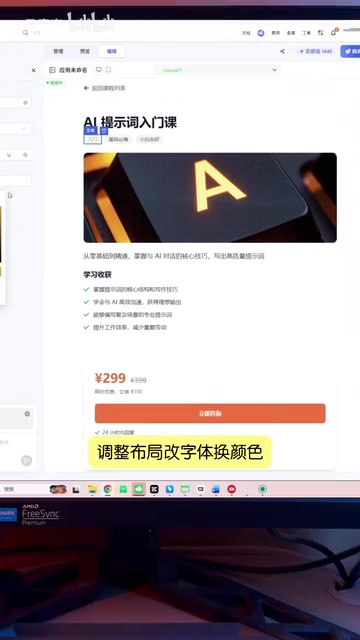
You can switch freely between the two modes without writing any code throughout the entire process. For non-technical users, this flexibility is very user-friendly — simple changes are handled through conversation, while precise adjustments are made with the visual editor.
Design Logic of Dual-Mode Editing: The dual-mode architecture combining conversational and visual editing represents the mainstream trend in Low-Code/No-Code (LCNC) platform design. The visual editor concept (WYSIWYG — What You See Is What You Get) dates back to Xerox PARC research labs in the 1970s, and through the evolution of tools like Dreamweaver and WordPress Gutenberg, has become the standard paradigm for non-technical users building websites. Conversational editing is a new dimension from the LLM era — describing intent in natural language while AI translates it into specific DOM operations or CSS modifications. Combining both modes addresses each one's limitations: pure conversational mode is inefficient for precise layout adjustments, while pure visual mode becomes cumbersome for batch modifications or complex logic changes. This "dual-mode fusion" architecture is becoming the standard design pattern for next-generation website building tools.
Publishing and Going Live: True End-to-End Automation
This is the critical phase where Wanxiaozhi pulls ahead of other AI website builders.
After clicking the "Publish" button in the upper right corner, the system automatically executed a complete workflow: plugin configuration, application initialization, storefront upload, cache clearing... The entire checklist was completed automatically by Wanxiaozhi without any user configuration.
The final step is domain binding. If users already have a domain under their Alibaba Cloud account, the system can automatically bind it and configure DNS resolution; if they don't have a domain, they can quickly register one through a built-in portal. Additionally, compliance operations such as SSL certificate configuration and ICP filing number display are also integrated into the workflow.
Related articles
 Product Reviews
The Programmer's Desk Setup Guide: Building a Workspace That Feels Like Home
Discover how programmers build productive, comfortable workspaces. From multi-monitor setups to ergonomic design, explore the desk philosophy that drives focus and flow.
 Product Reviews
Qoder vs Cursor Real-World Comparison: Which $20/Month AI IDE Is Better?
Hands-on comparison of Qoder vs Cursor AI IDEs: Agent autonomy, human interaction count, and architecture decisions. Qoder needed only 2 interactions vs Cursor's 8.
 Product Reviews
Cursor Cloud Agent Demo: Eliminating Bottlenecks Across the Entire Software Development Lifecycle
Deep analysis of Cursor's Cloud Agent demo showing how cloud VMs, automated test artifacts, and a full-chain control plane systematically eliminate human bottlenecks across the software development lifecycle.