Alibaba Miaowu Hands-On Review: Can This Chinese Alternative to Lovable Actually Deliver on AI Full-Stack Development?

Alibaba launches Miaowu, a full-stack AI dev tool filling China's gap in zero-code platforms
Alibaba has launched Miaowu, a domestic AI full-stack development tool supporting complete application generation from frontend to backend with one-click deployment. Its core highlight is a multi-agent parallel coding architecture that generates standard React engineering projects and provides proprietary Cloud services (PostgreSQL database, user authentication, API endpoints). Compared to overseas products like Lovable, Miaowu offers barrier-free access in China and data compliance advantages, making it ideal for rapidly building MVP prototypes.
A Homegrown Full-Stack AI Development Tool Has Finally Arrived
Over the past year, overseas markets have seen the emergence of AI-driven "zero-code" development platforms like Lovable, bolt.new, and v0, enabling people with zero programming knowledge to quickly build H5 applications and even full-stack projects. This space exploded in 2024, driven by the qualitative leap in large language models' code generation capabilities — models like GPT-4o and Claude 3.5 Sonnet now achieve over 90% pass rates on code benchmarks like HumanEval, making "from prompt to engineering project" a reality and giving rise to the entirely new development paradigm of "Vibe Coding." However, Chinese users wanting to use these tools face either network access issues or latency and compliance risks associated with overseas cloud services. A truly competitive domestic alternative has been sorely missing.
Recently, Alibaba launched an AI full-stack application development tool called "Miaowu" (秒悟Ad), focused on complete application generation from frontend to backend with one-click deployment. This article puts the tool through its paces with a real-world case — building a Xiaohongshu (RED) clone H5 application — to deeply test its actual capabilities and usage boundaries.
Creating a Project: From Prompt to Complete Code
Upon entering the Miaowu platform, you can see it supports three types of applications: Web Apps, H5 Apps, and Skills. For this test, we chose to create a Xiaohongshu-style H5 application.

Before coding begins, there's a noteworthy feature — the Skill system. Miaowu includes built-in design Skills, such as "UiOS Pro Max," which automatically applies high-quality UI design specifications during code generation. After loading a Skill, you simply input your prompt and submit, and Miaowu begins automatically generating code.
Multi-Agent Parallel Coding: Miaowu's Core Differentiator
The most impressive aspect is that Miaowu doesn't use a single AI model to write code line by line. Instead, it launches group tasks, with multiple AI agents collaborating in parallel to complete the coding.
Multi-Agent Architecture is a cutting-edge paradigm in current AI engineering. Unlike single-model sequential code generation, multi-agent systems decompose complex tasks into subtasks, processed in parallel by specialized agents before being integrated. In code generation scenarios, this means UI components, business logic, and the data layer can be written simultaneously by different agents. Theoretically, this compresses generation time to 1/N of the original, while each agent focuses on a smaller context window, effectively reducing "hallucinations" and code inconsistency issues.
Different agents handle different responsibilities — some focus on component decomposition, others handle business logic, and others specialize in style replication. This multi-agent architecture not only improves generation speed but also provides better guarantees for final code quality and consistency.
Code Quality: Truly Engineering-Grade Project Structure
After coding is complete, the generated pages visually come remarkably close to Xiaohongshu's style. But what's more noteworthy is the code-level performance.
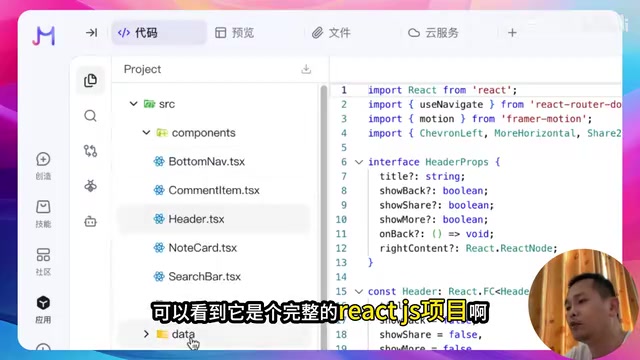
Examining the project structure reveals a complete React.js engineering project, including:
- components/ — React component directory
- hooks/ — Custom Hooks
- pages/ — Page routing
React.js is currently the most widely used frontend framework globally, open-sourced and maintained by Meta. This standard engineering structure follows the "separation of concerns" principle and closely aligns with the default conventions of mainstream scaffolding tools like Vite and Create React App — components store reusable UI components, hooks encapsulate state logic and side effects, and pages correspond to routing hierarchy. This means Miaowu generates not just simple code snippets or single-file demos, but a complete project with standardized engineering structure that professional developers can directly take over for maintenance and extension. Compared to some AI tools that can only run code snippets in sandboxes, this represents a qualitative leap.
Frontend Results and One-Click Publishing
The initially generated version uses mock data, but overall functionality works properly — page layout, interaction logic, bottom navigation, and other main modules all function without issues.

The top-right corner provides a one-click publish function. After publishing, you can open it directly in a mobile browser or wrap it in a Mini Program WebView to quickly create a complete Xiaohongshu-style mini program. From writing the prompt to getting an accessible live link, the entire process takes no more than a few minutes.
Backend and Database: Cloud-Based Full-Stack Capabilities
With the frontend done, the next step is the real test of full-stack capabilities — connecting the backend and database.
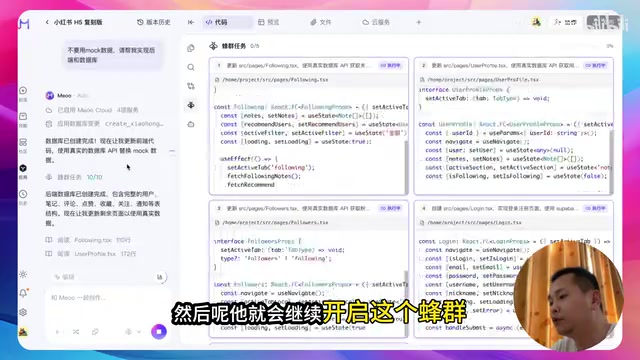
Simply tell Miaowu "don't use mock data, implement backend and database," and it will ask whether to enable Miaowu Cloud services. After confirmation, the platform automatically configures:
- PostgreSQL cloud database
- User authentication system
- RESTful API endpoints
PostgreSQL is currently the most popular open-source relational database among developers, renowned for its powerful JSON support, full-text search, and extension ecosystem. Miaowu's self-built Cloud service takes the same "Backend as a Service (BaaS)" approach as overseas Supabase (Lovable's default backend), but deploys infrastructure on domestic nodes, avoiding data cross-border compliance risks — for commercial applications involving user data, this carries substantial significance under China's Data Security Law and Personal Information Protection Law frameworks.
Miaowu automatically initializes database table structures (user profile tables, notes tables, etc.), then once again launches multi-agent parallel coding groups to replace the frontend's mock data with real backend API calls.
Functional Verification
After backend integration was complete, comprehensive functional testing was performed:
- User Registration and Login — Completed through the cloud authentication system, smooth process
- Creating Notes — Supports image upload, title entry, and submission
- Data Persistence — All data stored in cloud PostgreSQL, data persists after page refresh
In testing, core flows including registration, login, and note publishing all worked properly. There were still some minor glitches with image display, but these can be iteratively fixed by continuing the conversation with the AI. The platform also provides a database management panel for directly viewing table structures and data states, convenient for debugging.
Miaowu vs. Lovable: Comparative Analysis
Comparing Miaowu horizontally with overseas products like Lovable, several key differences are immediately apparent:
| Dimension | Miaowu | Lovable |
|---|---|---|
| Frontend Framework | React.js | React/Next.js |
| Backend Support | Proprietary Cloud service | Supabase integration |
| Deployment | One-click deploy | One-click deploy |
| Multi-Agent Architecture | ✅ Parallel group coding | ❌ Single model generation |
| China Access | ✅ No barriers | ❌ Requires VPN |
| Cloud Compliance | ✅ Domestic nodes | ❌ Overseas nodes |
Miaowu's multi-agent parallel coding is a clear technical differentiator. For Chinese developers and product managers, the two points of no VPN required and cloud services deployed domestically directly eliminate the biggest usage barriers.
Conclusion: Is Miaowu Worth Using?
Miaowu's arrival fills a gap in the Chinese market for AI full-stack application development tools. Based on actual experience, it already possesses end-to-end capabilities spanning frontend UI generation, engineering-grade project structure, backend API construction, and cloud database configuration.
For entrepreneurs looking to quickly validate product ideas, the value of such tools lies in dramatically compressing the MVP (Minimum Viable Product) build cycle. MVP is the core concept of Lean Startup methodology — building a product version with core functionality at minimal cost, rapidly deploying it to real user testing, and using data to drive subsequent iteration decisions. AI full-stack development tools compress the MVP build cycle from "weeks" to "hours," essentially reducing the time cost of the "Build-Measure-Learn" loop, enabling entrepreneurs to validate market hypotheses at higher frequency.
As a new product, there's still room for polish in the details (such as image display bugs and stability in complex interaction scenarios). But overall, for entrepreneurs and product managers looking to quickly validate product ideas and build MVP prototypes, Miaowu is already a very practical choice.
AI programming tools are evolving from "assisting with writing code" to "directly generating complete applications" — this trend is irreversible. Whether Miaowu can establish a firm foothold in the Chinese market will depend on its iteration speed and developer community building going forward. But at the very least, Chinese users now have a credible domestic option.
Related articles
 Product Reviews
The Programmer's Desk Setup Guide: Building a Workspace That Feels Like Home
Discover how programmers build productive, comfortable workspaces. From multi-monitor setups to ergonomic design, explore the desk philosophy that drives focus and flow.
 Product Reviews
Qoder vs Cursor Real-World Comparison: Which $20/Month AI IDE Is Better?
Hands-on comparison of Qoder vs Cursor AI IDEs: Agent autonomy, human interaction count, and architecture decisions. Qoder needed only 2 interactions vs Cursor's 8.
 Product Reviews
Cursor Cloud Agent Demo: Eliminating Bottlenecks Across the Entire Software Development Lifecycle
Deep analysis of Cursor's Cloud Agent demo showing how cloud VMs, automated test artifacts, and a full-chain control plane systematically eliminate human bottlenecks across the software development lifecycle.