Alibaba Open-Sources QwenGyre: Long-Task Training Without Dropped Connections, Agents Learn While They Work

Alibaba's QwenGyre eliminates GPU idling in long-task agent training; consumer hardware runs 125B models as multiple LLMs accelerate.
This AI roundup covers two main themes: agent training efficiency and model deployment barriers. Alibaba open-sources QwenGyre, which uses async GPU scheduling to let finished units train first while unfinished tasks migrate with state and cache, reducing GPU idling. Stratum deploys 125B-parameter Qwen 3.8 Flash Next on a 12GB VRAM gaming PC at 94 tokens/sec. Zhipu's GLM 5.3 High Speed hits ~500 tokens/sec with sub-5s first-token latency; StepFun's Step 5 Preview launches free on WorkBuddy with 600B parameters and 1M context. DeepSeek plans to invest in Winverse AI at ~$400M valuation for robot perception and decision-making.
AI agents frequently dropping out during long-task training while GPUs sit idle has long been a core pain point for developers. Alibaba's newly open-sourced QwenGyre (referred to as "Q1 JIR" in the original text) aims to change this. According to Bilibili's "Will叔每日AI动态" (Uncle Will's Daily AI Updates), this framework lets agents complete training while executing long tasks, with GPU utilization expected to improve significantly.

The Long-Task Training Dilemma and QwenGyre's Solution
In traditional agent training pipelines, a single task often runs for hours across hundreds of interaction rounds, involving millions of tokens. GPUs face severe waiting issues during this process—some compute units finish their work early but must wait for all other units to complete before the next training round can begin.
QwenGyre's core idea is to split the GPU into independent compute units: whoever finishes their task first starts training first, while unfinished tasks—along with their state and cache—are "moved away" and seamlessly resumed once subsequent units complete their execution. In other words, it's like letting the team member who hands in their exam early start reviewing while others keep working. This asynchronous scheduling mechanism reduces GPU idle time and truly parallelizes training and inference.
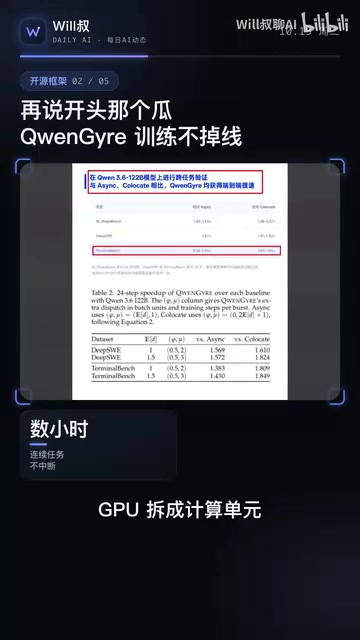
To understand the GPU idling problem, we need to return to the fundamentals of large model training. Model training typically proceeds in "batches": all compute units within a batch (such as tensor cores and SM streaming multiprocessors) must complete forward computation and backpropagation, synchronously update parameters, and only then can the next batch begin. In long-task agent scenarios, computational demands vary enormously across tasks—some interactions need only dozens of tokens, while others involve million-token reasoning chains. This forces fast units within the same batch to wait for slow ones, causing GPU utilization to plummet. Common industry mitigations include gradient accumulation, dynamic batching, and pipeline parallelism, but these either sacrifice timeliness or require high task homogeneity. QwenGyre's asynchronous scheduling approach is closer to a fusion of "pipeline parallelism" and "elastic scheduling": through state and cache migration, completed units enter the training phase early, essentially transforming the rigid constraint of batch synchronization into task-level elastic continuation—a significant departure from traditional data-parallel training.
New Possibilities for Consumer Hardware: 125 Billion Parameters in 12GB VRAM
Another development worth noting comes from the community project Stratum. It deployed the 125-billion-parameter Qwen 3.8 Flash Next model on a gaming PC with only 12GB of VRAM, achieving a measured output speed of 94 tokens per second with an RTX 5070. While this number can't compete with data-center-grade solutions, given the hardware cost gap, it's enough to show that running large models on consumer GPUs is shifting from "can it be done" to "is it usable."
For individual developers and small-to-medium teams, this means the barrier to running hundred-billion-parameter models locally is steadily decreasing.
Running a 125-billion-parameter model on 12GB of VRAM relies primarily on model quantization and Mixture-of-Experts (MoE) architecture. Taking Qwen 3.8 Flash Next as an example, it likely uses an MoE structure—activating only a subset of expert parameters per inference rather than computing with all 125 billion parameters simultaneously. On top of this, community projects typically adopt 4-bit or even lower quantization schemes (such as GPTQ and AWQ), compressing each parameter's storage to a quarter or less of its original size. The 12GB of VRAM actually loads quantized weights and some activation caches, while remaining parameters or experts are dynamically loaded from system memory or even SSD on demand. This "not enough VRAM, compensate with RAM" strategy sacrifices some speed but makes running hundred-billion-parameter models on consumer GPUs possible. It's worth noting that the 94 tokens/second output speed was measured under specific quantization precision and context lengths; real-world experience will fluctuate with prompt length, concurrency, and other factors. The significance of this progress lies in the shift from "hardware adapting to models" to "models adapting to hardware."
GLM 5.3 High Speed and Step 5 Preview: The Speed Race Accelerates
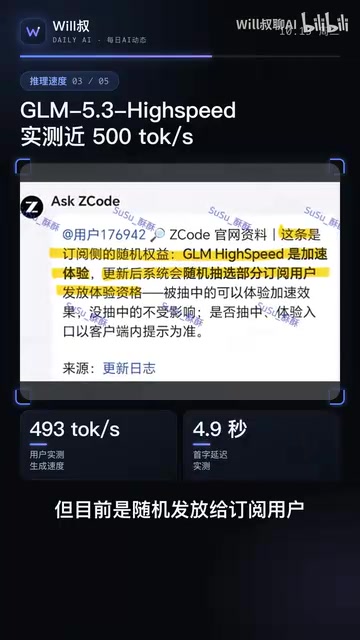
Zhipu's GLM 5.3 High Speed version has entered gray-scale testing, with users measuring nearly 500 tokens per second and first-token latency under 5 seconds. However, access is currently granted randomly, so whether subscribers can experience it comes down to luck. The efficiency is impressive, but it's not yet fully open.
Another notable player is StepFun's Step 5 Preview, now available on the WorkBuddyAd platform for a limited-time free trial. With 600 billion parameters, 27 billion activated, and support for 1 million tokens of context—this set of numbers puts it in the top tier among current open-source models. The practical usability of that 1-million-token context will be the key metric for evaluating its engineering capabilities.
"First-token latency" and "tokens per second" are two key metrics for measuring large model inference experience, but they reflect different capability dimensions. First-token latency (Time to First Token, TTFT) refers to the time from when a user sends a request to when the model produces its first token, primarily affected by the prefill stage—that is, how long the model takes to process the input prompt; longer contexts mean slower prefill and higher TTFT. Tokens per second (TPS) reflects throughput speed during the decode stage, i.e., how efficiently the model generates answers token by token, mainly constrained by memory bandwidth and model size. For interactive applications, TTFT determines the "sense of waiting," while TPS determines "reading fluency." GLM 5.3 High Speed's claims of TTFT under 5 seconds and TPS near 500 suggest it likely has targeted optimizations in both prefill (such as chunked attention and KV cache reuse) and decode acceleration (such as speculative sampling and parallel decoding). However, such high-speed versions typically come at the cost of slightly reduced generation quality or limited context length, and whether they're suitable for production environments still requires empirical validation.
DeepSeek's Robotics Play
According to Bloomberg, DeepSeekAd plans to invest in Winverse AI, founded by former Tencent scientist Hu Han, at a post-investment valuation of approximately $400 million. The company specializes in robot perception, understanding, and decision-making, positioning itself as "the brain inside the robot."

From large models to embodied intelligence, DeepSeek's move isn't surprising. Extending algorithm-level capabilities into the physical world is one of the most noteworthy trends in the current AI industry. Whether Winverse AI can leverage DeepSeek's resources and model capabilities to quickly establish barriers in robot decision-making is worth continued observation.
Embodied AI is a core direction for the AI industry's transition from the digital world to the physical world, with the goal of enabling robots to perceive their environment, understand tasks, and make decisions. Unlike pure language models, embodied AI systems need to integrate multimodal information including vision, touch, and motion control, and complete action planning under real physical constraints. The industry typically divides such systems into two layers: a "brain" responsible for high-level semantic understanding and task decomposition, and a "cerebellum" responsible for low-level motion control and real-time response. Winverse AI's positioning as "the brain inside the robot" means it focuses on perception, understanding, and decision-making layers rather than directly participating in motor control. Competitive barriers in this field lie in the accumulation of real-world scenario data, sim-to-real transfer capabilities, and ecosystem ties with hardware manufacturers. DeepSeek's investment can be seen both as an attempt to extend its multimodal and reasoning capabilities into the physical world and as a reflection of large model companies using capital deployment to secure entry points into embodied intelligence.
One-line Summary
Alibaba open-sources QwenGyre to eliminate GPU idling in long-task training, as consumer hardware running hundred-billion-parameter models and multiple large model speedups take center stage.
Paragraph Summary
This edition of AI updates focuses on two main threads: agent training efficiency and model deployment barriers. Alibaba open-sources the QwenGyre framework, which uses asynchronous GPU scheduling to let completed units train first while unfinished tasks migrate with their state and cache, reducing GPU idling and improving long-task training efficiency. Community project Stratum deploys the 125-billion-parameter Qwen 3.8 Flash Next on a 12GB VRAM gaming PC, achieving 94 tokens per second on an RTX 5070, showing consumer hardware running large models is moving from usable to genuinely practical. Zhipu's GLM 5.3 High Speed hits nearly 500 tokens per second in gray-scale testing with first-token latency under 5 seconds; StepFun's Step 5 Preview launches on WorkBuddy with a limited-time free trial, featuring 600 billion parameters with 27 billion activated and 1 million token context support. Additionally, DeepSeek plans to invest in Winverse AI, founded by former Tencent scientist Hu Han, at a valuation of approximately $400 million, positioning itself in robot perception and decision-making.
Related articles

How Big Can Stars Really Get? The Physical Limits of the Largest Stars
Red supergiants are the largest stars by volume, with radii up to 2,000 times the Sun, engulfing the inner solar system. But there is no precise upper limit on stellar size—models predict up to 15,000 solar radii. The most massive blue stars are far smaller than red supergiants—biggest and heaviest are two different things.

Apple HomeView Smart Display Full Feature Breakdown: Wall-Mount or Desktop, $299
Apple launches HomeView, a $299 smart display with wall-mount and desktop options, 12MP camera for facial recognition, smart home control, music playback, and recipe step-by-step cooking. Full breakdown of watch faces, apps, privacy, and cooking integration.

Where Did the Promised New Studio Go? Craft Computing Answers After Five Years
Craft Computing's host responds to viewer questions: the new studio promised five years ago was shelved as construction costs soared from $30,000 to $75,000, and was replaced by a 168-square-foot garage conversion.