Alibaba Qwen Code Repository Leaks Qwen4 Series Models: Max, Coder-Plus, and Omni Exposed
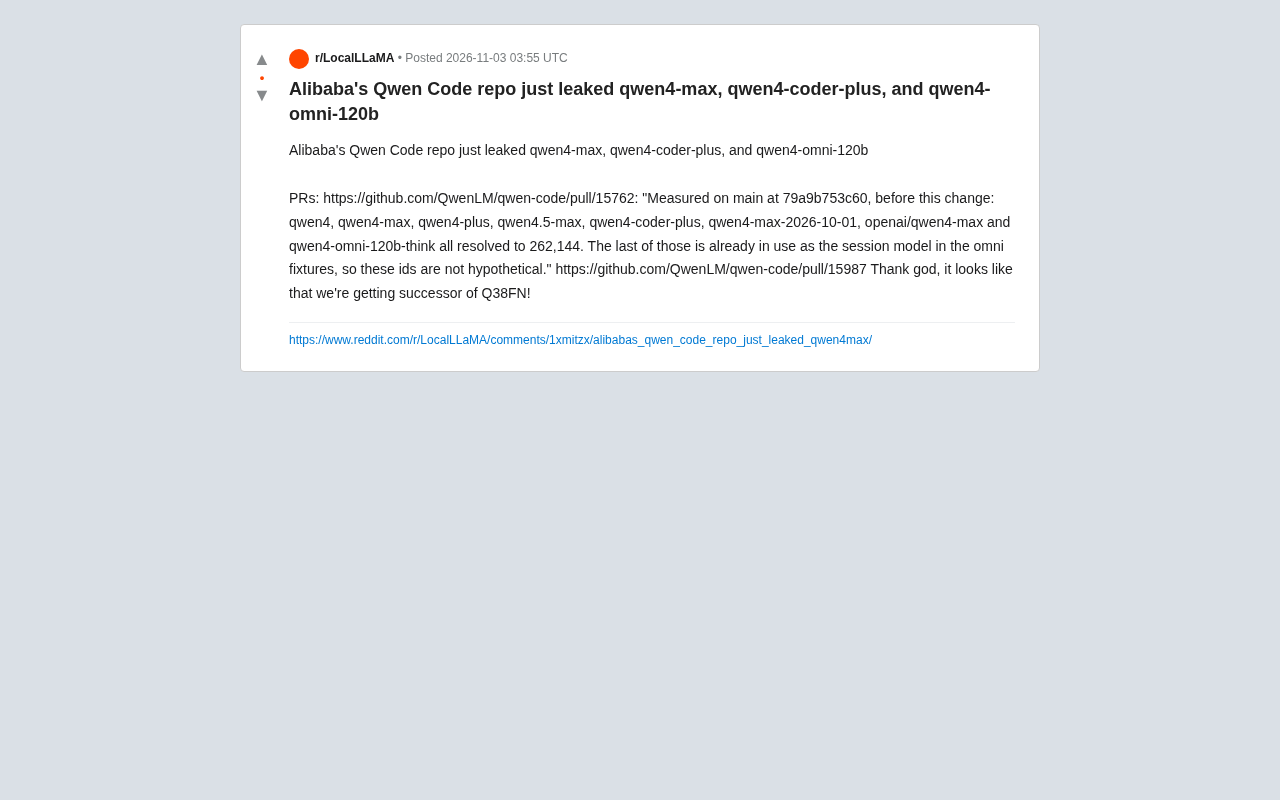
Qwen Code repository PRs leak multiple Qwen4 series model IDs, suggesting Alibaba's next-gen models are in internal testing.
Alibaba's Tongyi Qianwen Qwen Code repository accidentally leaked its next-generation model lineup through two GitHub PRs, including unreleased model IDs such as qwen4, qwen4-max, qwen4-plus, qwen4.5-max, qwen4-coder-plus, qwen4-max-2026-10-01, and qwen4-omni-120b-think. These IDs all resolve to a context length of 262,144 under the specified commit, and qwen4-omni-120b-think has already been used as a test fixture, indicating it genuinely exists at the code level and can be used for benchmarking. The naming system shows Alibaba continues to operate its general flagship (max/plus), programming-specific (coder-plus), and multimodal (omni) product lines in tiers, while the date suffix suggests planned release milestones. Community reaction is mostly excitement, but rational voices remind that model IDs appearing in a repository do not equate to imminent public release, and developers should wait for official confirmation before making technology selection decisions.
Alibaba's Tongyi Qianwen Qwen Code repository recently accidentally leaked its next-generation model lineup. According to the Reddit community, two GitHub Pull Requests revealed multiple unreleased model IDs including qwen4-max, qwen4-coder-plus, and qwen4-omni-120b, suggesting the Qwen4 series may already be in internal testing or even preparing for launch.
What Leaked: A Full Model Panorama Exposed by a Single PR
The incident began with PR #15762 in the QwenLM/qwen-code repository. When describing performance benchmarks, the PR directly listed a series of model IDs: qwen4, qwen4-max, qwen4-plus, qwen4.5-max, qwen4-coder-plus, qwen4-max-2026-10-01, openai/qwen4-max, and qwen4-omni-120b-think.
These IDs are not arbitrarily fabricated. The PR description mentions that all the above models resolve to a context length of 262,144 under the specified commit, and qwen4-omni-120b-think has already been used as the session model in omni test fixtures. In other words, these model IDs at least genuinely exist and are referenced at the code level, rather than being hypothetical placeholders.
Another PR #15987 was also linked by the community to this leak, with one user commenting "looks like we're finally getting the successor to Q38FN." Although the specific content of that PR is not detailed in the source material, the proximity in timing of the two PRs further reinforces the judgment that the Qwen4 series is in progress.
Pull Request (PR) is a core collaboration mechanism on code hosting platforms like GitHub: developers fork their own copy from the main repository, make changes on an independent branch, and then submit a merge request to the original repository, where maintainers review, discuss, and decide whether to merge into the main branch. PR descriptions, discussion threads, and code diffs are all publicly visible, so when teams do benchmark comparisons, record commit hashes, or reference model endpoints in PRs, it's easy to inadvertently expose internal information that was never meant to be public—such as unreleased model IDs. This is the direct cause of this leak: the PR was originally just describing the context of performance benchmarks, but ended up listing the complete internal model inventory.
Test fixtures are fixed data or environments in software testing used to make tests repeatable. In applications that call large models, fixtures often contain a real model endpoint or simulated responses, and tests send requests directly to that endpoint when running. Therefore, when a model ID is used as a fixture, it means it is at least callable in some internal environment, which is more credible than merely appearing in documentation or configuration.
Naming System Reveals Product Roadmap
From the leaked IDs, we can read Alibaba's product tiering strategy for the Qwen4 family.
Max and Plus form the general-purpose flagship tier. qwen4-max and qwen4-plus continue the naming logic from the Qwen3 era, corresponding to the highest capability and balanced versions respectively. The appearance of qwen4.5-max suggests Alibaba may be doing minor version iterations within the same major version—intermediate versions like "4.5" are not common in previous Qwen series and are worth watching.
Coder-Plus targets programming scenarios. The naming of qwen4-coder-plus indicates Alibaba continues to operate programming capabilities as an independent product line. Given that the qwen-code repository itself is a tool for code scenarios, it makes sense that the coder series is updated in sync with the code repository.
Omni-120b points to multimodality. The "omni" in qwen4-omni-120b-think typically represents full modality (text, images, audio, etc.), "120b" suggests the parameter scale, and the "think" suffix may correspond to reasoning mode. This naming combination shows Alibaba continues to double down on integrating multimodality and reasoning capabilities.
Date suffix exposes release cadence. qwen4-max-2026-10-01 carries an explicit date marker. Model IDs with dates like this are typically used for snapshot version management, potentially meaning this model corresponds to a planned release milestone.
Context length refers to the maximum number of tokens a model can process in a single inference (a token is the basic unit of text processing for a model, roughly equivalent to a word or part of a word). 262,144 is 256K tokens, meaning the model can theoretically read in hundreds of thousands of characters at once, suitable for long document analysis, large codebase comprehension, and similar scenarios. The longer the context window, the higher the memory and attention computation overhead required, so long context capability is typically tied to model architecture and inference optimization solutions. It's important to note that nominal context length is not equivalent to the model's actual effective performance at that length (such as the "lost in the middle" problem), and the actual usable length often needs independent evaluation and verification.
Context Length: Uniform 262,144 Specification
A key data point in the PR description is that all listed model IDs resolve to a context length of 262,144. If this number is accurate, it means the Qwen4 series maintains a level consistent with current mainstream long-context models in terms of context window.
More interestingly, the PR's context is discussing benchmark performance before and after a certain change, indicating these models have entered a measurable, comparable performance evaluation stage. A model ID being used for benchmarking typically means it has at least completed basic training and possesses inference capabilities.
Community Reaction and Credibility Assessment
The Reddit community's reaction to this leak was mostly excitement, but there were also rational voices. Some users pointed out that model IDs appearing in a code repository do not equate to the models being about to be publicly released—internal testing IDs may exist in code for months or even longer in advance.
However, the detail that qwen4-omni-120b-think has been used in test fixtures increases the credibility of the leak. Test fixtures typically need to connect to actually callable model endpoints, meaning this model ID is genuinely usable in at least some internal environment.
Historically, the Qwen series has had model information leaked in advance before, and Alibaba typically advances releases at its own pace. This leak is more like an accidental "preview" than official preheating.
Model IDs and API endpoints are two different things at different levels. A model ID is just a string key in an internal registry or gateway configuration, used for routing requests, doing A/B testing, or version snapshots; while developer-facing API endpoints still need to go through a series of launch processes including quotas, billing, rate limiting, compliance review, documentation, and SDK adaptation. Therefore, model IDs appearing in code repositories typically precede public release by months, and may also be deprecated or renamed if internal evaluation falls short of expectations. When judging the credibility of leaked information, the key is whether it is actually called (such as in test fixtures), rather than merely appearing in comments, configuration, or placeholders.
Significance for Developers
For developers using Qwen series models, this leak provides several practical signals. The continued existence of Coder-Plus indicates that programming assistance remains a key focus for Alibaba, and the update cadence of the qwen-code toolchain is worth tracking. If the Omni series continues the multimodal路线, it may provide new options for applications that need to uniformly handle text and visual inputs.
As for when these models will be officially released and what their actual capabilities are, there is currently no official information. The leaked IDs and context length can only serve as reference; true performance still needs to wait for official benchmarks and independent evaluations.
Before official confirmation, developers are advised to stay informed but not make technology selection decisions based on leaked information. After all, there's still considerable distance between a model ID appearing in a code repository and a stably callable API.
One-line Summary
Qwen Code repository PRs leak multiple Qwen4 series model IDs, suggesting Alibaba's next-generation models are already in internal testing.
Paragraph Summary
Alibaba's Tongyi Qianwen Qwen Code repository accidentally leaked its next-generation model lineup through two GitHub PRs, including unreleased model IDs such as qwen4, qwen4-max, qwen4-plus, qwen4.5-max, qwen4-coder-plus, qwen4-max-2026-10-01, and qwen4-omni-120b-think. These IDs all resolve to a context length of 262,144 under the specified commit, and qwen4-omni-120b-think has already been used as a test fixture, indicating it genuinely exists at the code level and can be used for benchmarking. The naming system shows Alibaba continues to operate its general flagship (max/plus), programming-specific (coder-plus), and multimodal (omni) product lines in tiers, while the date suffix suggests planned release milestones. Community reaction is mostly excitement, but rational voices remind that model IDs appearing in a repository do not equate to imminent public release, and developers should wait for official confirmation before making technology selection decisions.
Related articles
 Tech Frontiers
Sherlock: An Open-Source Tool for Tracking Usernames Across Social Networks
Sherlock is an open-source Python tool that tracks social accounts across networks by username. This article covers its core features, why developers love it, typical use cases, and privacy compliance considerations.
 Tech Frontiers
GitHub Daily·Nov 07: Agent-Ready and Context Compression
GitHub Trending Nov 07: meta's agent-ready design system astryx, billion-context's 5x context compression, sherlock nearing 100k stars, plus local-first localthings and bare-metal GPU orchestration nvke.
 Tech Frontiers
Buoyant Open-Sources Kinference: An Inference Control Plane for vLLM on K8s
Buoyant open-sources Kinference, an inference control plane for vLLM on Kubernetes, with declarative routing, KV-cache-aware load balancing, and per-tenant metrics—claiming 95% lower median TTFT in official benchmarks.