Alibaba's 2.4 Trillion Parameter Qwen Model: Separating Technical Substance from Marketing Hype

Alibaba's 2.4T-parameter Qwen model impresses on specs but its 'second only to Gemini' claim lacks independent verification.
Alibaba unveiled a 2.4 trillion parameter Qwen flagship at WAIC, claiming it ranks 'second only to Gemini 2.5.' The MoE architecture and 1M token context window are real technical achievements, and Qwen's 700M+ Hugging Face downloads show genuine ecosystem strength. However, the ranking claim rests on internal benchmarks with no public Model Card or third-party data, and the promised open-source weights haven't actually been released yet.
The Controversy Behind "Second Only to Gemini"
At the World Artificial Intelligence Conference (WAIC) in Shanghai, Alibaba unveiled the next-generation flagship model in its Qwen (Tongyi Qianwen) lineup — with a parameter count of 2.4 trillion. But the most attention-grabbing moment wasn't the scale itself; it was the bold claim that followed: "second only to Gemini 2.5."
The timing made this statement particularly striking. Just days earlier, Kimi had released a 2.8 trillion parameter model, and Alibaba followed up within 48 hours with its own 2.4 trillion parameter entry. Chinese AI labs are racing to position themselves right behind the world's top models, and a full-blown arms race — measured in both parameters and soundbites — is now underway.
But the key question remains: what actually backs up that "second only to" claim? As of now, Alibaba hasn't released a single comprehensive benchmark table. That alone makes this launch worth examining carefully.
The Technical Specs That Actually Hold Up
Let's start with what's genuinely substantive. This generation of Qwen uses a sparse Mixture of Experts (MoE) architecture, and at 2.4 trillion parameters, it marks Alibaba's first trillion-scale multimodal model — capable of handling text, images, video, and documents.
MoE (Mixture of Experts) traces its roots back to a landmark 1991 paper by Jacobs et al., but it truly came into its own during the large language model era by solving a fundamental tension: larger models have more capability, but also higher inference costs. Unlike dense models that activate all parameters for every inference pass, MoE splits the model into multiple specialized "expert" sub-networks and uses a router mechanism to dynamically assign each input token to the most suitable experts. This achieves an efficiency balance — large total parameter count, small active parameter footprint — which significantly reduces compute costs and inference latency. Of the 2.4 trillion total parameters, only a fraction are activated at any given time. GPT-4, Gemini 1.5, and some Meta models use similar architectures. MoE's main challenges lie in load balancing across experts and training stability, but its efficiency advantages make trillion-scale commercial deployment feasible.
Equally noteworthy is the context length: 1 million tokens. This means the model can process extremely long documents or conversations in a single pass — a significant capability for long-document analysis, code comprehension, and similar use cases.
A token is the basic unit of text processing in large language models. One Chinese character corresponds to roughly 1–2 tokens; one English word is approximately 1 token. A 1 million token context window means the model can "read in" roughly 750,000 English words — or hundreds of pages of a PDF — without losing contextual memory. Compare this to GPT-3's original 4,096 token limit, and this represents a several-hundred-fold improvement. Achieving this relies on continuous optimization of attention mechanisms — standard Transformer attention scales at O(n²), meaning doubling sequence length quadruples compute. Researchers have developed sparse attention, FlashAttention, and positional encoding improvements like RoPE (Rotary Position Embedding) to extend effective context range. Long-context capability is transformative for legal document review, large codebase analysis, and academic literature synthesis. However, ultra-long contexts also introduce the "lost in the middle" problem — models often show degraded accuracy on information in the middle of very long inputs — a challenge the research community is still actively addressing.
The Qwen Max preview is now live and available directly in the Tongyi app, with preview pricing set at 10% of the official rate. From a usability standpoint, these are tangible, deployed features — not paper promises.
"Second Only to Gemini" Deserves a Skeptical Eye
And yet, the loudest claim in this launch is precisely the one that warrants the most scrutiny.
AI model evaluations fall into two broad categories: vendor-internal benchmarks and independent third-party tests. Third-party benchmarks — such as MMLU (multi-task language understanding), HumanEval (code generation), MATH (mathematical reasoning), and LMSYS Chatbot Arena (human preference voting) — are maintained by academic institutions or independent organizations, with transparent evaluation protocols and reproducible results. It's worth noting that traditional static benchmarks have faced growing credibility concerns due to "data contamination" — where test questions may have been included in training data. In response, the community has shifted toward dynamic evaluation, with LMSYS Chatbot Arena's blind human voting and Elo rating system considered the hardest to "game," since it measures real user preferences on open-ended questions rather than fixed-answer objective scoring. Vendor-internal evaluations can more thoroughly cover a product's own use cases, but their lack of transparency makes them prone to test set leakage or cherry-picking results. This is precisely why the industry treats self-proclaimed rankings with caution — a legitimately recognized ranking must be reproducible by others using the same methodology.
According to analysis by content creator Mr.Cloud, the "second only to Gemini" claim originates from an Alibaba-published tweet, based on internal evaluation — with no public benchmark table, no Model Card, and no independent third-party test data. In plain terms: "second only to Gemini" is currently a vendor slogan, not a conclusion drawn from any authoritative leaderboard.
A Model Card is a standardized technical document released alongside a model, first proposed and popularized by Google researchers in 2018. A complete Model Card typically includes: intended use cases and limitations, training data sources and processing methods, detailed benchmark evaluation results, known biases and risk disclosures, and usage license terms. A Model Card is the open-source community's baseline expectation for "responsible AI release." The absence of one means external parties cannot independently verify the model's capability boundaries or potential risks — which is a key reason researchers have questioned this Qwen release.

This isn't the first time. When the previous Qwen 3.5 was released, it similarly claimed to be "on par with the top configurations of GPT and Claude" — generating plenty of buzz, but with independent verification that never quite caught up. So the more rational posture toward this 2.4 trillion parameter model is: treat it as "worth trying," not as a confirmed world #2.
The Open-Source Promise: Still Just Words for Now
There's another detail that's easy to gloss over in the headlines: the promised open-source weights have not actually been released yet.
There is no corresponding repository on Hugging Face, no open-source license, and no clear timeline. It's worth noting that the Max flagship series has historically been closed-source and paid — so announcing a shift toward open-source is a genuinely significant directional change.
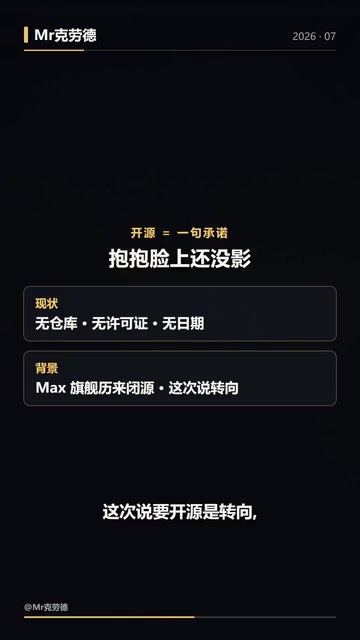
But a directional change is not a delivery. Until the weights, Model Card, and license are actually on the table, the open-source announcement also warrants a degree of caution.
The Real Moat: #1 in Global Downloads
Qwen's actual competitive strength doesn't rest on this as-yet-unverified ranking. It sits in an entirely different dimension.
It is the most downloaded open-source large model in the world. On Hugging Face, Qwen has accumulated over 700 million downloads, already surpassing Meta's Llama series. The number of derivative models built on top of it exceeds 110,000.
Hugging Face is currently the world's largest AI model hosting and collaboration platform — often called the "GitHub of AI." Developers publish, download, and fine-tune open-source models there, and download figures are widely regarded as an important metric for measuring a foundation model's ecosystem influence. Qwen surpassing Meta's Llama series to top the download charts is a landmark achievement — Llama had long been the default foundation model for the open-source community. Behind those 110,000 derivative models lies an enormous body of work by companies and research teams completing instruction tuning and RLHF (Reinforcement Learning from Human Feedback) alignment in vertical domains such as healthcare, law, coding, and multilingual applications. The toolchains, fine-tuning experience, and evaluation scripts built around a specific foundation model create an "ecosystem lock-in effect" analogous to programming languages or operating systems — migration costs rise as the ecosystem matures. This frequency of being chosen often reflects a model's long-term value and technical credibility far more than any single launch event ranking.

One analogy captures it well: Qwen is to open-source LLMs what Linux is to operating systems — developers keep building on top of it. From this perspective, the real significance of this news isn't "a new global #2 has arrived," but rather that the ecosystem foundation for Chinese open-source AI models keeps getting stronger.
A real moat is never built from a ranking on a launch stage. It's built from how many developers choose to build their applications on your model.
Look at the Cards Before Drawing Conclusions
Taking stock of this Qwen release, the substantive achievements are clear: 2.4 trillion parameters, multimodal capabilities, 1 million token ultra-long context, a stated commitment to open-sourcing the flagship model, and a massive open-source ecosystem.
The areas requiring caution are equally clear: "second only to Gemini" is currently an internal talking point, not an independently verified conclusion, and the open-source commitment remains a promise rather than a delivery.
The pace at which Chinese AI labs are closing the gap with global leaders is obvious to anyone following the space. But as a reader, learning to distinguish "what's been proven" from "what's just a slogan" in any given AI news story is the key to actually understanding this race. There's no rush to declare Qwen a global #2. Once Alibaba puts the weights, the Model Card, and independent benchmark results on the table, that conversation can happen — and it will mean something.
Related articles

Databricks Genie: The AI Analytics Assistant That Tripled a Marketing Team's Data Usage
Databricks' AI analytics assistant Genie tripled marketing team data usage. Discover how this conversational NL2SQL tool lowers the data access barrier and what it means for enterprise AI adoption.

How The Oregon Trail Became a Cultural Icon for Generations
How The Oregon Trail grew from educational software into a multigenerational cultural icon — through classrooms, "You have died of dysentery," and shared childhood memories.

Health Benefits Platform Thatch Hits $1B Valuation as Healthcare Costs Surge
Thatch raises $108M and hits a $1B valuation, backed by a16z, Index Ventures, and General Catalyst, as surging U.S. healthcare costs drive demand for flexible benefits platforms.