Alibaba's Open-Source OCR: An AI Code Review Solution with 4.7x Better Precision and 14x Fewer Tokens

Alibaba's OCR tool boosts AI code review precision 4.7x while cutting Token costs 14x via hybrid engineering.
Alibaba open-sourced OCR (Open Code Reviewer), a CLI tool that combines deterministic engineering with Agent architecture to dramatically improve AI code review. On the same model, it achieves 4.7x better precision, 14x fewer Tokens, and 9.5x faster execution than general Agents. Its five-stage pipeline handles chunking, rule matching, line number correction, and reflection loops, making it production-ready for CI integration with any LLM.
Introduction: The Dilemma and Breakthrough in AI Code Review
When it comes to AI-powered code review, the quality of results has largely depended on which model you use — the stronger the model, the more accurate the review, but also the higher the Token consumption and cost. This has been an almost unsolvable paradox.
Tokens are the basic units that large language models use to process text. An English word typically corresponds to 1-2 Tokens, and a Chinese character usually maps to 1-2 Tokens. Mainstream LLM APIs charge by Token count — for example, Claude Opus costs approximately $15/million input Tokens and $75/million output Tokens. When each PR in a code review scenario consumes millions of Tokens, costs accumulate rapidly, making large-scale AI code review deployment economically unsustainable.
Alibaba recently open-sourced a command-line tool called OCR (Open Code Reviewer) that takes a completely different approach: instead of relying solely on model capability improvements, it uses a Deterministic Engineering + Agent hybrid architecture to impose an external layer of rule constraints on the AI.
The results are remarkable: on the same model, precision improved by 4.7x while Token consumption decreased by approximately 14x. This means you don't need the most expensive large model — you can plug in any LLM and get engineering-grade code review capabilities, with cost and latency dropping simultaneously while accuracy actually increases. A 14x reduction in Token consumption means the same review budget can cover 14x more PRs, or compress API costs to below 7% of the original at the same coverage level.
Core Architecture: Deterministic Engineering + Agent Running in Parallel
The key to this architecture is that it doesn't hand everything over to the large model. Instead, it splits the work into two tracks: Deterministic Engineering and Agent.
Deterministic Engineering refers to using traditional software engineering methods with clear rules and predictable outputs to handle problems, complementing the probabilistic outputs of large models. Agent architecture refers to AI systems with autonomous decision-making, tool invocation, and multi-step reasoning capabilities. The idea of mixing both stems from the industry's reflection on the insufficient reliability of pure LLM Agents — large models excel at understanding semantics and making complex judgments, but perform inconsistently in precise localization, format compliance, and coverage completeness. By decomposing tasks into "what models are good at" and "what engineering is good at," and handling each with the most appropriate method, overall system performance can be dramatically improved without upgrading the model.
Deterministic Engineering: Solving Three Chronic Problems of General Agents
General Agents have long suffered from three chronic issues in code review: incomplete coverage, line number drift, and inconsistent quality. OCR solves these in three steps:
- File analysis and chunking: Large-scale changes are split and processed concurrently, preventing missed reviews due to code volume
- Fine-grained rule matching: Covers over a dozen languages and configuration types, catching what needs to be caught
- Line number localization: Handled by an independent external module rather than relying on the model's own memory, avoiding positional drift
Regarding the line number drift problem — this is a classic engineering challenge in AI code review. When a large model reads a code diff and generates review comments, it needs to accurately point out which line the issue appears on. But LLMs are fundamentally sequence generation models; their "memory" of numbers depends on positional information within the context window rather than true counting ability. When code snippets are long and diff formats are complex (containing a mix of added lines, deleted lines, and context lines), the model easily produces deviations in line numbers. OCR extracts line number localization into an independent deterministic module that uses programmatic logic for precise calculation, fundamentally eliminating this problem.
Agent Track: Dynamic Decision-Making and Tool-Driven Workflow
The Agent handles dynamic decision-making, dispatching different Prompts based on language and change type, invoking a set of custom tools distilled from production data, and letting the tool loop drive the entire review process.
Five-Stage Pipeline: Connecting Both Tracks
The two tracks are connected through a five-stage pipeline:
- Planning: Chunking strategy triggers when changes exceed 50 lines
- Main Review: Agent invokes tools, with rules and model working in coordination
- Comment Filtering: Deduplication, merging, and validity verification
- Relocation: External module corrects line number drift
- Reflection: Compresses memory as needed, writes back to main review, forming a closed loop
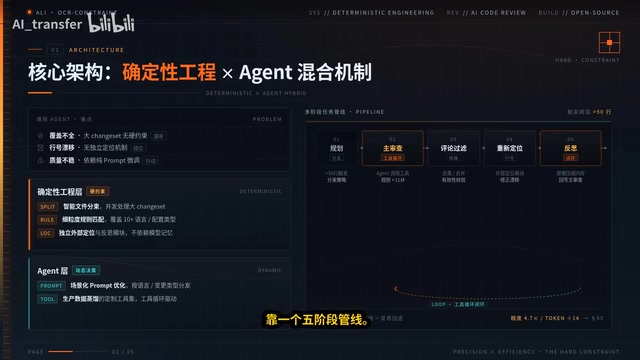
Straight lines represent deterministic flows; arcs represent reflection feedback loops. The essence of this design is using engineering methods to constrain the model's uncertainty within controllable bounds — the model is only responsible for judgment; engineering handles the safety net.
Benchmark Results: OCR Comprehensively Outperforms General Agents
With the architecture explained, let the data speak. The test benchmark comes from 50 open-source repositories, 200 real PRs, covering 10 languages, with 1,505 real defects annotated by over 80 senior engineers. On the same model (Claude 4.6 Opus), OCR was compared head-to-head against a general Agent:
Precision and Quality Comparison
| Metric | OCR | General Agent | Multiplier |
|---|---|---|---|
| Precision | 33.9% | 7.23% | 4.7x |
| F1 Score | 25.1% | 11.57% | 2.17x |
Cost and Efficiency Comparison
| Metric | OCR | General Agent | Multiplier |
|---|---|---|---|
| Average Token Consumption | 385K | 5664K | 14.7x savings |
| End-to-End Latency | 1min 23sec | 13min | 9.5x faster |

With Tokens reduced, API costs and CI queue times drop directly. Compressing latency back to the second-level range makes it truly viable for CI pipelines.
An Honest Trade-off
There's a trade-off worth mentioning: OCR's recall rate is 20%, while the general Agent achieves 28.9% — OCR is somewhat lower. But this is a deliberate design choice.
In CI scenarios, it's better to under-report than to ensure everything reported is a real issue, reducing noise in manual review. Few but accurate beats many but noisy — this is the core philosophy of OCR's precision-first strategy. In information retrieval and machine learning, Precision measures "how many of the reported issues are real problems," while Recall measures "how many of all real problems were reported." The two often have an inverse relationship, and OCR explicitly chose a precision-first strategy, which is the more pragmatic choice in scenarios requiring human confirmation.
Practical Implementation: Complete Path from Local to CI
OCR itself is a command-line tool that developers can run locally with a single command. It offers two modes:
- Review mode: Performs incremental review, only examining code changed in the current PR — suitable for daily development
- Scan mode: Performs full audit without depending on Git history, scanning immediately after checkout — suitable for taking over unfamiliar repositories or reviewing third-party dependencies
CI Integration: Out of the Box
For CI deployment, both GitHub Actions and GitLab CI have ready-to-use examples that can be plugged in directly.
In real environments, CI frequently encounters API rate limiting. OCR has built-in exponential backoff and low-quota throttling mechanisms that automatically wait when rate-limited, preventing pipeline failures. Exponential Backoff is a standard strategy in distributed systems for handling rate limiting and transient failures — when an API returns status codes like 429 (Too Many Requests), the client doesn't retry immediately but waits for an exponentially growing time interval (e.g., 1s, 2s, 4s, 8s...) before retrying, usually with random Jitter added to avoid the "thundering herd" effect from multiple clients retrying simultaneously. In CI scenarios, multiple PRs may trigger reviews simultaneously; without a backoff mechanism, API rate limiting would cause pipeline failures, requiring developers to manually re-run and severely impacting development efficiency.
It also includes a Precision Gate — if precision doesn't meet the threshold, it blocks directly, maintaining the review quality baseline. The Precision Gate borrows from the Quality Gate concept in software engineering — setting quality thresholds at critical pipeline checkpoints, blocking the process if standards aren't met. If AI-generated comments have excessively low precision (i.e., many false positives), it not only wastes developer time but also creates a "boy who cried wolf" effect toward AI review tools, ultimately leading teams to abandon the tool. By setting a precision floor, OCR ensures only high-confidence review results are presented to developers, maintaining the tool's long-term credibility.

Multi-Scenario Integration
Beyond CI, OCR can also serve as an MCP Server or Plugin integrated with tools like Claude Code and Codex — no changes to the LLM backend needed, just direct command-line invocation for plug-and-play use. MCP (Model Context Protocol) is an open protocol proposed by Anthropic aimed at standardizing interactions between large models and external tools/data sources. Through an MCP Server, any tool can expose its capabilities to MCP-supporting AI clients (like Claude Code), enabling plug-and-play integration. When OCR runs as an MCP Server, tools like Claude Code can directly invoke OCR's code review capabilities during conversations without developers switching context or manually executing commands, achieving seamless integration between AI-assisted programming and code review.
Production-Grade Engineering Details
The underlying engineering is also production-ready:
- Full-chain tracing: Integrated with OpenTelemetry, every review is traceable. OpenTelemetry is a graduated project of the CNCF (Cloud Native Computing Foundation), providing unified observability standards covering three pillars: Traces, Metrics, and Logs — the de facto standard for cloud-native observability.
- Precise Token metering: Granular to file level, using local BPE estimation without network dependency. BPE (Byte Pair Encoding) is the tokenization algorithm used by current mainstream large models, including the GPT series and Claude. It builds vocabularies by counting high-frequency byte pairs in corpora and segments text into Token sequences. Local BPE estimation means developers can predict cost consumption for each review without making network requests — particularly important for offline environments and cost budget management.
- Cross-platform distribution: Packaged as a pure static binary — one file handles Linux, macOS, and Windows
These details determine whether it can truly stay in developers' daily workflows rather than just being a demo with impressive benchmarks.
Capability Boundaries: A Restrained Positioning

This solution is also quite restrained, clearly aware of its capability boundaries:
What it can do:
- Model-agnostic, works with any LLM
- CI-friendly, commercially usable under Apache 2.0 license
- Handles multi-language mixed repositories
- Delivers low-noise, precise reviews
What it doesn't do:
- If your requirement is high recall, you'll need to complement it with other tools
- It doesn't replace existing SAST, Lint, and similar tools — it complements them
SAST (Static Application Security Testing) mentioned here is a technology that discovers security vulnerabilities by analyzing source code, such as tools like Semgrep and CodeQL; Lint refers to tools that check code style and common programming errors, such as ESLint and Pylint. These tools run on deterministic rules and excel at finding pattern-based issues but struggle to understand business logic and complex semantic defects. OCR complements them — SAST and Lint handle rule-coverable issues, while OCR handles logic defects requiring semantic understanding.
The positioning is very clear: a precision-first review gate.
Implementation Recommendations: A Three-Step Strategy
For developers, implementation is actually very straightforward:
- Local validation: After global installation, a single command can review a real PR without any repository modifications
- Team rollout: Fork the official GitHub Actions example, which has built-in rate limiting and fallback mechanisms, and plug it into your CI pipeline to set up an AI Review gate
- Manage expectations: Focus it on reviewing newly added logic, don't single-mindedly pursue recall rate — use it with a precision-first mindset
Conclusion
The core value of Alibaba's OCR solution lies in not competing head-on with Prompt engineering for large models, but instead using a deterministic pipeline to impose hard constraints on the LLM. This approach has inspirational significance for the entire AI engineering field — rather than waiting for models to get stronger, use engineering methods to squeeze every bit of capability from existing models.
4.7x precision, better F1, 14x Token savings, 9.5x latency reduction — the methodology behind these numbers deserves serious consideration from every team building AI applications: in your scenario, what uncertainties can be backstopped with deterministic engineering? This hybrid paradigm of "deterministic engineering + probabilistic models" likely applies not just to code review, but to all engineering scenarios involving AI — document generation, data analysis, automated testing, and more. Find the model's capability boundaries, use engineering to fill the gaps, rather than blindly pursuing bigger and stronger models.
Related articles

Felix Rieseberg Personal Homepage
Felix Rieseberg's personal homepage sparks attention on Hacker News. This article covers the Slack engineer's technical background, the rise and fall of nativefier, and the value of a developer homepage as a tech calling card.

@ai-sdk/vue 3.0.306 Patch Release Syncs with [email protected] Update
@ai-sdk/vue 3.0.306 released, synced with [email protected]. A routine patch release for the Vercel AI SDK ecosystem with no public API changes; the Vue adapter layer stays version-aligned with the core package.

Gemini 4 Argon API Launches: The Era of Million-Token Output Begins
Google launches Gemini 4 Argon with sparse MoE architecture, up to 1M output tokens, and a 68.90% Vals Index score, available across API, AI Studio, and the Gemini app.