Alibaba's Qwen Officially Dispels Rumors: Qwen 4.0 and 5.0 Will Remain Open Source

Qwen lead denies closed-source rumors, commits to keeping 4.0 and 5.0 open source, emphasizing AI for all.
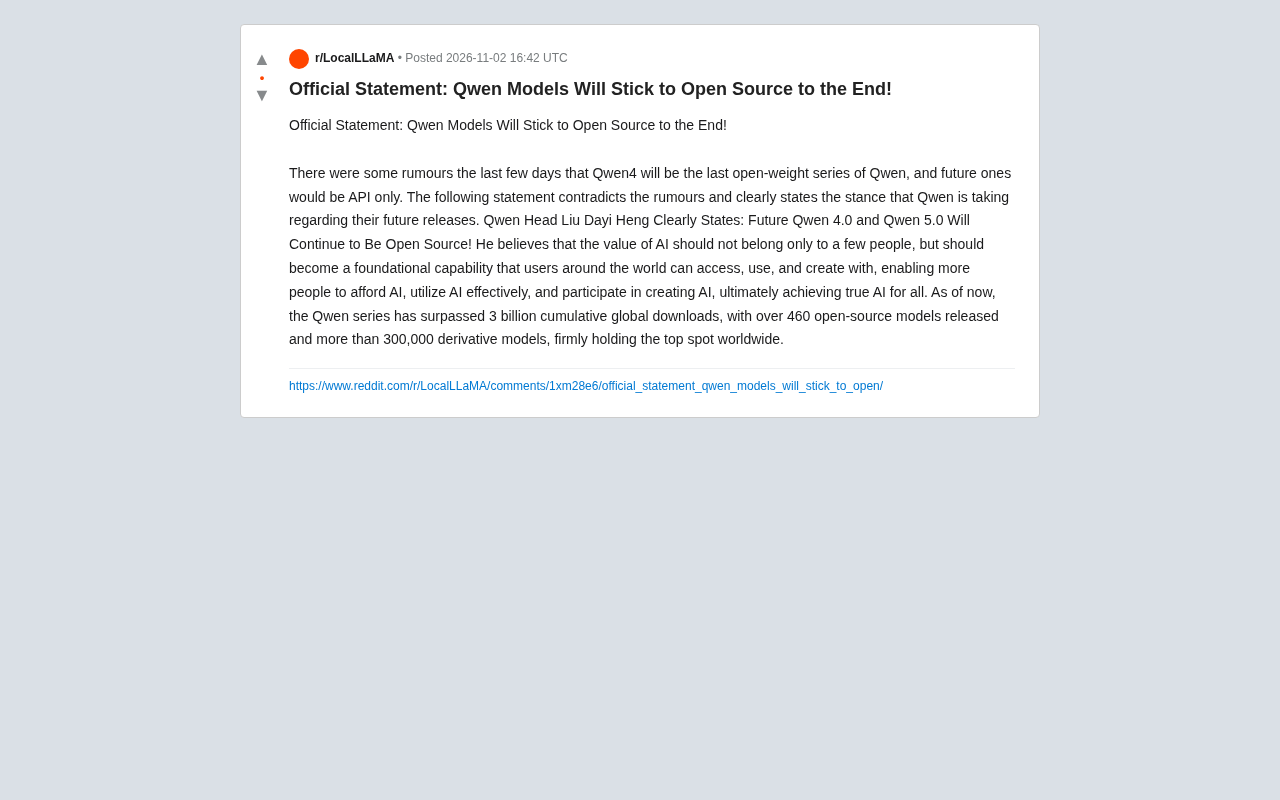
In response to speculation that Qwen4 might be the last open-weight release, Qwen lead Liu Dayi Heng clarified that Qwen 4.0 and Qwen 5.0 will remain open source. The statement emphasizes AI for all—making AI affordable, usable, and open to creation worldwide. Official data shows 3 billion+ cumulative downloads, 460+ open source models, and 300,000+ derivatives, ranking first globally, confirming the ecosystem network effects. The commitment removes uncertainty for developers and impacts the open vs. closed source landscape, though it still needs verification via future releases and licensing terms.
Open Source Commitment Breaks the Rumor
Over the past few days, a troubling speculation has been circulating in the AI open source community: Qwen4 might become the last version of the Qwen series to be released with open weights, with subsequent models offered only through an API. The rumor spread rapidly among developers—after all, Qwen has become one of the most widely used open source large model series in the world, and any hint of "closed sourcing" is enough to stir the nerves of countless developers.
However, this speculation was quickly addressed head-on by the official team. Qwen lead Liu Dayi Heng made it clear: the future Qwen 4.0 and Qwen 5.0 will continue to be open source. This statement directly refutes the rumor and sets the tone for Qwen's open source trajectory.
Open Weights refers to publicly releasing the weight parameters of a trained model in downloadable form, allowing anyone to download, run, fine-tune, or even redistribute it. Strictly speaking, it is not entirely equivalent to "open source": open source typically requires disclosing training code, data, and training procedures, whereas open weights only guarantee that the parameters are visible and usable. The Qwen series adopts the open weights model, which is also the common practice for "open source" among mainstream large models today. This is precisely why the community is especially sensitive to "whether open weights will continue"—once the upstream switches to API-only, developers will no longer be able to deploy locally or retrain, and all previously built fine-tuning and distillation solutions based on the weights will become invalid.
The Value Proposition Behind Open Source
In the statement, Liu Dayi Heng articulated his understanding of AI's value: the value of AI should not belong to only a few, but should become a foundational capability that users worldwide can access, use, and create with. This philosophy translates into three levels—enabling more people to "afford AI," to "use AI well," and to "participate in creating AI," ultimately achieving true AI for all.
This passage is not empty rhetoric. For open source models, "affordable" means no expensive API call cost barrier; "use well" depends on continuous iteration of model capabilities and the refinement of community tools; and "participate in creating" is embodied in developers' ability to fine-tune, distill, and further develop based on open weights. Qwen's positioning here is essentially placing itself as infrastructure rather than following a purely commercial product logic.
Distillation is a model compression and capability transfer technique: a powerful large model serves as the "teacher," and its outputs (such as probability distributions or generated results) are used to train a smaller "student" model, enabling the student model to approximate the teacher's performance despite a substantially reduced parameter count. In the open source ecosystem, distillation is one of the main sources of derivative models—developers often use open-weight models like Qwen as teachers to distill lightweight versions tailored to specific hardware or tasks. This also explains why open weights have a multiplier effect: once weights are public, the community can produce derivative models in bulk at extremely low cost, thereby amplifying the influence of the original model.
Data Evidence: The Scale Effect of the Open Source Ecosystem
A set of figures disclosed in the official statement provides strong evidence for Qwen's open source investment. As of now, the Qwen series has surpassed 3 billion cumulative global downloads, released more than 460 open source models, and generated over 300,000 derivative models, ranking first worldwide.
These numbers reflect the network effects brought by the open source strategy: each model release spawns a large number of community fine-tuned versions, and the prosperity of derivative models in turn expands the influence and use cases of the original model. 3 billion downloads and 300,000 derivative models show that Qwen has formed a developer ecosystem with self-reinforcing capacity. For a commercial company, sticking with open weights means giving up some short-term API monetization benefits in exchange for ecosystem scale and standard-setting influence—this is itself a trade-off rooted in long-termism.
Network Effects refers to the phenomenon where the value of a product or platform increases as the number of users grows. In the open source model ecosystem, network effects manifest as a positive feedback loop: the more downloads a model has, the more derivative models are fine-tuned based on it; the richer the derivative models, the more complete the original model's applicable scenarios and community tools become, which in turn attracts more developers. This effect creates high switching costs—developers' toolchains, tutorials, and best practices accumulate around a particular model series, and switching to another model requires renewed investment. Therefore, download counts and derivative model counts are not only popularity indicators but also reflect the depth of ecosystem lock-in and long-term competitiveness.
What It Means for Developers and the Industry
For teams relying on Qwen for product development, the official commitment removes a key uncertainty. One of the biggest risks of open source models is that the upstream suddenly changes its licensing strategy or stops releasing open weights, causing fine-tuning and deployment solutions based on that model to face disruption. Qwen's clear commitment that 4.0 and 5.0 will remain open source effectively provides developers with a longer expectation horizon for technology selection.
From an industry perspective, a leading model series sticking to open source will also affect the competitive landscape between open and closed source. As open source models' capabilities continue to approach those of closed source solutions, the pricing space and differentiation advantages of closed source vendors will be further compressed. Qwen's stance is, to some extent, endorsing the "open source first" path and providing a reference point for other model teams.
Of course, commitments need action to verify. The actual release cadence, degree of openness, and specific licensing terms of Qwen 4.0 and 5.0 remain the focus of the community's continued attention. But at least at this moment, the rumor has been clarified and the direction reaffirmed.
One-line Summary
Qwen lead denies closed-source rumors, commits to keeping 4.0 and 5.0 open source, emphasizing AI for all.
Paragraph Summary
In response to community speculation that Qwen4 might be the last open-weight release, Qwen lead Liu Dayi Heng clearly stated that Qwen 4.0 and Qwen 5.0 will remain open source. The statement elaborates on the AI for all philosophy—enabling global users to afford, use well, and participate in creating AI. Official figures show the Qwen series has surpassed 3 billion cumulative global downloads, released over 460 open source models, and generated more than 300,000 derivative models, ranking first worldwide, confirming the ecosystem network effects of the open source strategy. The article notes that this commitment removes uncertainty for developers regarding abrupt upstream licensing changes, supports long-term technology selection, and influences the open vs. closed source competitive landscape—though the commitment still needs to be verified through subsequent release cadence and licensing terms.
Related articles

Altman Says Local Deployment Can't Beat Data Centers: The Open-Source AI Debate Reignites
Altman says local deployment of open-source models can't match centralized data-center computing. Bilibili creator Guashu Diluola breaks down the technical roadmap debate and China-US AI industry differences behind the remark, asking whether local deployment should really be abandoned.

MiniMax H3 Open-Source Workflow: Breathing-Skin Results Even on Low VRAM
This article introduces a MiniMax H3 dual-sampling workflow shared by a Bilibili creator, using fused models, a line-breaking LoRA, and low-VRAM nodes to fix greasy AI character faces and run on 12GB VRAM devices. Includes model pairing, dual-sampling logic, and parameter details.

On-Device LLM + ESP32: Build a DIY Calorie Reminder
A Bilibili creator open-sourced a calorie intake reminder: a phone app uses the open-source miniCPM model to locally recognize food photos and estimate calories, while an ESP32 mini screen syncs data and shows intake status with green/yellow/red rings — magnetically attachable to the fridge door for constant reminders.