All Tests Pass, But Code Gets Harder to Maintain? Cursor's Thermonuclear Review Targets Structural Decay
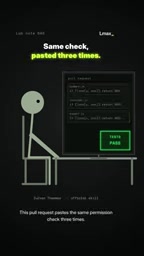
Cursor launches thermonuclear code quality review, targeting structural issues tests cannot detect.
Cursor's "thermonuclear code quality review" targets the blind spot in AI-assisted programming where tests are all green but code maintainability declines. It doesn't rerun tests, but acts as a strict maintainability checklist flagging four structural signals: duplicated logic, thin wrappers, oversized files, and special-case branches. Using permission validation as an example, the review pushes logic to converge into one place rather than being copied three times. It's a prompt rather than a linter, requires manual installation via `/add plugin thermos` and active invocation, and only reviews the branch diff. It sits alongside bug and security review with clear division of labor, aiming to fill the process gap in structural oversight—but depends on teams actively adopting it.
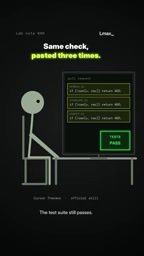
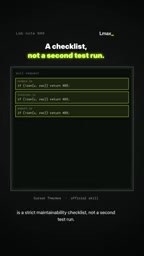
Tests are all green, yet the code becomes increasingly hard to maintain—this is a real dilemma in many AI-assisted programming scenarios. A piece of permission validation gets copy-pasted three times, the test suite still passes entirely, but maintainability has already taken a big hit. Cursor's "thermonuclear code quality review" is aimed precisely at this blind spot: it doesn't run the tests a second time, but rather acts as a strict maintainability checklist, specifically hunting down duplicated logic, thin wrappers, oversized files, and special-case branches.
Passing tests doesn't mean healthy structure
The test suite verifies whether behavior meets expectations, not whether the code structure is reasonable. When the same permission check is pasted three times in a PR, every call site passes tests, but when permission rules need to be modified later, developers must find and update three locations in sync—missing any one plants a hidden risk. These issues won't turn CI red, but they continuously drive up maintenance costs.
According to a demo from a YouTube source, Cursor's review treats "permission checks should exist in only one place" as an explicit requirement, rather than simply running tests again. Its judgment is based on structural signals, not test results.
DRY principle (Don't Repeat Yourself) is a core tenet in software engineering, emphasizing that every piece of knowledge should have a single, unambiguous representation in the system. Violating DRY typically manifests as duplicated logic—not just a matter of code volume, but meaning that modifications require synchronized updates in multiple locations, increasing the risk of omissions. The opposite of DRY is WET (Write Everything Twice), often used to describe the bad smell of duplicated code. In AI-assisted programming, models may generate duplicated code due to contextual convenience, exacerbating the WET problem. Thermonuclear review makes duplicated logic its primary check item precisely to discover and drive abstraction early, rather than remediating only when maintenance costs are already high.
What thermonuclear review checks
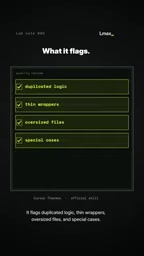
This review is positioned as a strict maintainability checklist, focusing on flagging four categories of structural issues: duplicated logic, thin wrappers, oversized files, and special-case branches.
Duplicated logic is the most typical signal—the same code block appearing in multiple locations means missing abstraction or insufficient reuse. Thin wrappers refer to functions or components that merely forward calls without adding real value; they increase comprehension cost without bringing benefit. Oversized files reflect accumulated responsibilities, and excessive special-case branches often suggest undigested differences in the design.
What these check items share is: none of them affect whether a single test run passes, but they continuously erode the long-term maintainability of the codebase.
Thin wrapper refers to functions or components that merely forward calls without adding any substantive logic. For example, a function that just calls another function and returns the result as-is. Thin wrappers increase call chain length and comprehension cost without bringing abstraction benefits or functional enhancement. In tests, thin wrappers often pass easily because they simply delegate. Thermonuclear review flags them as structural issues, aiming to encourage developers to merge or remove worthless indirection layers, making the code structure more direct.
It wants convergence, not duplication
Taking permission checks as an example, thermonuclear review's goal is to converge this logic into one place, rather than leaving one copy in each of three locations.
Behind this requirement is the implementation of single responsibility and the DRY principle. When permission rules need adjustment, a single-point modification covers all call paths, avoiding the classic accident of "changed A but forgot B." For AI-assisted generated code, this is especially important—models tend to generate usable code directly in context, and copy-paste is the lowest-cost way to satisfy requirements, but structural debt accumulates as a result.
Usage boundaries: it's a prompt, not a linter
It's important to clarify that thermonuclear review itself is a prompt, not an automated linter. It doesn't run on its own; you must actively initiate the request.
Another key limitation is the review scope: it only checks the branch's diff, not the entire repository. This means it can focus on structural issues introduced by the current change, but won't scan historical debt. Installation is via a slash command to add the plugin, specifically /add plugin thermos.
This feature also has a sibling skill at the same level—bug and security review—with clear division of labor: one checks structure, the other checks defects and security. Thermonuclear review focuses on structural health.
Linter is a static code analysis tool used to check for syntax errors, style issues, or potential defects in code, typically integrated into the CI pipeline to run automatically. Unlike thermonuclear review, linters are based on rule engines, covering syntax and style levels, but struggle to understand structural semantics. Thermonuclear review, as a prompt skill, relies on large language models' comprehension capabilities, able to identify higher-level structural issues like duplicated logic and thin wrappers, but requires manual triggering. The two are complementary: linters automatically safeguard basic standards, while thermonuclear review is used for targeted structural review.
Who checks the structure
When all tests are green, who guards the structure? This is the core question this feature poses to developers. Tests cover behavior, linters cover syntax and style, while structural-level maintainability issues have long relied on manual code review—in situations where review resources are limited or AI-generated code volume surges, this step is easily diluted. Making structural review a prompt skill that can be actively invoked is a pragmatic way to fill this gap in the process, provided the team is willing to incorporate it into daily review habits rather than expecting it to take effect automatically.
One-line Summary
Cursor launches thermonuclear code quality review, specifically targeting structural issues tests cannot detect.
Paragraph Summary
Cursor's "thermonuclear code quality review" targets the blind spot in AI-assisted programming where tests are all green but code maintainability declines. It doesn't rerun tests, but acts as a strict maintainability checklist, flagging four categories of structural signals: duplicated logic, thin wrappers, oversized files, and special-case branches. Using permission validation as an example, the review pushes logic to converge into one place rather than being copied three times. The feature is a prompt rather than a linter, requires manual installation via /add plugin thermos and active invocation, and only reviews the branch diff. It sits alongside bug and security review with a clear division of labor, aiming to fill the process gap in structural oversight, but depends on teams actively incorporating it into review habits.
Related articles

Michael Nielsen Takes Down His Classic Neural Network Textbook, Sparking Community Discussion
Michael Nielsen's classic free textbook Neural Networks and Deep Learning has been taken offline, sparking discussion on Hacker News about the reasons and impact.

Inside the AI Training Data Market: The Trade-off Between Exclusivity and Discounts
G2i founder Gabe Greenberg reveals the dual-track pricing of the AI training data market: labs pay a premium for exclusive data or accept discounts that allow others to buy it.

SessionGraph: Unifying All Coding Agent Sessions in One Interactive Graph
SessionGraph aggregates coding agent sessions into an interactive graph, helping developers review, debug, and manage AI coding workflows across sessions. This article examines its positioning, value, and open questions.