AllPros Review: See If an Online Course Is Worth Buying Before You Pay

AllPros helps you verify online course quality through real student reviews before you pay.
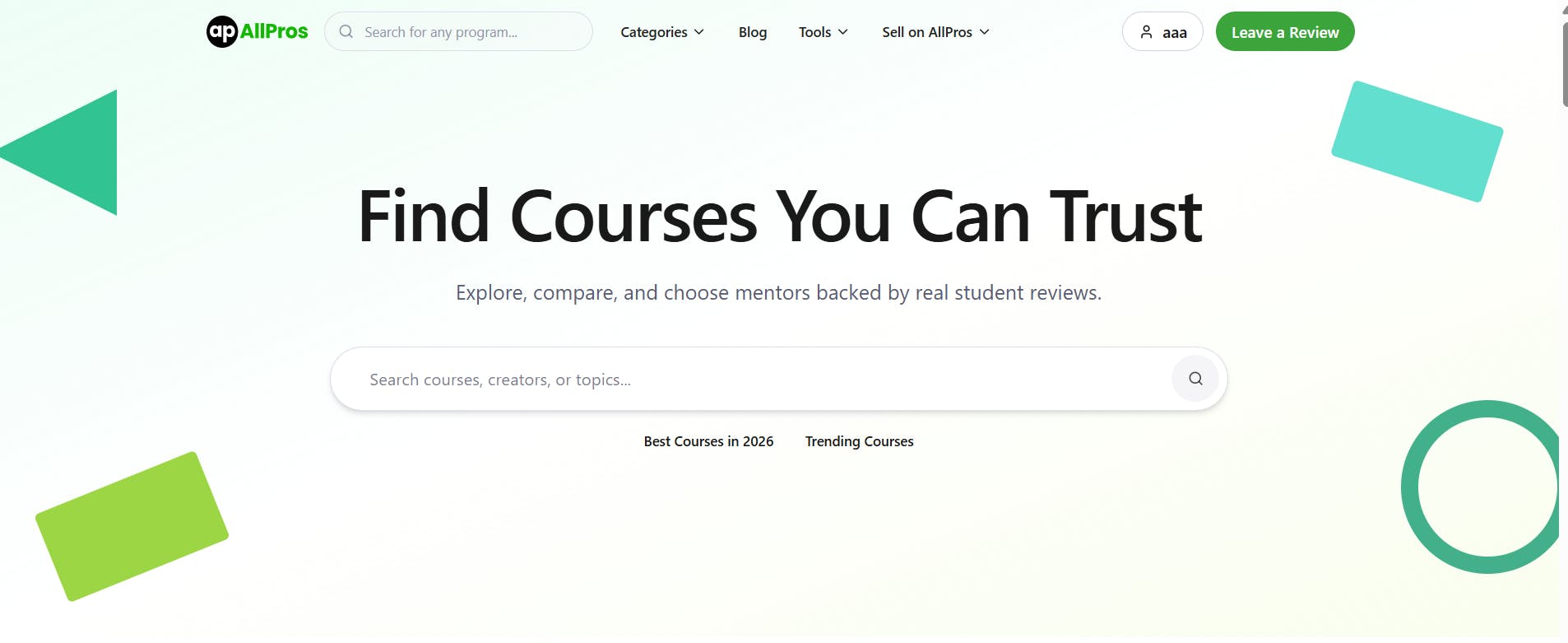
AllPros is a new Product Hunt launch positioning itself as the "Yelp for online courses," letting consumers read real student reviews before spending thousands on courses sold by social media gurus. While the concept addresses a genuine trust crisis in the booming online education market, the platform faces significant challenges including the cold start problem, ensuring review authenticity, and navigating legal risks around public course critiques.
A $5,000 Lesson Learned the Hard Way
You've probably seen these people on social media: luxury cars, polished lifestyles, success on full display everywhere. You're drawn in, yearning to become like them. Then one day, they drop that line: "Want to be like me? I have a course—just $5,000, a small price to pay for your dream life."
So you pay up. A month later, the truth hits you—you've been scammed. No results, and that $5,000 is gone for good.
This is exactly the pain point that AllPros, a new product, aims to solve. Launched on Product Hunt, this platform sums up its mission with one punchy tagline: "Know if an online course is worth it before you pay."
The Trust Crisis in Online Education: Why We Need a Course Review Platform
In recent years, online courses and the "knowledge economy" sector have experienced explosive growth. The global online education market surpassed $350 billion in 2023 and is projected to exceed $1 trillion by 2030. Behind this boom lies the COVID-19 pandemic's acceleration of digital learning adoption, along with social media platforms (especially YouTube, Instagram, and TikTok) spawning a wave of knowledge-based influencers within the "creator economy." From coding and design to investing and entrepreneurship, nearly every field has seen a flood of self-proclaimed "experts." They build personal brands through short-form videos and social media, use glamorous lifestyles as marketing bait, and then sell courses at prices running into thousands of dollars.
Within this ecosystem, the so-called "Guru Economy" is particularly prominent—individuals establish authority by showcasing luxurious lifestyles, then monetize that authority through premium-priced courses. The U.S. Federal Trade Commission (FTC) has issued multiple warnings in recent years about "income claim" marketing, but regulation consistently lags behind market expansion.
The problem is that this market has long lacked a transparent review mechanism. Before paying, prospective students can typically only see the instructor's carefully crafted promotional materials and "student testimonials"—whose authenticity is impossible to verify. By the time they discover the course content is hollow and promises can't be delivered, the money is already spent with no path to a refund.
AllPros targets precisely this trust crisis born from information asymmetry. Its core logic is simple: provide real reviews from real students for every online course or paid instructor, so consumers can access the "truth" before spending their money.
AllPros' Product Positioning: The "Yelp" for Online Courses
From a product positioning standpoint, AllPros is essentially a "review platform" for online education. Just as people check restaurant ratings before dining out or read e-commerce reviews before buying products, AllPros aims to become the go-to reference before purchasing an online course.
This model isn't new, but applying it to the murky waters of "knowledge commerce" hits a need that has long been underserved. After all, losing a few dozen dollars on a bad meal is bearable, but a sunk cost of several thousand dollars on a single course creates intense demand for "pre-purchase verification."
Core Challenges Facing AllPros
Currently, AllPros is still in a very early stage—on Product Hunt it has no votes, only two comments, ranks 11th, was launched by maker amit zandberg, and is categorized in the Education & Online Learning track.
Product Hunt is one of Silicon Valley's most influential platforms for new product launches, founded by Ryan Hoover in 2013 and later acquired by AngelList. Its core mechanism lets tech community members vote and comment on newly launched products each day, forming a leaderboard. For startups, achieving a high ranking on Product Hunt means massive early-user exposure and potential investor attention. Many products that later became successful (such as Notion and Loom) completed their cold starts through Product Hunt. AllPros' choice to debut on this platform represents a typical path for startup teams to acquire seed users.
From a product outlook perspective, AllPros faces several key challenges:
The Cold Start Problem: How to Accumulate the First Batch of Genuine Reviews
The core value of any review platform comes from the quantity and quality of its reviews. When there aren't enough genuine reviews in the early stages, the platform struggles to provide valuable reference for users—and without value, it's hard to attract users to contribute reviews. This is the classic "chicken-and-egg" dilemma that all UGC (User-Generated Content) platforms must face.
This problem has numerous precedents and solutions in the internet industry. Yelp broke through early on by inviting active local food bloggers to write the first batch of restaurant reviews; Airbnb scraped listing information from Craigslist to populate its initial supply. Common strategies include: seed user incentive programs (such as free access to premium features), importing existing course discussions from communities (Reddit, forums), partnering with KOLs to produce initial in-depth reviews, or even having the team purchase courses themselves to write the first professional evaluations. To break through this dilemma, AllPros will likely need to innovate in incentive mechanism design.
Ensuring Review Authenticity: Preventing Fake Positive Reviews and Malicious Negative Reviews
Ironically, the "fake positive reviews" problem that AllPros wants to solve could easily appear on its own platform. Course sellers have every incentive to flood the platform with positive reviews, and competitors could post malicious negative ones. How to verify that reviewers are genuinely "real students" and establish a credible verification mechanism will directly determine the platform's credibility.
Regarding review authenticity assurance, the industry has already developed multiple technical approaches. Amazon's "Verified Purchase" badge confirms that reviewers actually bought the product by linking order records. More advanced solutions include: requiring users to upload course purchase receipts or payment screenshots for manual/AI review; using NLP (Natural Language Processing) algorithms to detect textual patterns of fake reviews; building reputation score systems that give higher weight to users who consistently contribute quality reviews; and introducing blockchain technology to make review records tamper-proof. Platforms like Trustpilot also filter fake reviews through email verification, IP address analysis, and behavioral pattern recognition. AllPros needs to find a combination strategy suited to its own scale and stage among these options.
Legal and Compliance Risks
Publicly reviewing paid courses and instructors can easily trigger reputation disputes from negative reviews. The platform needs to find a balance between "protecting consumers' right to know" and "avoiding malicious defamation," which requires a mature content governance strategy.
On the legal framework level, Section 230 of the U.S. Communications Decency Act provides platforms with "safe harbor" protection for user-published content, meaning platforms typically aren't held liable for user reviews. However, this protection isn't absolute—if the platform participates in content editing or knowingly retains false information, it may lose this protection. Additionally, anti-SLAPP laws (Strategic Lawsuit Against Public Participation) in multiple states protect consumers' right to share genuine experiences, and the Consumer Review Fairness Act passed in 2016 explicitly prohibits businesses from using contract terms to restrict consumers from posting honest reviews. AllPros needs to establish clear content policies that distinguish between "factual statements" and "subjective opinions," and set up a comprehensive appeals process for disputed reviews.
Why an Online Course Review Platform Deserves Attention
Despite the significant challenges, the direction AllPros represents is still worth watching. As AI tools lower the barrier to content production, various "crash courses" and "get-rich-quick secrets" will only multiply, and the cost for consumers to distinguish truth from fraud will rise accordingly.
Since 2023, large language models like ChatGPT and Claude, along with AI image generation tools like Midjourney, have dramatically lowered the barrier to producing course materials. A person lacking genuine expertise can now use AI to generate professional-looking course handouts, slides, and even video scripts in just days. Platforms like Udemy have already reported a flood of low-quality AI-generated courses. This means that "looking professional" is no longer a reliable signal of course quality, making it even harder for consumers to judge a course's true value based solely on marketing materials—further strengthening the case for third-party review platforms.
A trustworthy third-party review platform, if successfully established, would exert positive constraints on the entire online education ecosystem—giving quality courses the reputation they deserve and leaving exploitative, low-quality courses with nowhere to hide. This not only protects consumers but also helps purify the industry environment in the long run.
For everyday users, the takeaway from AllPros may be even more practical: Before paying for any expensive online course, always cross-reference multiple sources and be wary of over-marketed "lifestyle flexing"—that's your first line of defense against getting burned.
Summary
AllPros is an early-stage product targeting the trust pain point in online education. Its concept of "see real reviews before you pay" strikes directly at a chronic industry problem. Whether it succeeds will hinge on how it overcomes the cold start challenge, ensures review authenticity, and navigates compliance risks. Regardless of its ultimate success or failure, the trend toward "transparency in knowledge commerce" that it points to deserves the attention of every online learner.
Related articles

What Is Vibe Coding? The Ideals and Realities of AI Programming
A deep dive into Vibe Coding: its meaning, how it works, and real-world experience. From Andrej Karpathy's concept to developer community feedback on AI programming tools' benefits and risks.

nanoGPT Speedrun Techniques: How Delayed Untying Solves the Sparse Gradient Problem in Embedding Layers
Deep dive into the Delayed Untying technique in nanoGPT speedruns: why tying embed and lm_head weights early then untying later solves both sparse gradients and limited expressiveness.
Real-World Coding Test Across Four AI Models: DeepSeek V4 Flash Unexpectedly Takes the Crown
Real-world coding test comparing DeepSeek V4 Flash, V4 Pro, Grok 4.6, and more. The lightweight Flash model unexpectedly beats flagships in speed and first-pass success rate.