Almanac: Building an Enterprise AI Knowledge Assistant That Truly Understands Your Company

Almanac builds an AI assistant that understands your company's internal knowledge, history, and context.
YC S26 startup Almanac addresses a fundamental gap in enterprise AI: general-purpose LLMs lack internal company context. Using RAG architecture, it unifies fragmented knowledge across tools like Slack, Notion, and Jira to deliver contextual Q&A and decision support. The article analyzes its positioning against competitors like Glean and Microsoft Copilot, and examines key challenges including data quality, AI hallucination, trust building, and security compliance.
The Core Pain Point of Enterprise AI: Lack of Internal Context
General-purpose large language models are remarkably capable, but they often struggle when deployed inside enterprises. The reason is straightforward: while models like ChatGPT and Claude have mastered vast amounts of public knowledge, they know nothing about the internal workings of any specific company. They don't understand your product naming conventions, organizational structure, historical decisions, or internal terminology — let alone the real reasons behind last week's architecture change.
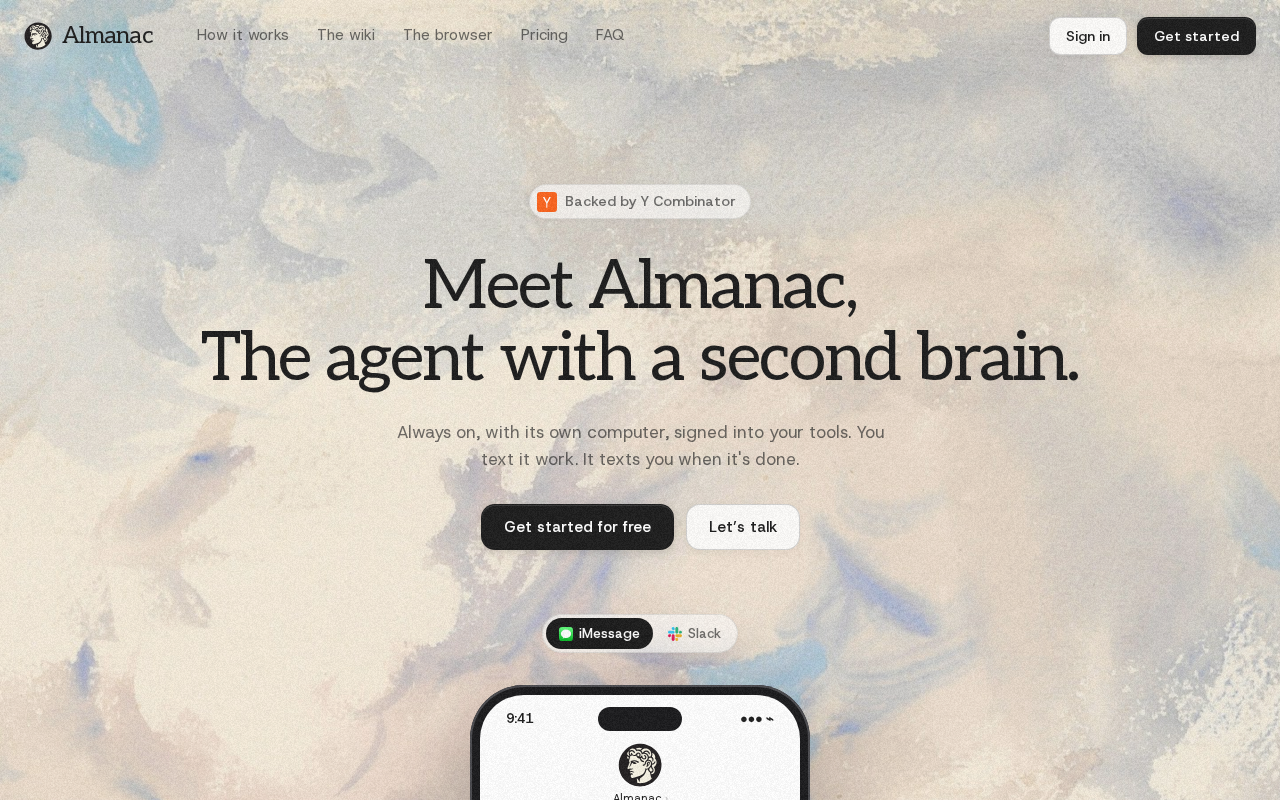
Recently, a startup called Almanac launched on Hacker News's "Launch HN" section. As a member of YC's S26 batch, it's targeting exactly this pain point: building an AI knowledge assistant that truly "knows your company." While the discussion is still in its early stages (40 points, 37 comments), the problem it addresses is significant enough to warrant a deep dive.
Y Combinator (YC) is one of the world's most influential startup accelerators. Founded in 2005, its portfolio has produced well-known tech companies including Airbnb, Dropbox, and Stripe, with a combined portfolio valuation exceeding $600 billion. Each batch admits roughly 200–300 companies, with an acceptance rate of just 1–2%. "Launch HN" is the traditional channel for YC founders to debut their products on Hacker News — used both to gather early user feedback and to build awareness within the tech community. As an S26 batch member, Almanac's YC backing means it passed a rigorous screening process, though long-term success remains far from certain.
Almanac's Product Positioning and Technical Approach
From a product standpoint, Almanac aims to build an AI system that continuously absorbs, organizes, and retrieves enterprise internal knowledge. This means breaking down information silos scattered across various platforms — documents, chat logs, code repositories, ticketing systems, meeting notes, and more — then delivering intelligent Q&A, decision support, and knowledge retrieval on top of that unified foundation.
Information silos are a long-standing structural problem in enterprise digitization. With the explosive growth of SaaS tools, a mid-sized tech company might simultaneously use dozens or even hundreds of applications — Slack, Notion, Jira, GitHub, Google Workspace, Figma, Salesforce, and more. According to Okta's 2023 report, large enterprises use an average of over 180 SaaS applications. These tools operate independently, with different data formats, permission systems, and incompatible search mechanisms. As a result, critical information for a single project can be scattered across a dozen platforms. Employees spend enormous amounts of time switching between tools to search for information, and organizational knowledge becomes severely fragmented.
From General Assistant to Company Brain
If ChatGPT is a knowledgeable but completely uninformed outside consultant, Almanac wants to be the seasoned employee who's been at the company for years and knows the backstory of every project. The key to this transformation lies in context:
- Organizational knowledge consolidation: Unifying information scattered across Slack, Notion, Google Docs, Jira, and other tools into a single index, eliminating information silos
- Historical context understanding: Not just answering "what" but explaining "why" — such as the historical decision-making logic behind a particular technology choice
- Personalized responses: Returning answers at different levels of granularity and scope based on the questioner's role and permissions
Products like this typically rely on a RAG (Retrieval-Augmented Generation) architecture: first retrieving relevant snippets from the enterprise knowledge base, then feeding them to a large language model to generate answers, thereby bridging the gap in the general model's knowledge of internal company information.
RAG (Retrieval-Augmented Generation) is an architectural paradigm first proposed by Meta AI's research team in 2020. Its core idea is to decouple information retrieval from text generation. When a user poses a question, the system first performs vector retrieval — using an embedding model to convert text into high-dimensional vectors, then applying methods like cosine similarity for semantic matching — to find the most relevant document fragments from an external knowledge base. These fragments are then injected as context into the large language model's prompt, which generates answers based on this real source material. Compared to relying purely on knowledge stored in model parameters, RAG offers several advantages: it can reference real-time updated external data sources to avoid outdated knowledge, answers can be traced back to original documents, and it eliminates the need for expensive fine-tuning of the base model. However, RAG faces its own technical challenges, including the fact that retrieval quality directly determines generation quality, chunking strategies for long documents have an enormous impact on results, and multi-hop reasoning (complex questions requiring synthesis of multiple documents) remains a widely acknowledged difficulty in the field.
Competitive Landscape: Differentiating in the Enterprise Knowledge AI Space
The enterprise knowledge AI space has become quite crowded in recent years. Glean, Notion AI, Microsoft Copilot, Dust, and others are all competing for this market. For an early-stage company just entering YC, finding a differentiated position amid these giants is the core question it must answer.
The competitive landscape in this space has formed multiple tiers. At the top are tech giants with platform advantages: Microsoft's Copilot is deeply integrated into the Microsoft 365 ecosystem, naturally covering enterprise email, documents, meetings, and other scenarios, with powerful distribution advantages through Azure's enterprise customer base. Google's Gemini for Workspace similarly takes an ecosystem-embedded approach. The second tier consists of independent companies that have raised significant funding: Glean is valued at over $4.6 billion, focusing on enterprise search and knowledge assistants with integrations for over 100 enterprise applications; Dust, founded by former Stripe engineers, emphasizes customizable AI assistant workflows for technical teams. Notion AI, Coda AI, and similar products enter from the collaborative document angle, attempting to layer AI capabilities on top of existing user stickiness. For an early-stage startup like Almanac, competing head-on with giants is virtually impossible. A more realistic path is to build deep enough moats in specific vertical industries, specific use cases, or specific technical dimensions, and then expand gradually.
Four Potential Differentiation Strategies
Looking at common approaches among startups in this space, Almanac's breakthrough opportunities likely center on these dimensions:
- Depth and breadth of data integration: Can it cover more — even niche — enterprise tools to achieve truly comprehensive knowledge integration?
- Accuracy and traceability: Enterprise scenarios have extremely low tolerance for AI hallucinations. Whether each answer comes with verifiable source citations is critical.
- Permissions and security controls: Enterprise internal knowledge involves sensitive information. Fine-grained access control isn't a nice-to-have — it's a baseline requirement.
- Continuous learning capability: Company knowledge evolves dynamically. Can the AI keep up with organizational changes in real time without information lag?
Three Real-World Challenges in Enterprise AI Deployment
The vision is compelling, but "making AI understand your company" faces tangible difficulties at both the engineering and product levels.
Data Quality Determines the Ceiling
Enterprise internal knowledge is often fragmented, outdated, or even contradictory. Garbage in, garbage out — if the knowledge base itself is chaotic, AI-generated answers will be unreliable too. How to clean, deduplicate, and annotate data for timeliness is foundational engineering work that these products can't avoid, and it's the unglamorous grind that most tests a team's execution capability.
Building Trust Requires Continuous Validation
Enterprise users won't trust AI answers overnight. A single seriously wrong answer can cause an entire team to abandon the tool. This explains why traceability is so critical — users need to be able to click through to the original source documents behind an answer to verify it, rather than blindly accepting AI output.
The AI hallucination problem is especially dangerous in enterprise settings. Large language models are fundamentally probabilistic text generation systems that predict the most likely next token based on statistical patterns, rather than extracting facts from a verifiable knowledge base. In consumer scenarios, minor hallucinations may be tolerable, but in enterprise environments the consequences can be severe: incorrectly citing a nonexistent company policy could create compliance risks, fabricating a technical parameter could affect product decisions, and inventing meeting notes could trigger team conflicts. A McKinsey 2024 survey showed that AI accuracy and trust issues are the primary barriers to large-scale enterprise adoption of generative AI. Therefore, enterprise-grade AI products must build anti-hallucination mechanisms into their architecture, including mandatory source citations, confidence thresholds, and explicitly refusing to answer questions when certainty is insufficient — rather than forcing out an answer that merely "looks right."
Security and Compliance Are Non-Negotiable
Having an AI system uniformly index all company knowledge inherently raises data security and privacy concerns. For large enterprise clients, capabilities like on-premises deployment, data residency, and comprehensive audit logs are often hard requirements in procurement decisions — not optional features. Particularly in regulated industries such as finance, healthcare, and government, data sovereignty and compliance certifications (such as SOC 2, GDPR, HIPAA) are not just technical issues but prerequisites for market access. Enterprise IT decision-makers need assurance that the AI system won't become a new data breach risk vector, which places security engineering demands on early-stage startups that far exceed those of typical products.
Conclusion: The Enterprise Context Race Has Just Begun
Regardless of whether Almanac ultimately prevails in the competition, "AI that understands your company" is an almost certain direction in the evolution of enterprise intelligence. As foundational LLM capabilities become increasingly commoditized, the competitive focus is shifting from "how powerful the model is" to "how deeply the model understands specific business contexts."
For early-stage startups like Almanac, YC's endorsement is a solid starting point, but the real test lies in whether they can build moats across three critical gates: data integration, answer accuracy, and enterprise trust. This race centered on enterprise context has only just begun.
Related articles

Workbuddy for Absolute Beginners: How a Desktop AI Agent Fits Into Real Workflows
A beginner's guide to the Workbuddy desktop AI agent: installation, claiming credits, file management, and building automated workflows—compared with CodeX for fit and cost, helping professionals shift from AI question-askers to AI managers.

OpenAI's New Agent Stack: Computer Use, Decisions API, and Ultra-Fast Workflows
OpenAI Dev Day unveiled a new agent stack: Computer Use outperforms humans, Decisions API delivers ultra-low-latency classification via Luna, Agents API opens the same Computer Use capabilities, and GPT-6.1 Sol costs only one-seventh of Astra. Core updates, benchmark data, and developer insights.

Liang Wenfeng Open-Sources DeepInfo Inference Framework, Takes On U.S. Ban
DeepSeek open-sources its DeepInfo inference framework after its models, featuring GPU/CPU cross-pipelining, small-model prediction with large-model verification, and full Huawei Ascend and NVIDIA chip support—facing the U.S. federal ban head-on. This article analyzes its significance for AI deployment and open-source strategy.