Almanzor: Cited AI Q&A and an MCP Server for Your Docs

Almanzor offers cited, no-fabrication document Q&A plus a hosted MCP server for coding agents.
Almanzor is a document-based AI Q&A product: paste a doc URL to generate a dedicated assistant that cites sources and says "I don't know" when information is insufficient, effectively mitigating hallucination. It also offers a hosted MCP server so coding agents can search documentation directly, extending docs from human reading to AI consumption. Three usage paths—script embedding, shareable links, and MCP—target high-accuracy scenarios like API docs and manuals. It received 71 votes and ranked 12th on Product Hunt in SaaS, Developer Tools, and AI. Its arrival reflects documentation becoming AI infrastructure, though real-world results still depend on doc quality and retrieval accuracy.
Almanzor: Cited AI Q&A and an MCP Server for Your Docs
With AI assistants everywhere today, how do you get users to trust the answers they give? Almanzor, a new product on Product Hunt, offers its own approach: generate answers grounded in your documentation, with every response backed by source citations, and admit "I don't know" when it doesn't. It also provides a hosted MCP server that lets coding agents retrieve your documentation directly.
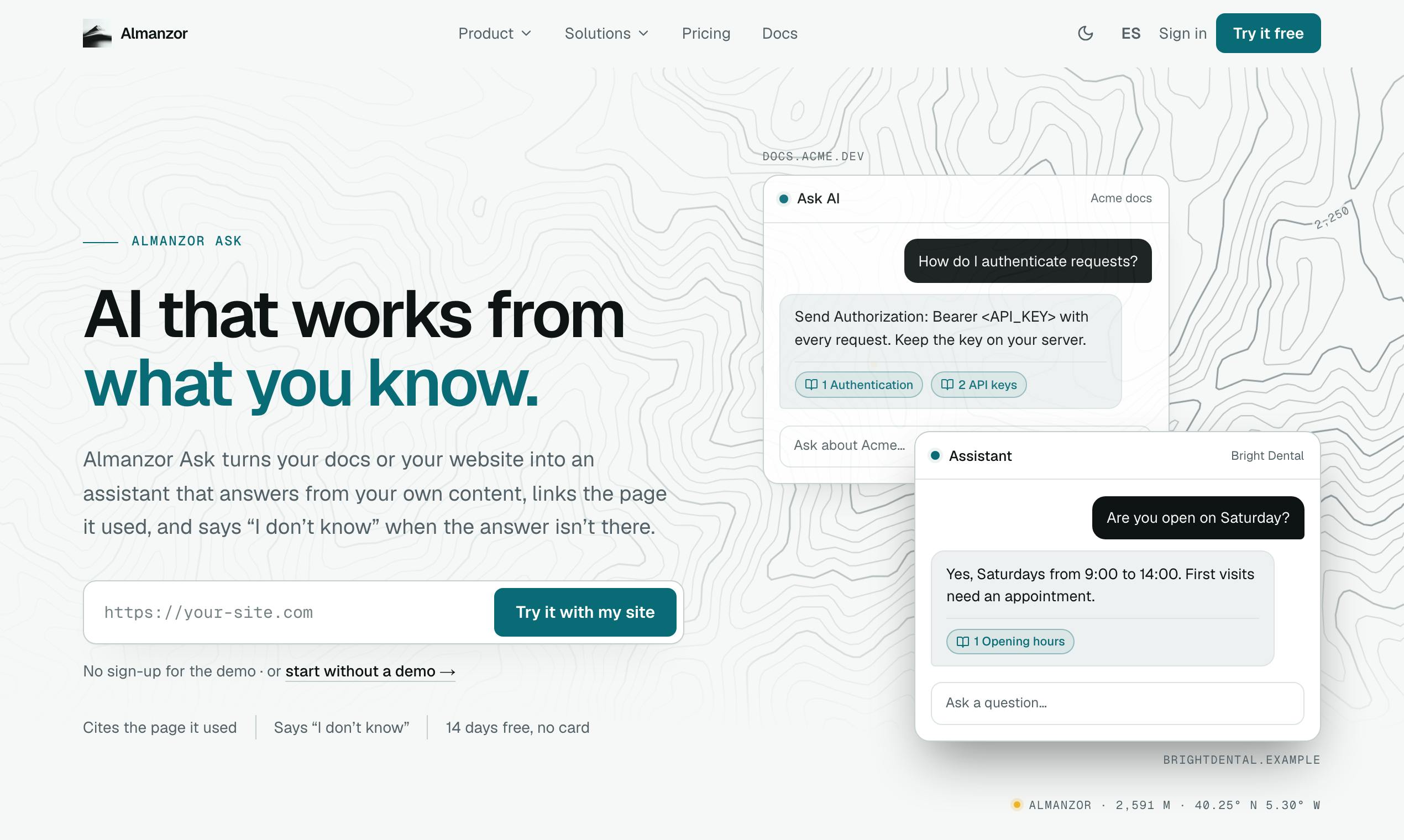
From Doc URL to Dedicated Assistant: Trustworthy Q&A in Three Steps
Almanzor is remarkably straightforward to use: paste your documentation URL and you get an assistant that finds answers within those pages. It doesn't make things up—it cites where each answer comes from and clearly states when it can't answer due to insufficient information. This "citations plus knowing what it knows" design directly tackles the hallucination problem that plagues current AI Q&A systems.
Deployment is equally lightweight: you can add it to your existing site with a single script tag, or simply share a link. For teams that already have a documentation site, it requires almost no additional engineering effort.
Retrieval-Augmented Generation (RAG) is the core technique for having AI answer questions based on external documents. The typical pipeline involves: splitting documents into chunks and converting them into vectors stored in a database; when a user asks a question, the system retrieves the most relevant chunks; those chunks are then passed as context to an LLM to generate an answer. Almanzor's "citations" feature is a classic RAG application—by labeling answer sources, users can verify information accuracy. The "I don't know" declaration relies on retrieval confidence thresholds or self-evaluation during generation: when sufficiently relevant content can't be retrieved, the system declines to answer rather than fabricating one.
MCP Server: Let Coding Agents Understand Your Docs
Beyond the end-user Q&A interface, Almanzor also offers a hosted MCP server. MCP (Model Context Protocol) is increasingly becoming the standard interface for AI agents to interact with external tools and data sources. Through this MCP server, coding agents can search your documentation content, referencing accurate official specifications when writing code or generating configurations.
This feature extends the value of documentation from "for humans to read" to "for AI to consume." Developers no longer need to manually copy-paste doc snippets to AI—agents can retrieve and cite on their own.
MCP (Model Context Protocol) is an open protocol introduced by Anthropic in late 2024, designed to standardize how AI models connect to external data sources and tools. It uses a client-server architecture: AI applications (such as coding agents) act as clients, discovering and invoking resources (such as documents, databases, APIs) through interfaces exposed by MCP servers. The core value of MCP lies in decoupling—developers don't need to adapt data sources separately for each AI tool; implementing an MCP server once makes it usable by all MCP-compatible agents. The protocol has been adopted by multiple AI coding tools and IDEs and is gradually becoming the "USB port" of the agent ecosystem.
Productizing Trustworthy AI Q&A
Almanzor's positioning is clear: it's not just another general-purpose chatbot, but one focused on the vertical of "documentation Q&A." The citation mechanism and "I don't know" declarations are fundamentally about building user trust in AI output. For content where accuracy is critical—API docs, product manuals, developer guides—this design is especially necessary.
From a product perspective, Almanzor covers three usage paths simultaneously: script tag embedding for websites, shareable standalone links, and an MCP interface for developers. This multi-channel distribution strategy lets the same documentation asset serve different scenarios.
According to its Product Hunt page, Almanzor received 71 votes, ranking 12th among products that day, in the SaaS, Developer Tools, and Artificial Intelligence categories.
AI hallucination refers to models generating plausible-sounding but factually incorrect content, which is especially dangerous in documentation Q&A scenarios. Common mitigation techniques include: forcing the model to answer only based on provided context, requiring citation of source passages, setting low temperature parameters to reduce randomness, and introducing "cannot answer" fallback logic. By making citations and refusals core selling points, Almanzor essentially translates academic trustworthy-AI research into a tangible user experience—citations make answers traceable, while refusals clarify capability boundaries. Together they build user trust in the system.
Docs as AI Infrastructure
Almanzor's emergence reflects a trend: documentation is no longer just a static knowledge base but is becoming infrastructure for AI applications. Through protocols like MCP, documentation can be retrieved and cited on demand by AI agents, enabling reuse at a larger scale. For teams with high-quality documentation, this means a single content investment can pay off across customer service, developer support, AI-assisted coding, and more.
Of course, the actual effectiveness of such products ultimately depends on the structure and quality of the documentation itself, as well as retrieval accuracy. Whether Almanzor can establish a foothold among the many documentation Q&A tools remains to be seen in real-world performance.
Related articles

Michael Nielsen Takes Down His Classic Neural Network Textbook, Sparking Community Discussion
Michael Nielsen's classic free textbook Neural Networks and Deep Learning has been taken offline, sparking discussion on Hacker News about the reasons and impact.

Inside the AI Training Data Market: The Trade-off Between Exclusivity and Discounts
G2i founder Gabe Greenberg reveals the dual-track pricing of the AI training data market: labs pay a premium for exclusive data or accept discounts that allow others to buy it.

SessionGraph: Unifying All Coding Agent Sessions in One Interactive Graph
SessionGraph aggregates coding agent sessions into an interactive graph, helping developers review, debug, and manage AI coding workflows across sessions. This article examines its positioning, value, and open questions.