Aloud: A macOS Tool That Turns Voice Feedback into AI Coding Tasks with One Click

Aloud turns developers' spoken feedback into structured, executable AI coding agent tasks on macOS.
Aloud is a new macOS tool that captures voice, screen, and real-time transcription simultaneously, then uses AI to rewrite rambling feedback into precise coding tasks for Claude Code, Cursor, or Codex. Its key differentiator is proactive disambiguation—asking clarifying questions when intent is unclear. With Whisper running locally for privacy, it addresses a growing gap in AI programming: as code generation becomes commoditized, the bottleneck shifts to how developers express requirements.
When "Saying It" Is More Natural Than "Writing It Down"
In the software development workflow, feedback is a frequent yet inefficient step. You're staring at a button, a layout, or an interaction on screen, knowing exactly what's wrong—but converting that intuition into structured written tasks takes real effort: screenshots, annotations, line-by-line descriptions, and endless rewording.
This problem has been extensively discussed in the field of Requirements Engineering. Research shows that over 50% of software project failures are requirements-related—including unclear requirements, missing requirements, and misunderstood requirements. In requirements engineering, "Requirements Elicitation" is considered one of the most difficult phases because stakeholders often cannot accurately express what they need—they may know what they don't want but struggle to describe what they do want. This phenomenon is known as the "Tacit Knowledge" problem. In the context of AI coding agents, the "requirement" takes the form of a prompt—the instruction text you feed to the AI. A high-quality prompt needs to include clear objectives, specific constraints, relevant context, and expected output format. Research shows that prompt structure directly impacts LLM output quality—a prompt containing context, constraints, and examples can achieve over 60% higher task completion rates than vague instructions. The gap between fuzzy intuition and structured description is precisely the root cause of low developer feedback efficiency.
The newly launched macOS tool Aloud on Product Hunt targets exactly this pain point. Its core proposition can be summed up in one sentence: Turn spoken feedback into tasks your coding agent can run. After launch, it received 89 upvotes, ranking #11 on the daily leaderboard across the Mac, Developer Tools, and Artificial Intelligence categories.
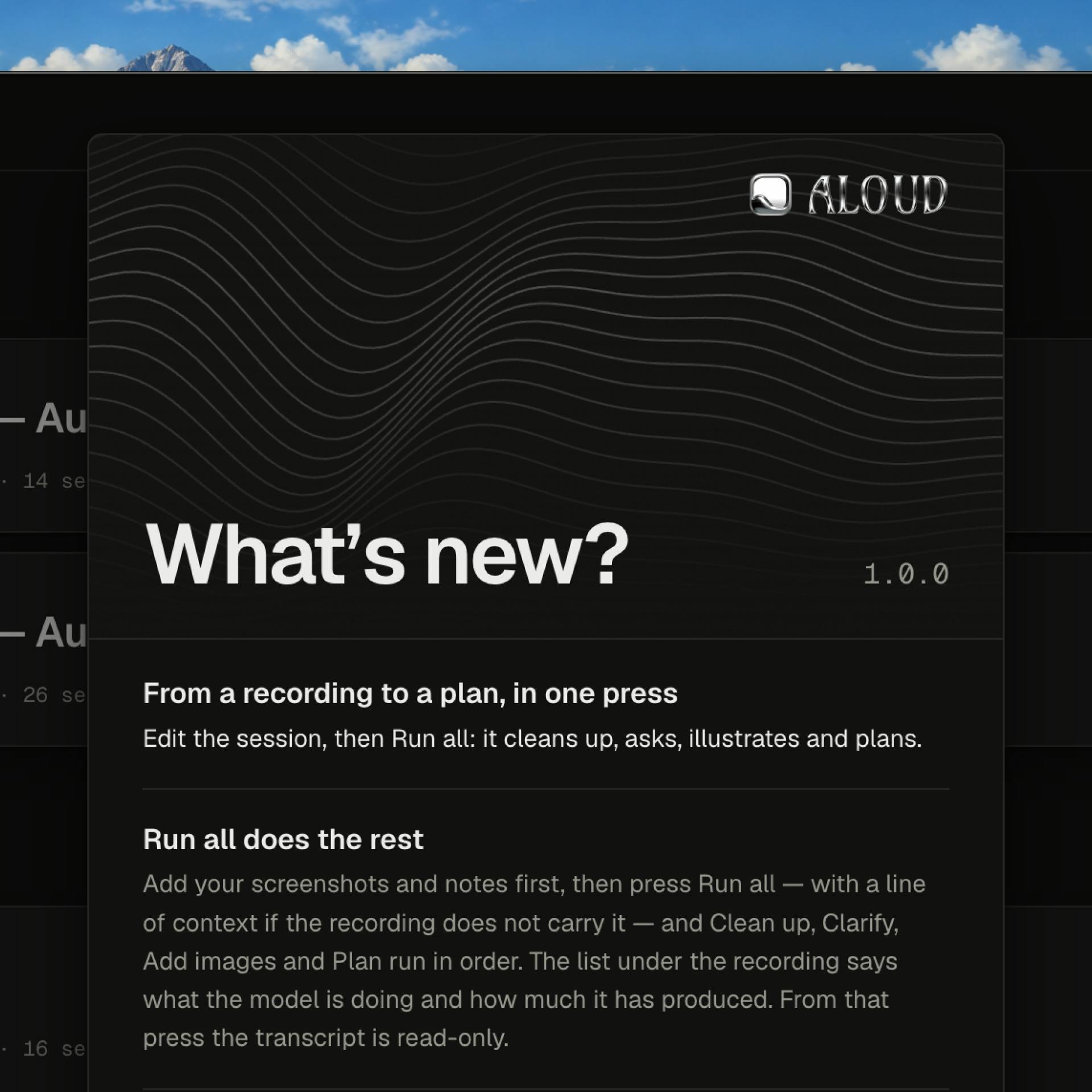
Aloud's Workflow: From Voice to Executable Tasks
Aloud's workflow is designed with remarkable restraint—nearly all complex processing is compressed into "one recording + one keypress."
Record as You Speak: Voice, Screen, and Transcription Combined
When you open your app and start "venting," Aloud simultaneously captures three things:
- Your voice (audio input)
- Your screen (real-time display)
- A live transcript
This means you can work like you're demoing to a colleague—pointing at interface elements while casually saying "this button is too far right" or "oh wait, it's actually a spacing issue." The product copy specifically highlights pointing at things, changing your mind as real-world scenarios—because verbal expression is naturally full of hesitation and corrections, and Aloud embraces this "imperfection."
This "voice + screen + transcript" combined recording approach is essentially a form of multimodal input fusion. In recent years, multimodal large models (such as GPT-4V and Claude 3.5's vision capabilities) have made it possible to simultaneously understand textual descriptions and visual content. When a user says "this button is too far right," the system needs to align the referential pronoun "this" in speech with a specific UI element in the screenshot—this involves jointly solving two AI subproblems: Coreference Resolution and Visual Grounding. It's the maturity of these underlying capabilities that makes products like Aloud technically viable.
Voice as an input method for developer tools has long remained on the periphery. The traditional view holds that programming is a highly precise text operation, fundamentally at odds with the ambiguity of speech. However, as the AI programming paradigm shifts—with developers increasingly describing intent through natural language rather than writing code line by line—the value of voice input is being reassessed. Voice programming exploration dates back to early 2000s integrations of Dragon NaturallySpeaking with programming environments, but limited recognition accuracy and programming's specialized vocabulary kept results unsatisfactory. Around 2020, the Talon project achieved breakthroughs in accessibility programming through custom grammars and command sets, while Serenade attempted more natural voice-to-code mapping. GitHub Copilot Voice's 2022 experiment further validated voice as a viable programming input modality. These pioneers demonstrated that voice is highly efficient for expressing high-level intent but still inferior to keyboards for precise syntax operations—making it best positioned at the requirements layer rather than the implementation layer. Aloud's unique approach is that it doesn't try to generate code directly from voice; instead, it positions voice as a medium for "feedback" and "requirements expression"—a positioning that better matches voice input's strength in expressing intent while acknowledging its weakness in precise control.
One-Click Generation: From Rambling to Precise Coding Tasks
The real value happens after you press that button. Aloud does four things:
- Rewrites the transcript, organizing your scattered speech into "what you actually meant to say"
- Proactively asks about ambiguities, initiating clarification for any statement that could be interpreted two ways
- Captures screenshots of what you pointed at, automatically associating the visuals from that moment
- Generates executable tasks, directly interfacing with Claude Code, Cursor, or Codex
The most interesting part of this pipeline is step 2—proactive disambiguation. Most speech-to-text tools only "faithfully record," while Aloud attempts to "understand intent" and even asks you questions when intent is unclear. This makes it more like an assistant that understands requirements rather than a tape recorder. From a technical implementation perspective, this step likely leverages large language models' semantic understanding capabilities—the model doesn't just parse literal meaning but combines visual context from screenshots to determine which specific UI element the user is referring to and their desired modification direction, proactively initiating confirmation when multiple reasonable interpretations exist. This "proactive disambiguation" design philosophy is known in dialogue systems research as "Clarification Dialogue Strategy," which significantly outperforms passively waiting for users to provide additional information, since users typically don't know what ambiguities exist in their own expressions.
Direct Integration with Major Coding Agents: Claude Code, Cursor, and Codex
Aloud positions itself not as another note-taking or voice memo tool, but as the "input end" of the coding agent workflow. It explicitly lists three integration targets:
- Claude Code (Anthropic's command-line coding tool that allows developers to write, refactor, and debug code directly in the terminal through natural language instructions, capable of understanding entire codebases and executing complex cross-file modifications)
- Cursor (An AI code editor built on VS Code architecture, integrating multiple large language models with support for code completion, conversational programming, and multi-file editing; it has rapidly become a popular developer community tool since 2024, with a valuation exceeding several billion dollars)
- Codex (OpenAI's programming model family, evolved from an initial code completion model into an agent system capable of understanding complex requirements and autonomously executing programming tasks)
These three represent three paradigms of AI programming: command-line agent, IDE-integrated agent, and API-driven agent. This choice is telling—their shared weakness is: input quality determines output quality. Give an agent a vague "make this look better" and you'll rarely get ideal results; but provide it with a task list that includes screenshots, disambiguation, and structure, and the agent's execution success rate improves dramatically.
The current AI programming ecosystem can be divided into three layers: the input layer (requirements expression), the reasoning layer (code generation/modification), and the verification layer (testing/deployment). The reasoning layer already has numerous players (Copilot, Cursor, Claude Code, Devin, etc.), the verification layer is developing rapidly (automated test generation, CI/CD integration, etc.), while the input layer remains relatively vacant. Beyond Aloud, explorers in this space include Loom (a video feedback tool acquired by Atlassian for $975 million), Linear's natural language project management, and various tools that convert design mockups into development tasks. The core value of the input layer lies in reducing the conversion cost from "intent to instruction"—this is precisely the link in the entire chain with the highest human involvement and the most susceptible to information loss.
Aloud is essentially doing the "dirty work" of requirements engineering—translating humans' vague verbal intent into task descriptions that machines can precisely execute. This is an underestimated link in the current AI programming chain. Traditional requirements elicitation methods include interviews, questionnaires, prototype demonstrations, and use case analysis, but these methods often feel too cumbersome for modern agile development and rapid iteration workflows. Aloud's voice + screen recording approach effectively simulates the most natural requirements expression scenario—"pointing at things while talking"—then lets AI handle the translation from natural language to structured tasks.
Local Privacy Protection: Audio and Video Never Leave Your Mac
In an era where AI tools overwhelmingly rely on cloud processing, Aloud plays a differentiation card: Whisper runs on-device – your audio and video never leave the Mac.
Whisper is an automatic speech recognition (ASR) model open-sourced by OpenAI in 2022, trained on a Transformer architecture using 680,000 hours of multilingual and multitask supervised data, supporting recognition and translation in nearly 100 languages, with near-human accuracy across multiple benchmarks. Whisper offers multiple model sizes from tiny to large, with parameter counts ranging from 39 million to 1.55 billion, allowing developers to choose the appropriate version based on device compute power and accuracy requirements. Running Whisper locally means all speech processing is completed on the user's device CPU or GPU without sending audio data to remote servers.
On Apple Silicon chips (M1/M2/M3/M4 series), Whisper's inference speed is already sufficient to support real-time transcription scenarios. Apple Silicon's Neural Engine is specifically designed for machine learning inference tasks—the M1 chip provides a 16-core Neural Engine capable of 11 TOPS, scaling up to 38 TOPS on M4. Community projects like whisper.cpp, through C/C++ rewrites and SIMD optimizations targeting ARM architecture, further reduce Whisper's resource consumption on Apple Silicon, enabling even medium-sized models to run fluently above real-time speed on consumer hardware. This allows macOS-native applications like Aloud to achieve fully local speech recognition without sacrificing performance.
This matters especially for the developer community. During development, screens may display unreleased products, sensitive internal data, API keys, or customer information. Any tool requiring screen recordings and voice uploads to the cloud will deter enterprises and privacy-conscious developers. Aloud uses local Whisper speech recognition to sidestep this concern, turning privacy from a "selling point" into a "default configuration."
However, it's worth noting realistically: while voice transcription is local, whether the subsequent "rewriting, disambiguation, and task generation" are also entirely local is not explicitly stated in official copy. Given that it interfaces with cloud-based large models (Claude, Codex), the task generation step very likely still requires internet connectivity—a boundary worth keeping in mind during use. This "local transcription + cloud reasoning" hybrid architecture is actually a pragmatic compromise between privacy and capability: the most sensitive raw audio/video data stays local, while only processed text summaries and screenshots are sent to the cloud, dramatically reducing the attack surface. From a security model perspective, this follows the "data minimization" principle—transmitting only the minimum information necessary to complete the task to external services.
AI Programming Tool Competition Is Shifting from Code Generation to Understanding Requirements
Aloud reflects a trend that's taking shape: AI programming tool competition is moving upstream from "generating code" to "understanding requirements." When agents like Cursor and Claude Code are already powerful enough, the bottleneck shifts to "how humans clearly communicate what needs to be done." The combination of voice + screen + intent rewriting is an interesting attempt to address this bottleneck.
This trend echoes a classic observation in software engineering: as programming tools raise their abstraction levels, developers' core work is shifting from "how to implement" to "what to implement." From assembly to high-level languages, from high-level languages to frameworks, from frameworks to low-code platforms—each leap hands more implementation details to tools while concentrating more cognitive burden on requirements definition. Fred Brooks distinguished between "Essential Complexity" and "Accidental Complexity" in software development in his classic 1986 paper No Silver Bullet, arguing that programming tool advances primarily eliminate accidental complexity, while essential complexity—understanding and defining the problem itself—remains the core challenge. AI coding agents are the latest step on this path—the more capable they become, the higher their quality requirements for input, and the more valuable the tool ecosystem around the "requirements input" link becomes.
From a market evolution perspective, this also follows the pattern of technology maturity curves: when a layer of technology becomes commoditized (code generation capabilities offered by multiple vendors with converging quality), value migrates to adjacent layers. Just as cloud infrastructure commoditization spawned the DevOps tool ecosystem, the proliferation of AI code generation capabilities is spawning "AI Requirements Engineering" as a new category. Aloud, and the many similar tools likely to emerge in the future, are early explorers of this new category.
Of course, as a newly launched product built by independent developer Wojciech Dobry, Aloud is still in its early stages (only 3 reviews), and its actual transcription accuracy, disambiguation quality, and task integration smoothness all need more real-world usage to validate. It's also currently limited to the macOS platform.
But the problem it addresses is real enough: Developers don't lack the desire to express themselves—they lack a low-friction channel to convert expression into action. If Aloud can smooth out this channel, it has a chance to become an inconspicuous yet high-frequency entry point in the AI programming workflow.
Key Takeaways
- Verbal feedback converted to executable coding tasks: By simultaneously recording voice, screen, and live transcription, Aloud transforms developers' casually expressed vague feedback into structured coding agent instructions, solving the conversion cost problem between intuition and precise description
- Proactive disambiguation as core differentiator: Unlike traditional speech-to-text tools that "faithfully record," Aloud proactively asks for confirmation on ambiguous expressions, combining multimodal context to understand users' true intent, making the final generated task descriptions more precise and executable
- A pragmatic compromise between local privacy and cloud capabilities: By running Whisper locally to achieve zero audio/video upload, sending only processed text and screenshots to cloud-based large models for task generation, it protects sensitive development data while retaining AI reasoning capabilities
- AI programming competition is migrating to the requirements understanding layer: As code generation capabilities become commoditized, toolchain value is shifting from the reasoning layer to the input layer—"how to help humans better express requirements" is becoming the new competitive focus and product opportunity
Related articles

Chain of Thought Isn't Just for AI: How Humans Can Use CoT to Improve Thinking Quality
Chain of Thought isn't just a prompt trick for large models. Starting from a Hacker News discussion, this article analyzes why CoT works for human thinking too, breaks down actionable ways to transfer it, and highlights the key differences between human CoT and machine CoT.
Cloudflare Teams Up with OpenAI: Closi…
Cloudflare Teams Up with OpenAI: Closing the Loop from Vulnerability Discovery to Defense with AI
Cloudflare uses OpenAI Daybreak to investigate security vulnerabilities and generate reviewable remediation plans, while developers use Codex to boost coding efficiency and quality.

Orca Multi-Agent Orchestration in Practice: A Guide to Parallel Collaboration with Claude and Codex
Orca is Stable AI's free open-source agent workbench supporting 34 agents like Claude Code and Codex in parallel. Learn its Git worktree isolation, multi-model orchestration, and mobile management.