ALPHACORE: An Open-Source Experiment in Running an Entire Company with Multi-Agent Systems

ALPHACORE is an open-source multi-agent framework focused on enterprise governance over raw AI capability.
ALPHACORE is an open-source multi-agent framework aiming to have hundreds of specialized agents collaboratively "operate a company." Unlike most projects chasing single-agent capability, its focus is governance: strictly separating an agent's ability to call an API from its authorization to do so, enforced through fine-grained permissions, budget constraints, and tamper-evident hash-chain audit logs. Built on Node.js with a no-API-key local mock mode, it spans 176 departments across 13 business units. The author uses it to surface a deeper question the field hasn't solved: how do you keep autonomous systems safe without making them useless?
When a Single Agent Can't Run a Company
Most AI agent frameworks excel at demonstrating single workflows: give an agent a goal, connect it to a few tools, and let it execute tasks sequentially. These demos look impressive, but the moment you scale them to the size of a real organization, problems surface immediately.
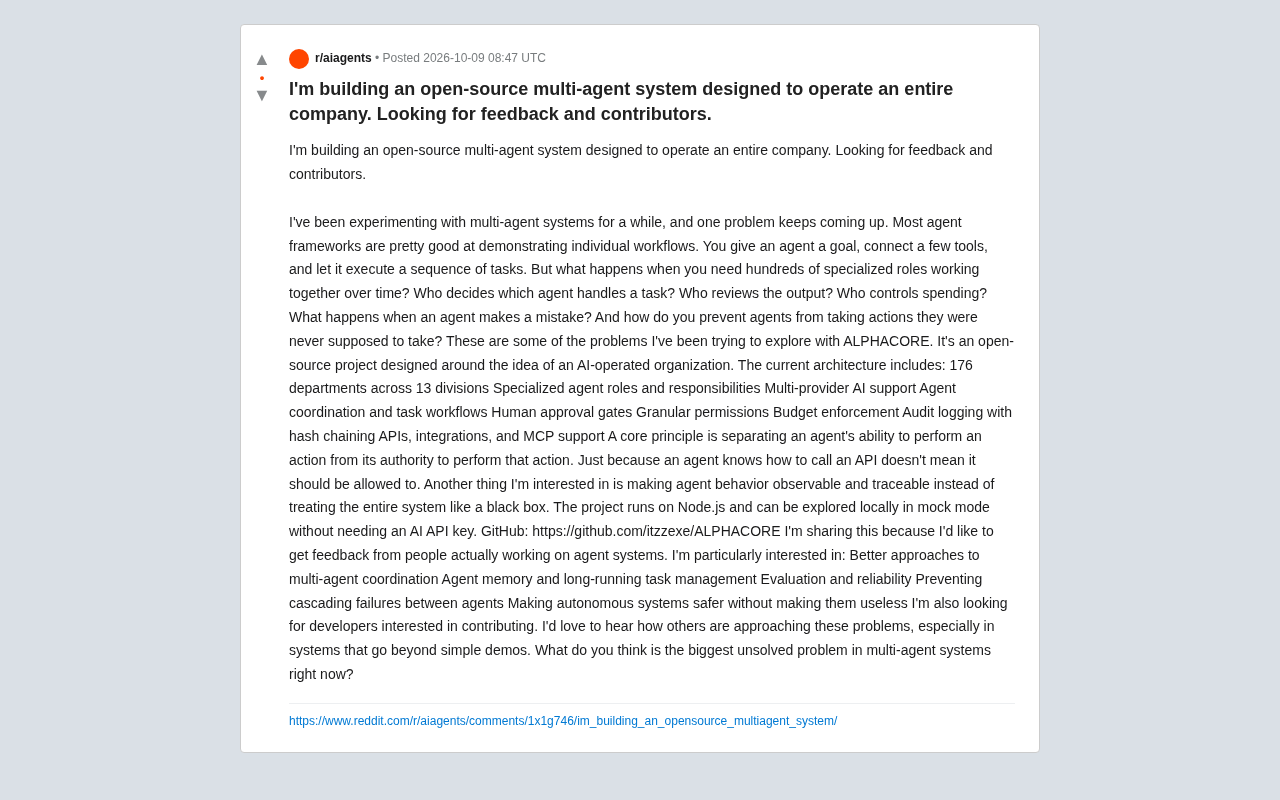
A developer shared his open-source project ALPHACORE on Reddit, attempting to answer a much more ambitious question — how to get hundreds of specialized agent roles to collaborate over the long term and collectively operate a company. The core questions he raised are precisely the thorniest parts of current multi-agent systems: Who decides which agent handles a given task? Who reviews the outputs? Who controls costs? What happens when an agent makes a mistake? And how do you prevent an agent from performing actions it was never supposed to perform?
What these questions share is that none of them are purely technical "can it be done" problems. They're organizational governance questions about "should it be done, and who's responsible." This is exactly the gap most easily overlooked in the transition from demo to production system.
ALPHACORE's Architectural Design
As described by its author, ALPHACORE is built around the concept of an "AI-operated organization" and currently features a fairly complete organizational design:
- 176 departments across 13 business units, simulating a real enterprise's hierarchical structure
- Specialized agent roles with clearly defined responsibilities
- Multi-provider AI support, avoiding lock-in to a single model vendor
- Agent coordination and task workflows
- Human approval gates
- Fine-grained permission controls
- Enforced budget constraints
- Audit logs with hash chains
- API and integration capabilities, plus MCP support
This list makes clear that the project's focus isn't on making agents "smarter" — it's on fitting a group of agents into a controllable, auditable governance framework. This philosophy stands in sharp contrast to most projects in the space, which chase the upper limits of raw capability.
Two Core Principles Worth Noting
Separating Capability from Authorization
The most fundamental design principle in the project is a clean separation between an agent's ability to perform an action and its authorization to perform that action. In the author's own words: just because an agent knows how to call an API doesn't mean it should be allowed to.
This distinction seems simple, but it cuts to the heart of autonomous system security. In traditional software, permission management has long been a mature practice. But in agent systems, where agents can make autonomous decisions and call tools independently, the line between "can call" and "authorized to call" blurs very easily. ALPHACORE attempts to transplant enterprise-grade access control thinking into the agent world through fine-grained permissions and enforced budget constraints.
This design principle has a classical counterpart in security — the Principle of Least Privilege: any subject (user, process, or agent) should have only the minimum permissions necessary to complete the current task. Traditional operating systems and cloud platforms (like AWS IAM) have long institutionalized this concept. But the challenge in agent systems is that permission boundaries are dynamic: agents may autonomously decide at runtime which tools to invoke and which subtasks to generate, making static permission policies difficult to cover all scenarios. ALPHACORE's decoupling of "authorization" from "capability" is essentially introducing a Runtime Access Control layer for agent systems — ensuring every tool call goes through an independent authorization check rather than configuring permissions once at agent initialization. This also has implications for defending against Prompt Injection attacks: even if an attacker uses malicious inputs to coax an agent into attempting unauthorized operations, the underlying authorization layer can still serve as a last line of defense.
Observable and Traceable, Not a Black Box
The other key focus is making agent behavior observable and traceable rather than treating the entire system as a black box. Audit logs with hash chains are the technical implementation of this philosophy — every operation leaves a tamper-evident record.
For a system that claims to operate a company, this is nearly a hard requirement. When a decision chain spans hundreds of agents, if an error or loss occurs, without a complete audit trail, accountability and post-mortems become impossible.
Hash chains are the foundational data structure underlying blockchain technology, but their application in audit logging predates the blockchain era. The core principle: each log entry contains the hash of the previous entry, forming a chain of dependencies. Any tampering with a historical record invalidates all subsequent hashes, making it immediately detectable. This gives audit logs tamper-evidence — even system administrators cannot silently modify historical behavior records. In multi-agent scenarios, this mechanism is especially critical: when hundreds of agents operate concurrently, the trustworthiness of the logs themselves is a prerequisite for accountability. If logs can be freely modified, the entire audit system becomes meaningless. It's worth noting that hash chains provide detectable tampering, not prevention of tampering — they can tell you a record was modified, but cannot physically prevent deletion. This is why they're typically paired with append-only storage or external witnessing mechanisms to form a complete audit guarantee.
Technical Requirements and How to Try It
The project is built on Node.js and offers a mock mode that lets you run and explore it locally without any AI API keys. This lowers the barrier to entry, allowing interested developers to understand the architectural logic before deciding whether to connect real models. The code is open-sourced on GitHub (itzzexe/ALPHACORE), and the author is explicitly seeking feedback and contributors.
The Questions the Author Actually Wants to Discuss
Beyond the project itself, this post reads more like an invitation to discuss open problems in the multi-agent space. The author lists several directions he finds most interesting:
- Better approaches to multi-agent coordination
- Agent memory and long-horizon task management
- Evaluation and reliability
- Preventing cascading failures between agents
- Making autonomous systems safer without making them useless
That last point is particularly thought-provoking: "making autonomous systems safer without making them useless." This is essentially the dilemma every agent safety designer faces — too loose and you lose control, too tight and the agent becomes pointless. ALPHACORE's human approval gates and permission system are fundamentally an attempt to find balance on this tightrope.
The author ultimately throws the question to the community: what do you think is the biggest unsolved problem in multi-agent systems today?
Cascading failures in multi-agent systems pose risks far greater than in traditional distributed systems. Traditional microservices can isolate failing nodes with circuit breakers, but dependencies between agents often exist at the semantic level — an erroneous conclusion produced by one agent becomes the input premise for another, causing errors to amplify through the decision chain rather than being cut off. This is sometimes called Error Amplification or Hallucination Propagation. In a 176-department architecture, if a midstream agent produces a flawed task decomposition, every downstream agent depending on it may consume significant compute resources and budget heading in the wrong direction — and without human approval gates, the system may not surface the problem until real damage has already been done. This is part of why the author lists "preventing cascading failures between agents" as a standalone unsolved challenge.
A Final Observation
The direction ALPHACORE represents reflects a pragmatic movement rising within the agent space — rather than chasing ever-stronger individual intelligence, first solve the governance, security, and reliability challenges of scaled collaboration. The ambitious framing of 176 departments may be more conceptual than practical, but the underlying design thinking around capability-authorization separation and traceable auditing carries real reference value for any team building production-grade agent systems.
Of course, running an entire company with a multi-agent system remains more vision than reality today. The real test is whether this governance framework can both hold the line and give agents room to operate when confronted with the full complexity and uncertainty of real business. That's precisely why the author is reaching out to the community for feedback.
Related articles

Chain of Thought Isn't Just for AI: How Humans Can Use CoT to Improve Thinking Quality
Chain of Thought isn't just a prompt trick for large models. Starting from a Hacker News discussion, this article analyzes why CoT works for human thinking too, breaks down actionable ways to transfer it, and highlights the key differences between human CoT and machine CoT.
Cloudflare Teams Up with OpenAI: Closi…
Cloudflare Teams Up with OpenAI: Closing the Loop from Vulnerability Discovery to Defense with AI
Cloudflare uses OpenAI Daybreak to investigate security vulnerabilities and generate reviewable remediation plans, while developers use Codex to boost coding efficiency and quality.

Orca Multi-Agent Orchestration in Practice: A Guide to Parallel Collaboration with Claude and Codex
Orca is Stable AI's free open-source agent workbench supporting 34 agents like Claude Code and Codex in parallel. Learn its Git worktree isolation, multi-model orchestration, and mobile management.