Alsona: Using AI Agents to Capture Buying Signals and Lock In the 5% Ready-to-Buy Prospects
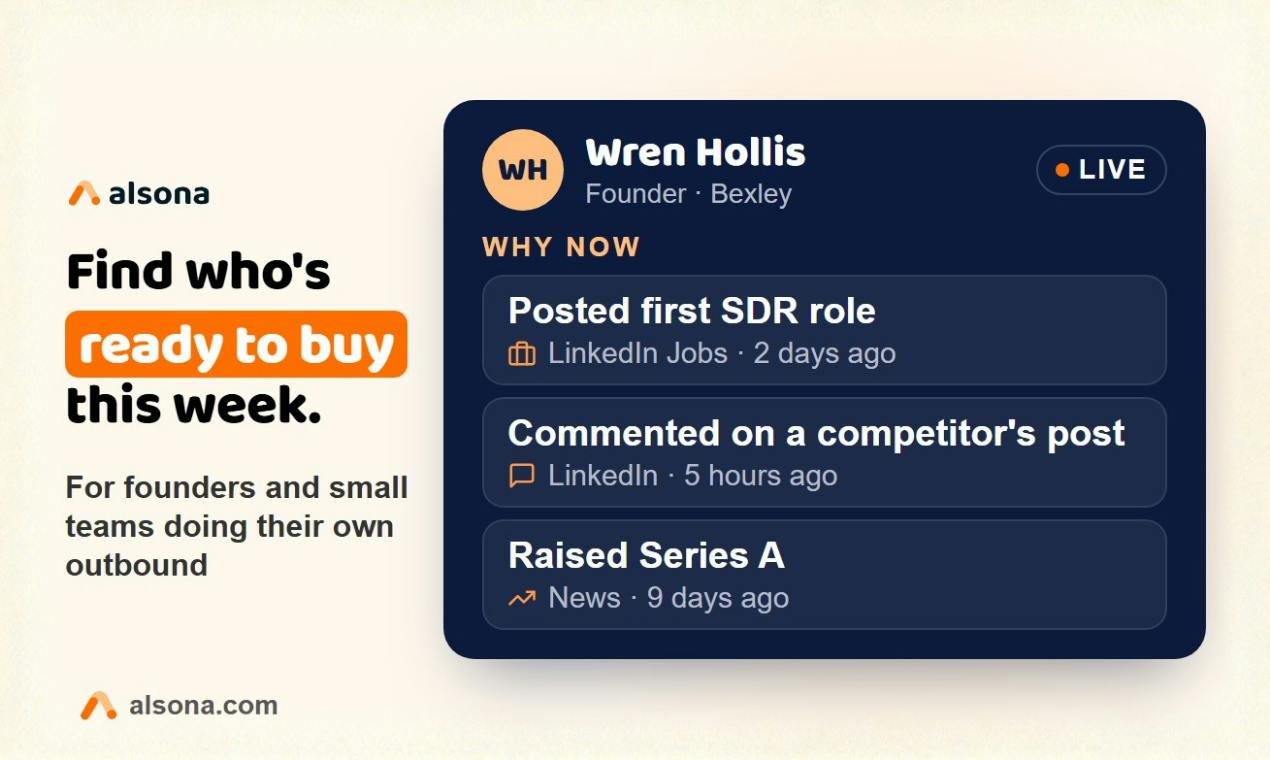
Alsona uses AI to track 32 buying signals and automatically reach the 5% of immediate buyers during their window period.
Alsona is a sales AI tool ranked #2 on Product Hunt. It abandons wide-net prospecting over the 95% of immature leads and instead tracks 32+ buying signals—hiring, funding, tech stack changes, reviews, ad spend—to identify the 5% of target customers currently in a buying window. It scores signals against ICP with explanations, then has AI agents generate personalized LinkedIn and email outreach to start conversations and book calls, forming a closed loop from signal discovery to outreach. The article notes three judgments: signal quantity ≠ quality, AI outreach carries content and compliance risks, and the product supplements rather than replaces existing lead nurturing.
In sales, one harsh reality has been repeatedly proven: when you reach out to prospects, 95% of them aren't ready to buy yet. The efficiency bottleneck of traditional cold calling and email blasting often isn't about the pitch—it's about timing. You can't find the person who's "in the window." Alsona, the #2 product on Product Hunt, targets exactly this pain point, attempting to use AI agents to turn buying signals directly into booked calls.
From "Casting a Wide Net" to "Precision Targeting": Signal-Driven Sales Logic
Alsona's core proposition is straightforward: rather than wasting energy on the 95% of immature leads, find the 5% that are currently signaling purchase intent. It tracks 32+ signal dimensions, covering hiring activity, funding events, tech stack changes, user reviews, ad spend, and more. These signals essentially reflect a company's "activity level" and "direction of change"—for example, a sudden expansion of a certain functional team, a new funding round, or a key infrastructure change often means budget and decision windows are opening up.
Compared to traditional lead scoring models that only look at static profiles (industry, size, job title), Alsona emphasizes the temporal "right now." It matches and scores captured signals against your Ideal Customer Profile (ICP) and explains why a company is worth contacting. This "explanatory" design is especially critical for sales teams: reps need more than just a score—they need concrete reasons they can use directly in their opening lines.
ICP (Ideal Customer Profile) is a systematic description of a company's most valuable customers, typically including industry, company size, revenue range, tech stack, organizational structure, and common pain points. In B2B sales, ICP is the foundation for lead filtering and scoring: only after clarifying "who is a good customer" can you judge whether a signal is worth pursuing. Alsona matches captured buying signals against a user's predefined ICP and scores them—essentially using ICP as a filter to narrow vast public signals down to the few targets relevant to your business. The more precise the ICP definition, the higher the signal matching accuracy; conversely, an overly broad ICP leads to many false positives.
Buying Signal refers to publicly observable signs that a target customer may be about to purchase. Common types include: hiring for specific roles (indicating team expansion or new project launch), completing funding (increased budget), tech stack changes (seeking alternatives), posting negative reviews (dissatisfaction with current vendors), and increased ad spend (business growth). The core value of buying signals lies in timing rather than profile—it reflects a company's "state change at this moment," not static attributes. Signal-based selling is built on this logic: rather than calling down a list in order, intervene the moment a signal appears, when the customer's decision window is open.
AI Agents Take Over Outreach: Personalized LinkedIn and Email in Sync
Identifying signals is only half the battle. Alsona's AI agents generate personalized LinkedIn messages and email content based on these signals, initiating conversations while the buying window is still open. This is fundamentally different from pure email automation tools—the latter typically blast preset templates, while the former's copy and hooks are driven by specific signals, such as referencing the prospect's recent hiring moves or funding progress as a conversation starter.
In terms of product positioning, Alsona places itself across the full chain of "signal discovery—scoring explanation—multi-channel outreach—call booking," rather than as a point solution. For SDR (Sales Development Representative) teams, this means the steps from lead filtering to first-round communication are compressed, allowing manpower to focus on conversations with genuine intent.
SDR (Sales Development Representative) is the role in B2B sales organizations responsible for lead development and first-touch outreach. Their main work is contacting prospects via phone, email, LinkedIn, and other channels, screening leads with initial intent and handing them off to AEs (Account Executives) for follow-up. The typical pain point for SDR teams is spending large amounts of time on invalid leads: low call connection rates, low email open rates, and difficulty maintaining follow-up cadence. The value of signal-driven tools is shifting SDR energy from "who to contact" to "how to communicate," reducing mechanical pre-screening work and focusing manpower on high-intent conversations.
Three Product Judgments Worth Noting
First, signal quantity doesn't equal signal quality. 32+ signals sounds rich, but actual effectiveness depends on how well these signals match specific industries and deal sizes. For high-frequency, low-ticket SaaS, hiring and funding signals may be too sparse; for B2B products with high deal sizes and long decision chains, such signals are more relevant. Alsona's ICP scoring and explanation mechanism is, to some extent, compensating for this generalization problem.
Second, compliance and brand risks of AI-generated outreach content. Personalized emails and LinkedIn messages are automatically generated and sent by AI. Without human review, this can lead to tone deviations or factual errors. Although the Product Hunt comment section has only 10 discussions, the common concern with such tools is: the higher the automation level, the weaker the sales team's control over content quality.
Third, positioning in the "window period" rather than the "full cycle." Alsona explicitly focuses on the 5% of immediate buyers—this is both a differentiation advantage and a limitation: it cannot replace long-term lead nurturing systems. For teams relying on long-cycle nurture, it's better suited as a supplementary layer to existing CRM and marketing automation, not a replacement.
Market Position and Applicability Boundaries
Judging from its 116 upvotes and #2 ranking on Product Hunt, Alsona has tapped into sales teams' persistent anxiety about "efficiency." But buying-signal products aren't a new category—tools like Clay and Common Room have already established positions in signal aggregation and enrichment. Alsona's differentiation lies in incorporating AI agent outreach execution into the closed loop, reducing the friction of switching between multiple tools.
For teams interested in trying it, we recommend first clarifying your ICP's signal sensitivity: if your target customers have publicly trackable traces in hiring, funding, or tech changes, and your deal size can support refined outreach, the value of such tools will become apparent faster. Conversely, if target customer signals are sparse, more signal sources will only add noise.
The essence of sales has never changed—finding the right person at the right time. Alsona's attempt is to turn "the right time" from intuitive judgment into a quantifiable, actionable signal stream. Whether this path succeeds depends on whether signal quality and the controllability of AI outreach can both pass muster.
One-line Summary
Alsona uses AI to track 32 buying signals and automatically reach the 5% of immediate buyers during their window period.
Paragraph Summary
Alsona is a sales AI tool ranked #2 on Product Hunt. Its core logic is to abandon casting a wide net over the 95% of immature leads and instead track 32+ buying signals—hiring, funding, tech stack changes, user reviews, ad spend—to identify the 5% of target customers currently in a buying window. It matches signals against ICP, scores and explains the rationale for contacting, then has AI agents generate personalized LinkedIn messages and emails, initiating conversations while the window is open and driving toward booked calls—forming a closed loop from signal discovery to outreach. The article also offers three judgments: signal quantity doesn't equal quality, AI-automated outreach carries content and compliance risks, and the product is positioned as a supplement to, not a replacement for, existing lead nurturing systems.
Related articles

Gemini 4 Neon Released: A Balance Between Frontier Intelligence and Efficient Task Execution
Google DeepMind releases Gemini 4 Neon, focused on frontier intelligence and fast end-to-end task execution. This article breaks down its benchmark performance in coding, enterprise analysis, scientific reasoning, and cybersecurity, its four thinking levels, pricing, and safety alignment data.

Is AI the Culprit Behind Global Outages? The Trust Crisis Behind the NSA and FAA Failures
Fourth major failure in five days hits NSA classified network. Microsoft blames a software bug, FAA denies its new AI system, NSA says routine maintenance. Senator Warner suggests AI accelerates vulnerability discovery, leading to rushed fixes — while 39% of Americans already view AI negatively, exposing a deepening trust crisis.

Robot Developer Builds Custom B-rep Kernel with 3,487 Tests
A robot developer builds a custom B-rep geometry kernel with 3,487 tests, exploring why robotics needs dedicated CAD tools and the barriers to building one.