Altara Tech Revolutionizes Scientific Research Workflows with OpenAI Models: Multimodal Data Processing and Transparent AI

Altara Tech uses OpenAI models to bring transparency and multimodal processing to multi-step scientific workflows.
Altara Tech leverages OpenAI's large language models to help scientists efficiently process multimodal scientific data and advance multi-step R&D workflows. Its core value lies in enhancing the transparency and explainability of AI reasoning, addressing the "black box problem" in research by making every analytical step traceable and verifiable — directly responding to the reproducibility crisis. This reflects the broader industry trend of AI moving from general-purpose to vertical, from assistance to collaboration, and from results to process.
The Multimodal Challenge of Scientific Data
Data in scientific research is inherently multimodal and highly complex. From spectral data and microscope images in the lab to genomic sequences and chemical molecular structures, scientists and engineers process massive amounts of data from different sources and in different formats every day.
Multimodal Data in scientific research refers to heterogeneous collections of data from different sensors, instruments, or experimental methods. For example, protein research may simultaneously involve X-ray crystallography diffraction images, mass spectrometry data, amino acid sequence text, and cellular microscopy images. Traditional machine learning models can typically only handle a single modality, while large language models (LLMs) combined with vision encoders in multimodal architectures (such as GPT-4o) can align different types of information within a unified semantic space — this is the core technical foundation behind the recent capability leap in AI research tools. This complexity not only increases the difficulty of data analysis but also fills every step of R&D workflows with uncertainty.
How to make these multi-step R&D processes more transparent and efficient has become a critical problem that the tech industry urgently needs to solve.
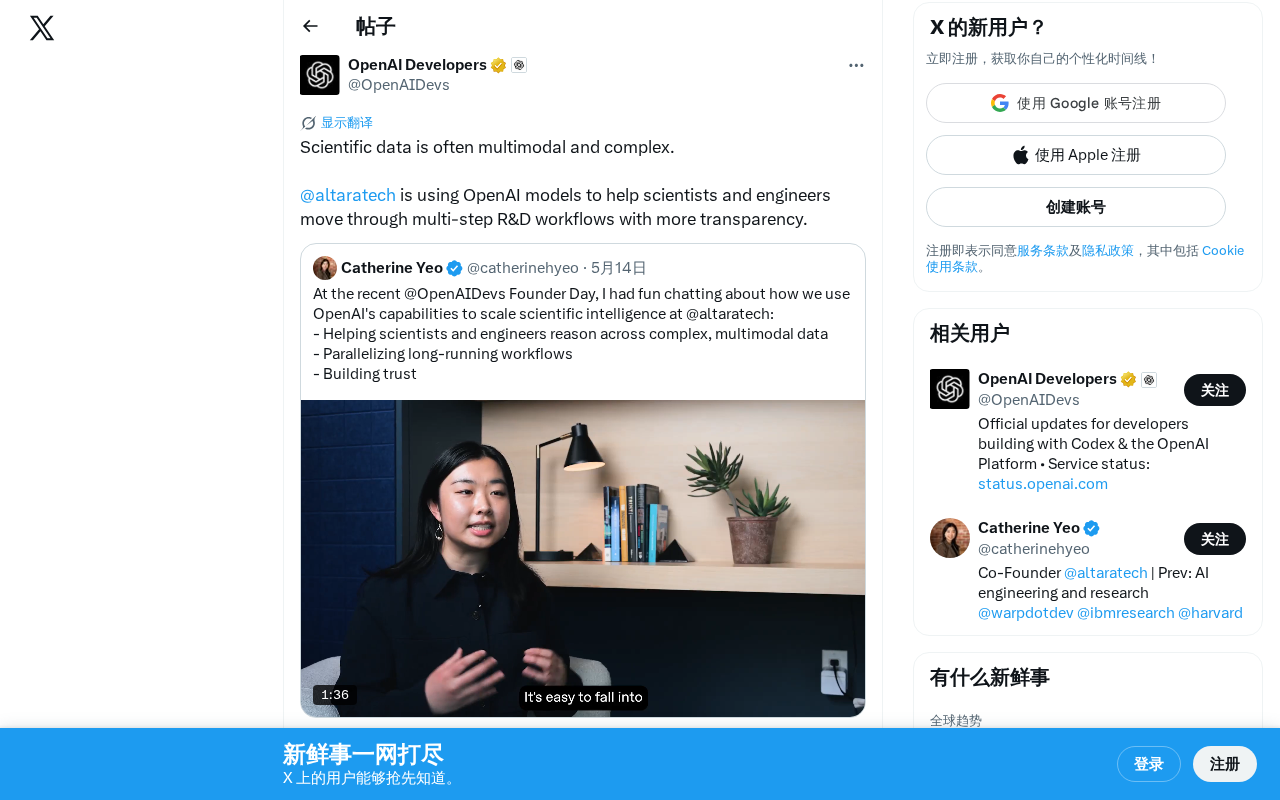
How Altara Tech Empowers Scientific Research with OpenAI Models
AI-Driven Multi-Step R&D Workflows
Altara Tech (@altaratech) is leveraging OpenAI's large language models to help scientists and engineers advance multi-step R&D workflows more efficiently. Its core value lies in bringing greater transparency to complex research processes — researchers can not only obtain AI-assisted analysis results but also clearly understand the reasoning and basis behind each step of decision-making.
The AI "Black Box Problem" refers to the opacity of deep neural network decision-making processes to humans — models can produce predictions but cannot clearly explain their reasoning paths. This is particularly dangerous in research scenarios: an unexplainable AI conclusion could misdirect experimental directions, causing resource waste or even safety risks. The field of Explainable AI (XAI) has emerged in response, with methods like LIME and SHAP attempting post-hoc explanations of model behavior. Meanwhile, LLM-based Chain-of-Thought reasoning provides a more natural path to reasoning transparency at the architectural level, allowing AI to demonstrate its analysis process step by step in human-readable language. Altara Tech's design philosophy directly addresses the scientific community's concerns about this problem, making AI a truly trustworthy research partner.
Multimodal Data Processing Capabilities
Multimodal data processing in scientific research has always been a key pain point. Traditional tools can typically only handle a single type of data, while Altara Tech's solution built on OpenAI's large models offers the following capabilities:
- Cross-modal understanding: Simultaneously processing text, images, tables, charts, and other data formats
- Contextual correlation: Maintaining understanding and memory of previous steps throughout multi-step workflows
- Reasoning transparency: Displaying the complete reasoning chain from data to conclusions, enhancing explainability
These capabilities allow researchers to complete analysis tasks on a unified platform that previously required collaboration between multiple tools.
The Profound Impact of AI on Scientific Research Workflows
Dramatically Improving R&D Efficiency
In traditional research workflows, researchers need to frequently switch between different tools and manually integrate data from various experiments and analysis stages. The introduction of OpenAI models can connect these scattered steps into a coherent automated process, significantly reducing repetitive work and allowing scientists to devote more energy to creative thinking.
Enhancing Decision Transparency and Reproducibility
"Transparency" is a core feature particularly emphasized in Altara Tech's solution. In scientific research, reproducibility and explainability are crucial. Notably, the Reproducibility Crisis has attracted widespread attention since the 2010s — a 2016 survey by Nature revealed that over 70% of researchers had attempted to reproduce others' experiments but failed. One root cause of this crisis is the opacity of analysis processes: the data processing steps and parameter choices used by researchers often lack complete documentation. If AI tools can automatically generate traceable analysis logs and reasoning chains, they will directly alleviate this systemic problem.
Unlike "black box" AI tools, Altara Tech is committed to making every analytical step traceable and verifiable — essential for rigorous research environments. When reviewers or collaborators question a conclusion, researchers can trace back through AI's complete reasoning process, which holds significant value in academic publishing and peer review.
Industry Trends in AI + Scientific Research
Altara Tech's practice reflects several important trends in the current application of AI in scientific research:
- From general-purpose to vertical: Foundation models like those from OpenAI are being applied in targeted ways to specific research scenarios, delivering greater value
- From assistance to collaboration: AI is transitioning from a simple tool role to an intelligent collaborative partner for researchers
- From results to process: The focus is shifting from pure output results to optimizing and making transparent the entire R&D process
Understanding this trend requires distinguishing the relationship between Foundation Models and vertical AI. Foundation models are large-scale models pre-trained on massive general-purpose data, such as OpenAI's GPT series; vertical AI builds on top of foundation models through techniques like fine-tuning, Retrieval-Augmented Generation (RAG), or Prompt Engineering to directionally adapt general capabilities to specific industry scenarios. The verticalization challenge in scientific research is particularly prominent: high density of specialized terminology, diverse data formats, and extremely strict accuracy requirements. Altara Tech's approach represents a mainstream paradigm — rather than training domain models from scratch, it leverages the powerful reasoning capabilities of top foundation models like OpenAI's, layering domain knowledge and workflow design on top to achieve high-value vertical applications at relatively low cost.
Future Outlook: Opportunities and Challenges for AI Research Tools
As foundation model capabilities from OpenAI and others continue to improve, AI companies focused on vertical domains like Altara Tech will provide increasingly powerful tools for researchers. In the future, we can expect AI to play a greater role in drug discovery, materials science, climate research, and other fields.
However, the development of AI research tools also faces real challenges: How do we ensure the accuracy of AI-generated results? How do we handle sensitive research data? How do we strike a balance between automation and human judgment? These are all questions that require ongoing exploration.
Altara Tech's commitment to "transparency" may well be the right direction for addressing these challenges — making AI a research partner that scientists can understand and trust, rather than an uncontrollable black box.
Key Takeaways
- Altara Tech uses OpenAI models to help scientists process complex multimodal scientific data
- The solution focuses on improving transparency and explainability in multi-step R&D workflows
- AI in scientific research is evolving from general-purpose tools toward verticalization and collaboration
- Transparency and traceability are key advantages that differentiate AI research tools from black-box solutions
- The reproducibility crisis provides an urgent real-world demand context for transparent AI tools
Related articles
Meta Muse Hits 900K Downloads in Six D…
Meta Muse Hits 900K Downloads in Six Days: The AI Agent Era Has Officially Arrived
Meta's AI agent Muse hit 902K downloads in 6 days, topping US App Store and Google Play charts above ChatGPT and Claude. A deep dive into Muse's capabilities and the AI Agent race.
 Industry Insights
IRS Fully Embraces Claude AI, Accelerating Federal Government's AI Adoption
The IRS is recruiting staff with 24/7 Claude AI access, marking Anthropic's breakthrough into the federal government. Explore the strategic implications and tax use cases.
 Industry Insights
The IRS Mobile App Debate: A Trust Crisis in Government Digital Transformation
The IRS's proposed mobile app has sparked heated debate. This article analyzes the core arguments, exploring data security, privacy, and the trust crisis in government digital transformation.