Altman Calls Personal PCs Stockpiling RAM "Quite Terrible," Data Centers Achieve Higher Utilization

Altman calls large RAM in personal PCs "quite terrible," sparking a debate over centralized scheduling vs. local configurations.
The article examines OpenAI CEO Sam Altman's statement that equipping personal computers with large amounts of RAM is "quite terrible." His logic: idle memory in personal devices cannot be used by others, while data centers can serve more tenants and tasks with the same physical memory through virtualization and containerized scheduling, achieving higher utilization and lower unit cost. The article notes this addresses only resource efficiency—large local memory still offers low-latency and privacy advantages for large datasets, local models, and video rendering. The statement reflects the efficiency tension between centralized scheduling and decentralized ownership in the AI era.
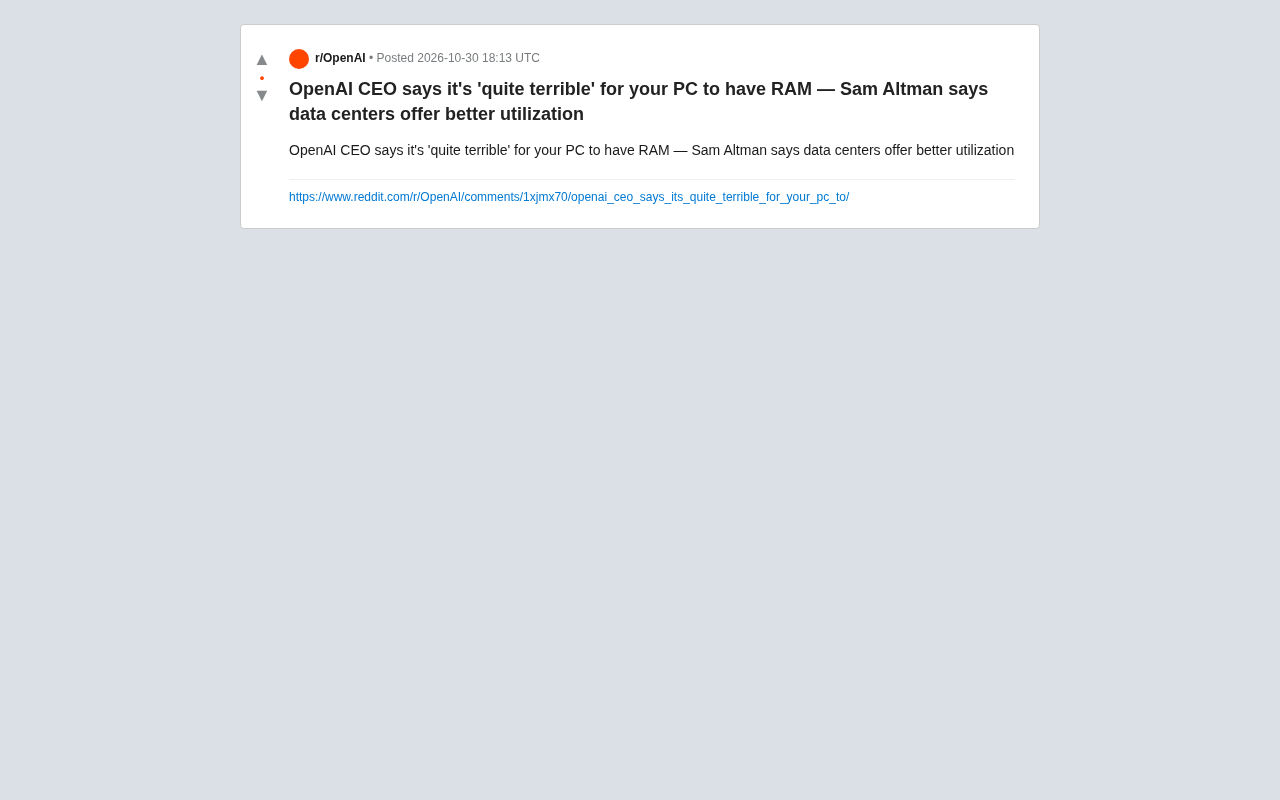
According to a widely discussed post on Reddit, OpenAI CEO Sam Altman recently gave a blunt assessment of the practice of equipping personal computers with large amounts of RAM: "quite terrible." His core argument is that memory sitting idle in personal devices is far less valuable than memory in data centers that can be efficiently scheduled and utilized.
What Altman Actually Said
According to the Reddit post's account, Altman's view can be summed up in one sentence: giving a personal computer a large amount of RAM is "quite terrible" from the perspective of resource utilization efficiency. By contrast, data centers can serve more computing tasks with the same pool of memory resources through centralized scheduling, achieving significantly higher overall utilization.
What made this statement spark discussion is that it touches on a long-standing tension: the trade-off between the configuration arms race in personal computing devices and the trend toward cloud centralization. For DIY enthusiasts and users with heavy local workloads, large memory is a hard requirement; but from the perspective of an AI company like OpenAI, centralized resource scheduling is the efficiency-optimal solution.
Sam Altman is the CEO of OpenAI and one of the most influential figures in the current AI wave. His public statements are often treated as industry bellwethers, so even casual remarks about personal computer memory configurations can trigger widespread interpretation in technical communities. It should be noted that such statements typically come from informal settings such as interviews, podcasts, or social media interactions, where the context is relatively loose and does not necessarily constitute a product roadmap declaration from OpenAI. The Reddit community's retelling and amplification of his remarks also carries the投射 of the discussants' own positions, and readers should distinguish between "personal opinion" and "company strategy" when interpreting them.
Why Data Centers Achieve Higher Memory Utilization
Altman's judgment has its own technical logic. Once memory in a personal PC is occupied, it cannot be called upon by other users or tasks even if it sits idle most of the time. A machine equipped with large-capacity memory has its memory effectively in a "dormant" state during off-peak usage periods.
The logic of data centers is different. Through virtualization and containerized scheduling, the same pool of physical memory can be dynamically allocated across different tenants and different tasks. Overall, centralized deployment can maintain average memory utilization at a higher level, diluting the resource cost per unit of compute. This is one of the fundamental reasons why cloud services can continue to squeeze out local deployment in terms of cost structure.
Local Large Memory Is Not Without Value
One caveat: Altman's comment addresses only the single dimension of "resource utilization efficiency." For users who need to process large datasets, run local large models, perform video rendering, or conduct scientific computing, the low-latency and data-privacy advantages of large local memory are difficult for cloud solutions to replace in the short term. Putting memory in your own machine buys certainty and control—value that falls outside the accounting of "utilization rate."
Virtualization and containerization are key to understanding data center memory efficiency. Virtualization uses a hypervisor to abstract multiple virtual machines on top of physical hardware, allowing different operating systems and tenants to share the same physical machine's CPU, memory, and storage; containerization (such as Docker and Kubernetes) further isolates processes at the operating system level, with lower overhead and finer-grained scheduling. Both rely on memory overcommit and dynamic reclamation mechanisms: when a tenant's memory is temporarily idle, the scheduler can allocate it to other tasks, freeing up space through swapping or migration when necessary. This ability to "allocate on demand and reuse across time slots" allows a data center's physical memory to be shared by multiple workloads along the time dimension, significantly improving average utilization—this is the underlying reason why centralized deployment beats分散ly held devices on unit cost.
When running large models locally, memory capacity directly determines whether a model can be loaded and how fast inference runs. Taking common quantized models as an example, a 7-billion-parameter model requires about 4–6 GB of memory at 4-bit quantization, while a 70-billion-parameter model may occupy 30–40 GB or more; adding the context cache (KV Cache) pushes actual requirements even higher. When a model exceeds VRAM capacity, the system falls back to memory or even disk paging, causing latency to spike. Therefore, for local AI experimenters, large memory is not "idle waste" but a hard threshold that makes models runnable and stable. This is a different evaluation framework from the average utilization pursued by data centers: the former measures task feasibility and response determinism, while the latter measures the diluted cost of resources across a group.
The Industry Signal Behind the Statement
From a broader perspective, Altman's remarks reflect a core issue in compute resource allocation in the AI era: when resources such as memory and GPUs become scarce, the efficiency gap between centralized scheduling and decentralized ownership widens. AI training and inference continue to demand ever more memory bandwidth and capacity, and whoever can keep every GB of memory running at high load gains an advantage in cost competition.
This also explains why leading AI companies generally prefer to build their own data centers or rent them at scale rather than relying on dispersed edge devices. For individual users, the practical significance of understanding this logic is that the choice between local configurations and cloud subscriptions is essentially a trade-off between "control" and "resource efficiency"—there is no one-size-fits-all answer.
The Reddit discussion also reflects this divergence—some agree with the efficiency advantages of centralized scheduling, while others point out that the idle cost of memory in personal devices is overestimated, since users are buying usage rights, not an investment product. Altman's statement is more of an observation from a resource-scheduling perspective than a moral judgment on personal configuration choices.
One-line Summary
Altman calls equipping personal PCs with large amounts of RAM "quite terrible," sparking a debate over centralized scheduling versus local configurations.
Paragraph Summary
The article centers on OpenAI CEO Sam Altman's statement that "equipping personal computers with large amounts of memory is quite terrible." The core logic: idle memory in personal devices cannot be called upon by others, whereas data centers can use virtualization and containerized scheduling to serve more tenants and tasks with the same pool of physical memory, achieving higher overall utilization and lower unit cost. The article also notes that this assessment addresses only the single dimension of resource utilization efficiency—large local memory still offers low-latency and privacy advantages for large datasets, local large models, video rendering, and other scenarios. The statement reflects the efficiency tension between centralized scheduling and decentralized ownership once memory and GPUs become scarce resources in the AI era, and shows that local configurations versus cloud subscriptions are essentially a trade-off between control and resource efficiency.
Related articles

Claude Code + Agent: Building a Fully Automated AI Testing Loop
Bilibili course breakdown: how test developers can use Claude Code terminal-based Agents to build a fully automated AI testing loop. Compares permission boundaries of terminal vs. device Agents, explains why enterprise projects choose Claude Code over Open Claude-type tools, and outlines the Node.js environment setup and DeepSeek model integration path.

Working with AI Agents Requires Nerves of Steel
The more autonomous AI agents become, the heavier the user's psychological burden. Drawing from a Hacker News discussion, this article analyzes black-box anxiety, behavior drift, and monitoring fatigue in agent collaboration, and offers practical approaches like sandbox isolation, permission control, and task granularity management to reduce cognitive load.

To Replace Adobe Acrobat, I Built My Own Open-Source PDF Reader Folio
A developer unhappy with Adobe Acrobat's bloat built Folio, a lightweight open-source PDF reader. Learn the design philosophy and use cases of this alternative.