Claude Code + Agent: Building a Fully Automated AI Testing Loop

Test developers should choose terminal-based Agents over device-based ones; Claude Code is the top pick for controllability and ecosystem maturity.
The article explores how test development can boost efficiency with AI programming tools, noting that Claude Code is Anthropic's terminal-based programming Agent running in the command line, scoped to a project or directory, with humans retaining ultimate decision-making power. The course divides Agents into terminal-based and device-based: the former offers project-level management and controllable permissions as the enterprise mainstream; the latter is invoked via IM tools with a low barrier but often holds full device permissions, risking system damage and leaks, so it's unsuitable for enterprise projects. Claude Code wins on capability, ecosystem maturity, and open-source references. The path includes Node.js setup, pairing with DeepSeek, and letting the Agent drive the testing loop autonomously.
Why Test Developers Should Care About Terminal-Based Agents
Test development roles have long been consumed by repetitive coding and debugging work, and the maturation of AI programming tools is changing this situation. In a Bilibili course aimed at advancing test developers, the instructor lays out a clear technical path: use Claude Code combined with Agent capabilities to push testing workflows from hand-writing code toward a fully automated loop. The starting point for this approach isn't chasing trends—it's solving a real problem: how to let AI take on actual work in enterprise projects safely and controllably.
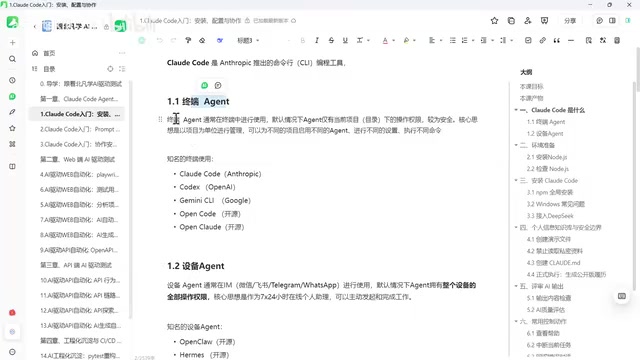
The course first clarifies an easily confused concept: Claude Code is a command-line programming tool released by Anthropic that runs in the terminal, not a conversational assistant in a chat window. Anthropic itself has deep roots in AI coding, its models rank at the top in coding ability, and widely discussed terms like MCP and Skills were first proposed and promoted by this company. Choosing it is essentially choosing a proven technical foundation.
The Key Divide Between Terminal-Based and Device-Based Agents
To understand Claude Code's value, you first need to see the two major categories of Agents clearly. The course divides Agents into terminal-based and device-based, with the core difference lying in permission boundaries.
Terminal-Based Agents: Controllable Collaboration at the Project Level
Terminal-based Agents are used in the command line, with their scope limited to the current project or directory. The computer isn't fully handed over to AI control—humans remain the ultimate decision-makers, opening only a single directory or project to the AI. This design fits enterprise reality: a computer is an asset and can't be casually entrusted to an uncertain AI. The instructor emphasizes that this is currently the most mainstream and reassuring application model in enterprises. Because it's managed at the project level, different projects on the same computer can have different configurations and execute different commands, with global control always in human hands.
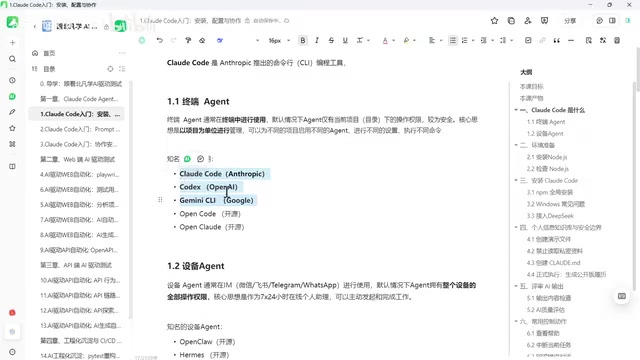
Well-known terminal-based Agents include Claude Code, Codex, and Gemini CLI, all released by commercial companies that typically bind their own models when using the tools. The open-source camp also has counterparts like Open Code and Open Claude, whose names themselves reveal their reference to and homage to Claude Code. The choices aren't narrow.
MCP (Model Context Protocol) is a standardized protocol proposed and open-sourced by Anthropic for letting AI models securely and structurally access external tools, data sources, and services. You can think of MCP as a "universal interface" between AI and the outside world: by defining a unified interaction spec between server and client sides, models can call file systems, databases, Git repositories, internal APIs, and other resources without writing separate integration code for each tool. For terminal-based Agents, MCP's value lies in turning "what AI can do" into declarable, auditable configuration—projects can mount only the necessary MCP servers, thereby narrowing the permission surface while extending capabilities. This is also an important support for the maturity of the Claude Code ecosystem: a large number of third-party tools already offer official or community MCP implementations, letting developers assemble capabilities per project rather than handing over the whole device to AI.
Skills is a capability encapsulation mechanism promoted by Anthropic in the Claude ecosystem, usually consisting of a set of files and documentation describing the standard operating procedures, caveats, and available tools for a certain type of task. Unlike direct conversation, Skills solidify domain knowledge into reusable "operating manuals" that Agents automatically load and follow when encountering matching scenarios. For test development, this means interface testing specs, test case writing templates, and environment switching steps can be沉淀 into Skills—letting Agents execute according to the team's established process and reducing the uncertainty brought by improvisation. Skills and MCP complement each other: MCP solves "what can be accessed," while Skills solves "how it should be done," and together they make terminal-based Agents' behavior more predictable and closer to engineering standards.
Device-Based Agents: Permission Risks Behind Convenience
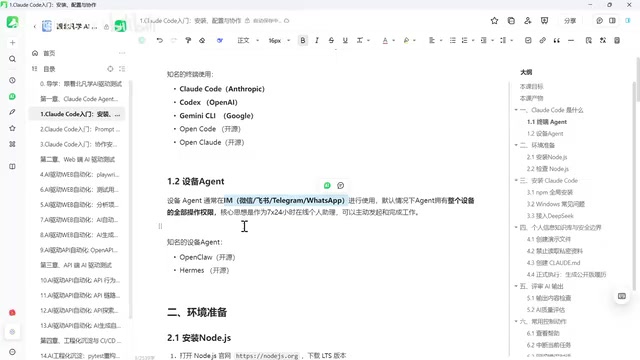
Device-based Agents are usually invoked through IM tools (such as WeChat, Feishu, DingTalk). They have a low barrier to entry and are quick to pick up—no need to open a computer or be familiar with commands. But the price of convenience is expanding permissions: instructions are sent to a backend gateway, and the AI needs to receive messages from the chat tool and complete complex tasks, at which point it often has full permissions over the entire device.
The course points out risk cases for such solutions—deleting system files and crashing the system, leaking confidential information. When "crayfish"-type tools went viral in March and April, national security authorities also issued warnings. Therefore, a common requirement in enterprise environments is not to use device-based tools like Open Claude in projects, because the uncertainty of entrusting company assets or even secrets to AI is too great. Device-based Agents are better suited for personal use, such as deploying an AI assistant for yourself.
Why It Ultimately Lands on Claude Code
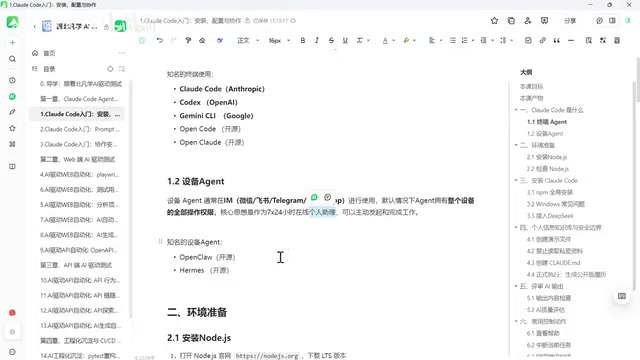
Among device-based Agents, Open Claude and the newer Elmas each have their characteristics; the latter has self-evolution capability, consuming more tokens but offering greater potential. However, self-evolution also means more uncertainty. For enterprise projects, controllability comes first—on the basis of maintaining excellent capability, you can't have "the computer blow up the next day." This is exactly why the course chooses terminal-based Agents and ultimately settles on Claude Code: it's excellent enough, and there are many open-source works referencing it, making the ecosystem mature.
Codex and Gemini CLI are two representative tools in the same terminal-based camp as Claude Code. Codex was originally OpenAI's code generation model and later extended into a command-line programming agent form; Gemini CLI is a terminal Agent released by Google, bound to the Gemini model. The three share similar positioning—running in the command line, scoped to the current directory, with humans retaining final decision-making power—but their underlying models, tool-calling protocols, and ecosystem extension methods differ. Understanding this landscape helps avoid equating "terminal-based Agent" with any specific product: when selecting, you should look not only at the model's coding ability but also at whether it supports open protocols like MCP, whether it can connect to the enterprise's internal toolchain, and whether the community has enough practical references.
After Technical Selection: Environment Preparation and Implementation Path
After determining the technical direction, the course moves into environment setup. The first step is installing Node.js, the foundational dependency for running Claude Code. The instructor mentions that if Node.js is already installed on the computer, this step can be skipped. Later, DeepSeekAd will be introduced as the AI large model to work with Claude Code to advance testing tasks.
From the framework revealed in the course, the core logic of this solution is: Claude Code acts as the terminal-based Agent to take on tasks, the Agent thinks, advances, and completes the task loop on its own, and test developers shift from typing code line by line to task design and result control. For test developers hoping to advance, understanding the Agent permission model and selection logic is more important than rushing to pick up a tool—choosing the wrong category can lead to completely opposite directions in terms of risk and effort savings.
The course also leaves room for interaction: if learners encounter conceptual or terminology questions during the course, they can ask the instructor in the comments section, which shows the content is aimed at test developers who are still unfamiliar with the AI toolchain.
One-line Summary
Test developers advancing their careers should choose terminal-based Agents rather than device-based ones; Claude Code becomes the top choice due to its controllability and mature ecosystem.
Paragraph Summary
The article focuses on how test development can leverage AI programming tools to improve efficiency, pointing out that Claude Code is a terminal-based programming Agent released by Anthropic, running in the command line, scoped to a project or directory, with humans always retaining ultimate decision-making power. The course divides Agents into terminal-based and device-based: the former is managed at the project level with controllable permissions and is the mainstream enterprise solution; the latter is invoked through IM tools with a low barrier to entry but often has full device permissions, posing risks of system damage and confidential information leaks, making it unsuitable for enterprise projects. Selection ultimately lands on Claude Code because of its excellent capability, mature ecosystem, and the many open-source products that reference it. The implementation path includes installing the Node.js foundational environment, pairing with the DeepSeek model, letting the Agent autonomously drive the testing task loop, and shifting test developers from line-by-line coding to task design and result control.
Related articles

Working with AI Agents Requires Nerves of Steel
The more autonomous AI agents become, the heavier the user's psychological burden. Drawing from a Hacker News discussion, this article analyzes black-box anxiety, behavior drift, and monitoring fatigue in agent collaboration, and offers practical approaches like sandbox isolation, permission control, and task granularity management to reduce cognitive load.

To Replace Adobe Acrobat, I Built My Own Open-Source PDF Reader Folio
A developer unhappy with Adobe Acrobat's bloat built Folio, a lightweight open-source PDF reader. Learn the design philosophy and use cases of this alternative.

Images 2.6 Released: Faster Image Generation and GIF Creation
Images 2.6 launches with faster image generation, GIF creation, more precise editing, and new developer API controls across ChatGPT, Codex, and the API.