Altman Says It's 'Hard to Imagine the AI Industry Without Jensen Huang' as Nvidia Founder Steps Down Amid Scandal

Huang steps down as Nvidia CEO amid scandal; Altman's remark reflects compute ecosystem dependence and governance concerns.
The article covers Jensen Huang's departure last week as Nvidia's founder and CEO amid personal scandals, including an affair with a woman alleged to be a Chinese spy. OpenAI CEO Sam Altman publicly said it's 'hard to imagine the AI industry without Jensen,' addressing only industry contributions while avoiding the scandal. The article argues this reflects the extremely high switching costs of Nvidia's GPU and CUDA ecosystem, making frontier labs' compute supply hard to replace short-term, and notes the founder's sudden exit exposes governance and strategic continuity vulnerabilities — while the 'Chinese spy' allegation lacks independent verification and warrants caution.
Nvidia founder Jensen Huang stepped down last week amid a series of scandals, including an affair with a woman alleged to be a Chinese spy — news that quickly reverberated across the tech world. OpenAI CEO Sam Altman responded publicly, saying it's "hard to imagine the AI industry without Jensen." Behind that remark lies both a nuanced assessment of an industry icon and a reflection of how deeply the AI hardware ecosystem depends on Nvidia's approach.
Background: A Founder's Abrupt Exit
According to RSS sources, Huang stepped down last week from his roles as Nvidia's founder and CEO. The immediate trigger was a series of scandals involving his personal life, including an improper relationship with a woman alleged to be a Chinese spy. Nvidia has not yet released further details on governance arrangements following his departure.
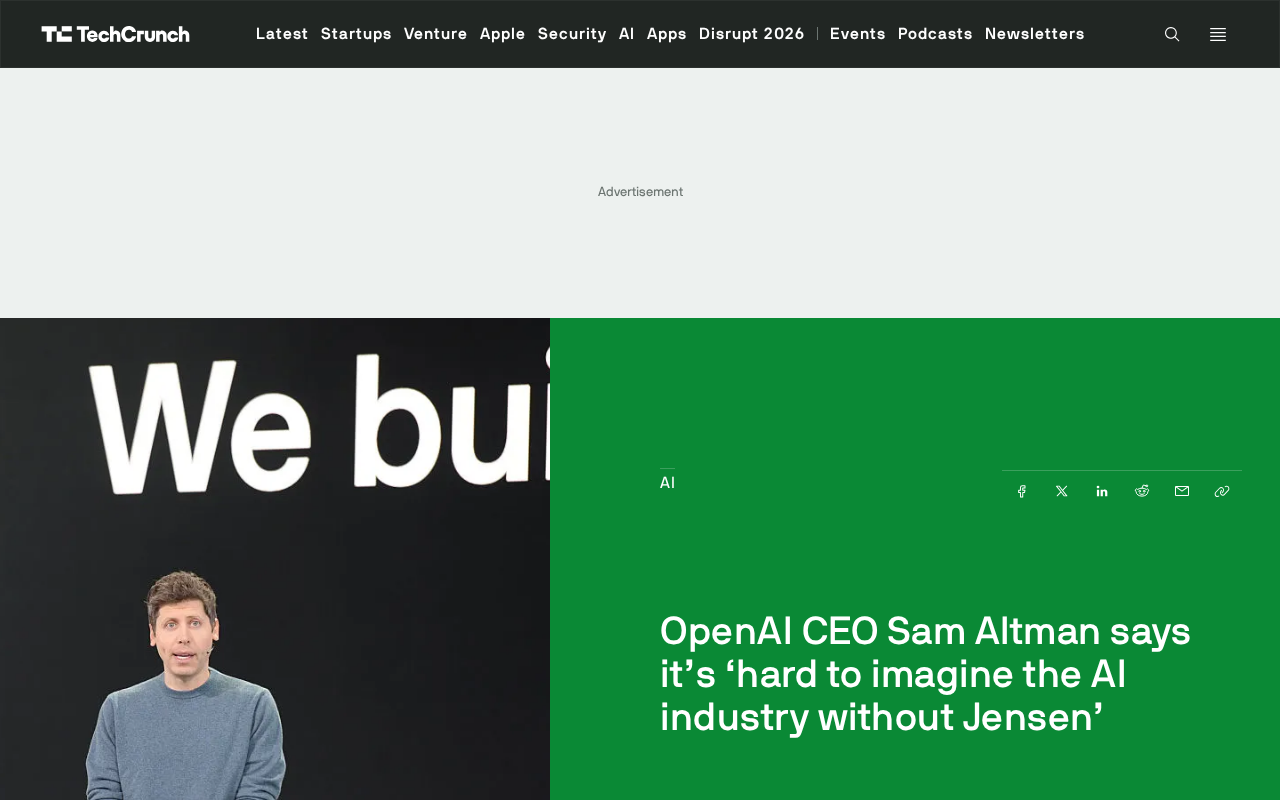
The news drew intense attention not only because Huang is the face of Nvidia, but because Nvidia occupies a near-central position in the AI compute supply chain. A founder exiting in this manner is not a story any company deeply tied to AI can afford to treat lightly.
Altman's Statement: Recognition and Silence
Only one line from Sam Altman's response has been widely quoted — "hard to imagine the AI industry without Jensen." The wording is a classic piece of executive PR: it acknowledges Huang's role in shaping the industry while making no judgment whatsoever on the scandal itself.
This "talk only about industry contributions, don't touch personal controversy" approach is hardly unusual among tech executives. But it leaves an obvious question: when a founder's personal conduct becomes entangled with corporate governance, supply chain stability, and even geopolitical sensitivities, the silence of industry leaders is itself a signal. By choosing to emphasize that "the industry can't do without him," Altman effectively shifted the focus of discussion from the scandal to Nvidia's irreplaceability.
Why "Can't Do Without": The Reality of the Compute Ecosystem
Putting Altman's words back into the reality of the AI industry, it's not hard to understand. Training and inference for today's mainstream large models rely heavily on Nvidia's GPUs and software stack. The developer ecosystem, toolchain, and optimization expertise built around CUDA create extremely high switching costs.
This isn't to say there are no alternatives — other chipmakers and in-house accelerators are all making progress — but moving from "usable" to "same scale, same maturity" takes years. For frontier labs like OpenAI, continuity of compute supply directly affects the pace of model iteration. Altman's "hard to imagine" is less an emotional expression than a plain description of supply chain reality.
CUDA (Compute Unified Device Architecture) is a parallel computing platform and programming model introduced by Nvidia in 2006, allowing developers to write general-purpose computing programs directly on GPUs using a C-like language. After nearly two decades of accumulation, the underlying operators of mainstream deep learning frameworks (PyTorch, TensorFlow, JAX), communication libraries (NCCL), inference engines (TensorRT), and a large number of academic codebases are optimized for CUDA first or even exclusively. This means migrating to other accelerators isn't just swapping hardware — it requires rebuilding operator libraries, debugging numerical precision, and rewriting performance-critical paths, at enormous cost in manpower and time. This "software moat" is harder to replicate in the short term than pure lithography or process advantages, and it is central to understanding Nvidia's bargaining power.
Governance Questions Beyond the Scandal
In this incident, the "alleged Chinese spy" description comes from the original report and has not been cross-verified by independent sources — it should be treated with caution. But even setting that allegation aside, a founder's sudden departure due to personal scandal exposes vulnerabilities at the corporate governance level: who the successor is, whether strategy will continue, and how partnerships with major customers will be stabilized are all open questions.
For the AI industry, the warning here is that the fate of leading companies is increasingly hard to separate from their founders' personal conduct. The more geopolitically sensitive the compute supply chain, the more easily such personal-level turbulence gets amplified into industry-level uncertainty. Altman's statement sidestepped these questions, but the industry cannot.
"Key-person risk" in corporate governance refers to a company's over-reliance on a single core individual, whose departure, incapacitation, or reputational damage can directly impact strategic continuity and market confidence. For founder-led tech companies, this risk is typically mitigated through board independence, clear succession plans, and dual-class share voting arrangements. Nvidia long had Huang serving simultaneously as founder, CEO, and public face, with his personal brand tightly bound to the company brand. Once he departs suddenly for non-business reasons, investors, customers, and supply chain partners all need to reassess the stability of the decision-making chain. This is why such events often trigger not just public discussion but also chain reactions at the level of contract terms, credit conditions, and partner due diligence.
One-line Summary
Huang steps down as Nvidia CEO amid scandal; Altman's statement reflects compute ecosystem dependence and governance concerns.
Paragraph Summary
The article centers on Jensen Huang's departure last week as Nvidia's founder and CEO amid personal scandals, including an affair with a woman alleged to be a Chinese spy. OpenAI CEO Sam Altman publicly said it's "hard to imagine the AI industry without Jensen," addressing only industry contributions while avoiding the scandal itself. The article argues that behind this statement lies the extremely high switching costs created by Nvidia's GPU and CUDA ecosystem, making frontier labs' compute supply hard to replace in the short term. It also notes that a founder's sudden exit due to personal scandal exposes vulnerabilities in governance and strategic continuity at leading AI companies, and that the "Chinese spy" allegation comes only from the original report without independent verification and should be treated with caution.
Related articles

Braised Meat Shop Forced Out by Rent Hike: A Life-and-Death Contest Between Craft and Location
Braised meat shop owner forced out by a 100,000 yuan rent hike moves overnight; landlord's daughter takes over with seasoning packets and overnight meat sickens customers. A tale of location versus craft.

AI One-Click Emotional Short Drama: Bilibili Creator Tests the "Beautiful Landlady" Script
Bilibili creator uses AI to produce the emotional short drama "The Beautiful Landlady Comes to Fix the Guy's Drain," testing everything from script generation to character consistency.

Braised Meat Stall Goes Viral, Landlord Raises Rent—She Leaves Gracefully by Contract While Rival Cuts Corners and Loses Everything
A braised meat stall's rent was hiked from ¥68K to ¥168K after going viral; the owner moved out by contract while her rival cut corners and lost it all.