Amazon Alexa Home Map Upgrade: 3D Reconstruction and Ring Camera Integration

Alexa Home Map is upgraded to an interactive 3D view and extends visibility outdoors via Ring cameras.
Amazon has rebuilt Alexa Home Map from a flat device diagram into an interactive 3D view, with devices embedded as spatial nodes in a three-dimensional home model, allowing users to directly find and operate devices in the corresponding room and reducing cognitive load in multi-device management. The new map also extends visibility outside the property through compatible Ring cameras, bringing security monitoring back from standalone apps into a unified smart home interface. This reflects the trend of smart home platform competition shifting from device count to spatial control experience, but the materials do not disclose compatible models, 3D modeling methods, pricing strategy, or privacy data handling details, so the actual experience remains to be seen.
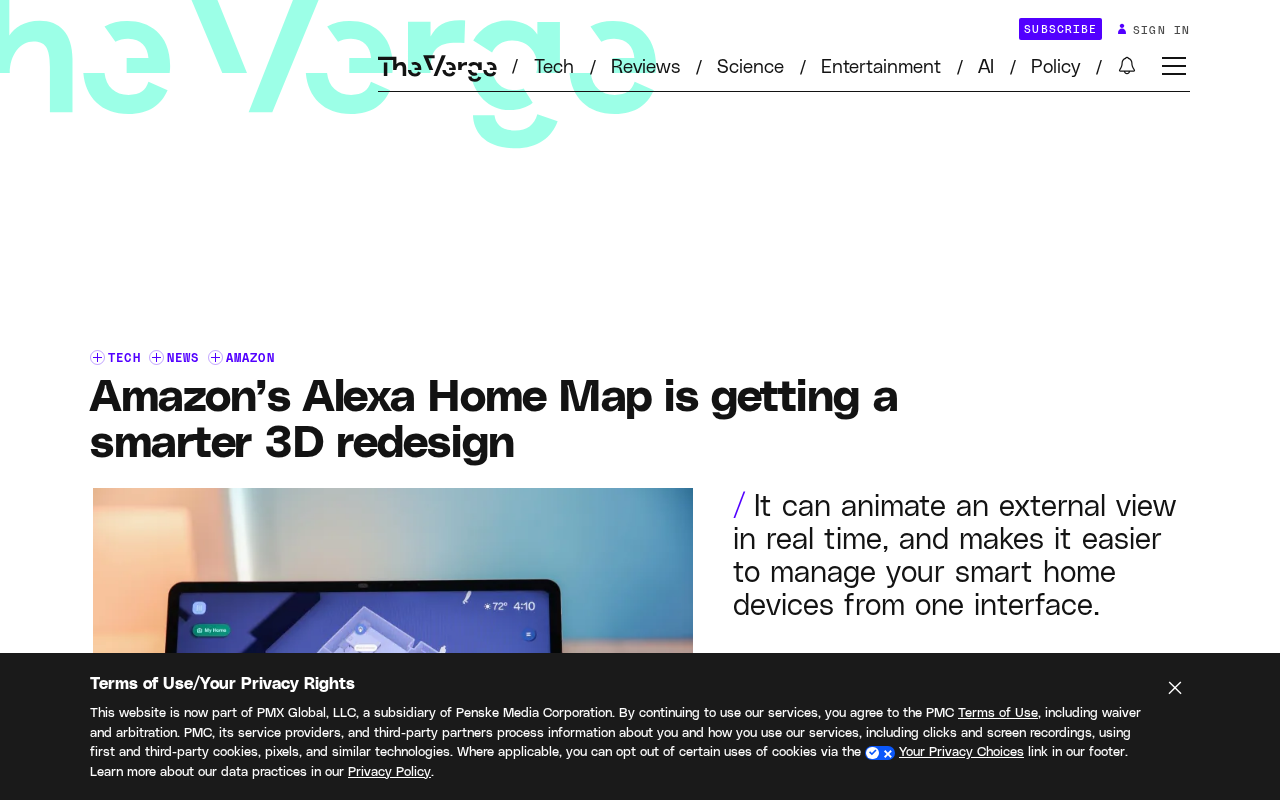
Amazon's smart home map interface has received a major update. What was once a flat display of device locations, Alexa Home Map, has now been rebuilt as an interactive 3D view that not only covers indoor devices but also extends the view outdoors through compatible Ring cameras. For users with many devices and complex spatial relationships, this may be a more intuitive control entry point than voice commands.
From Flat to Dimensional: Visual and Interaction Upgrades of the Home Map
According to reports from RSS sources, the new Alexa Home Map has been revamped across three dimensions: graphics, functionality, and dynamic effects. Users no longer see a flat floor plan marked with icons, but a three-dimensional home model in which devices are embedded as spatial nodes.
The significance of this shift lies in reducing cognitive load. As more and more smart devices are connected in the home, it becomes difficult for users to remember the specific location and name of each device. The 3D view turns a "device list" into a "spatial map," allowing users to directly find the lights, sensors, or cameras in the corresponding room within the model and operate them with a click. Dynamic effects provide more intuitive visual feedback for state changes, such as device on/off or camera feed updates.
Amazon has not disclosed specific graphical technical details or performance parameters in the materials, but from the interaction logic, this appears to be more about building a spatial control hub for Alexa rather than simple interface beautification.
Ring Camera Integration: Extending the Home Map Outdoors
A key change in this upgrade is the coverage of outdoor areas. The new map can leverage compatible Ring cameras to include the space outside the user's property within the map's field of view. In other words, the boundary of the home map has expanded from "indoor device distribution" to "integrated indoor and outdoor monitoring."
This integration has a clear ecosystem logic. Amazon-owned Ring holds an important position in the home security camera market. Connecting Ring feeds to Alexa Home Map essentially brings security monitoring back from a standalone app experience into a unified smart home interface. Users can see the real-time status of outdoor cameras on the map without switching between multiple applications.
However, the materials do not specify which Ring models are compatible, whether historical video playback is supported, or whether the data source for outdoor modeling is camera footage or manual user configuration. The absence of these details means the actual experience may vary by device and region.
Ring is a smart home security brand acquired by Amazon in 2018, known for its video doorbells and security camera product lines. Its devices typically connect via Wi-Fi and support motion detection, two-way audio, and cloud recording subscription services (Ring Protect). In the Amazon ecosystem, Ring feeds were previously accessed mainly through the standalone app or Alexa voice commands, integrated with Echo devices for scenarios such as "check the door." Connecting Ring cameras to Alexa Home Map means Amazon is breaking down the boundary between security and home control, turning cameras from standalone security tools into real-time sensing nodes on the spatial map. This integration also brings new privacy considerations: how camera feeds are stored in the map, who has access, and whether they are enabled by default are all issues users will care about.
The Competitive Logic of Smart Home Control Entry Points
From an industry perspective, the 3D transformation of Alexa Home Map is not an isolated move. The focus of smart home platform competition is shifting from "how many devices are supported" to "how to make multi-device collaboration understandable." When the number of devices exceeds a certain threshold, list-based management becomes ineffective, and spatial interfaces become an inevitable choice.
Amazon's advantage lies in the breadth of its hardware ecosystem: Echo devices, Ring cameras, smart appliances, and more form a closed loop from sensing to execution. Using the map as a unified entry point helps strengthen user stickiness to the Alexa ecosystem. But challenges remain—the coverage of 3D modeling, the accuracy of real-time device state synchronization, and the unified presentation of devices from different brands on the map are all engineering problems that require continuous iteration.
The materials do not provide user numbers, device compatibility lists, or release timelines, so the actual impact of this upgrade on the overall ecosystem will require observation of subsequent product rollouts.
Spatial UI is an important trend in the smart home field in recent years. Its core idea is to map device information into real physical space, leveraging humans' natural memory for location to reduce operation costs. Compared to list or card-based interfaces, spatial interfaces can simultaneously present the relative relationships between devices, such as the linkage between "living room light" and "living room camera." Implementing spatial interfaces typically relies on three types of data: room layouts manually annotated by users, sensor data from the devices themselves (such as camera feeds or UWB positioning), and automatically generated 3D models. The accuracy and privacy implications of different approaches vary greatly—manual annotation is the most controllable but tedious, while automatic modeling via cameras involves more sensitive data collection. This is one reason why Amazon has not yet disclosed the modeling method for Alexa Home Map.
Known Information and Open Questions
What can be confirmed so far: the new Alexa Home Map uses a 3D interactive view, covers indoor and outdoor spaces, extends outdoor visibility through compatible Ring cameras, and adds new graphics, functionality, and dynamic effects.
What remains unclear includes: whether it is available to all Alexa users, whether there is a fee, whether the 3D model is automatically generated or requires manual setup by users, and how privacy data for the outdoor map is handled. For users concerned about smart home privacy, the latter two points are particularly critical—how outdoor camera feeds are presented and stored in the map will directly affect the acceptance of this feature.
Overall, the direction of this upgrade is clear: to evolve the home map from "visualization of a device list" to "an entry point for spatial control." However, Amazon still needs to provide more details on the specific experience and privacy design.
One-line Summary
Alexa Home Map is upgraded to an interactive 3D view and extends visibility outdoors via Ring cameras.
Paragraph Summary
Amazon has rebuilt Alexa Home Map from a flat device diagram into an interactive 3D view, with devices embedded as spatial nodes in a three-dimensional home model, allowing users to directly find and operate devices in the corresponding room and reducing cognitive load in multi-device management. The new map also extends visibility outside the property through compatible Ring cameras, bringing security monitoring back from standalone apps into a unified smart home interface. This reflects the trend of smart home platform competition shifting from device count to spatial control experience, but the materials do not disclose compatible models, 3D modeling methods, pricing strategy, or privacy data handling details, so the actual experience remains to be seen.
Related articles

Private Key Set to 4? CA's Elementary Mistake Leaves TLS Exposed
CA eMudra set private keys to tiny values like 4, making TLS certificates brute-forceable. A Computerphile video demonstrates the full process from extracting public keys to forging certificates, and explores the fragility of the PKI trust chain.

How Gen Turns Data into Decisions with ChatGPT Work
In an OpenAI user case, business leader Gen shares how ChatGPT Work turns data into decisions: within hours of launch, teams can judge whether integrations and onboarding flows work, shifting decision iteration from hundreds of trial-and-error attempts to a fast feedback loop.

ChatGPT vs. Claude In-Depth Comparison: Strong at Coding but Weak at Research — How to Bridge the Gap?
A user considers switching from ChatGPT to Claude, finding Claude stronger at coding but shallower at research. We analyze the differences and share tips to make Claude's research deeper.