Amazon Alexa New Feature: Shop by Text Message
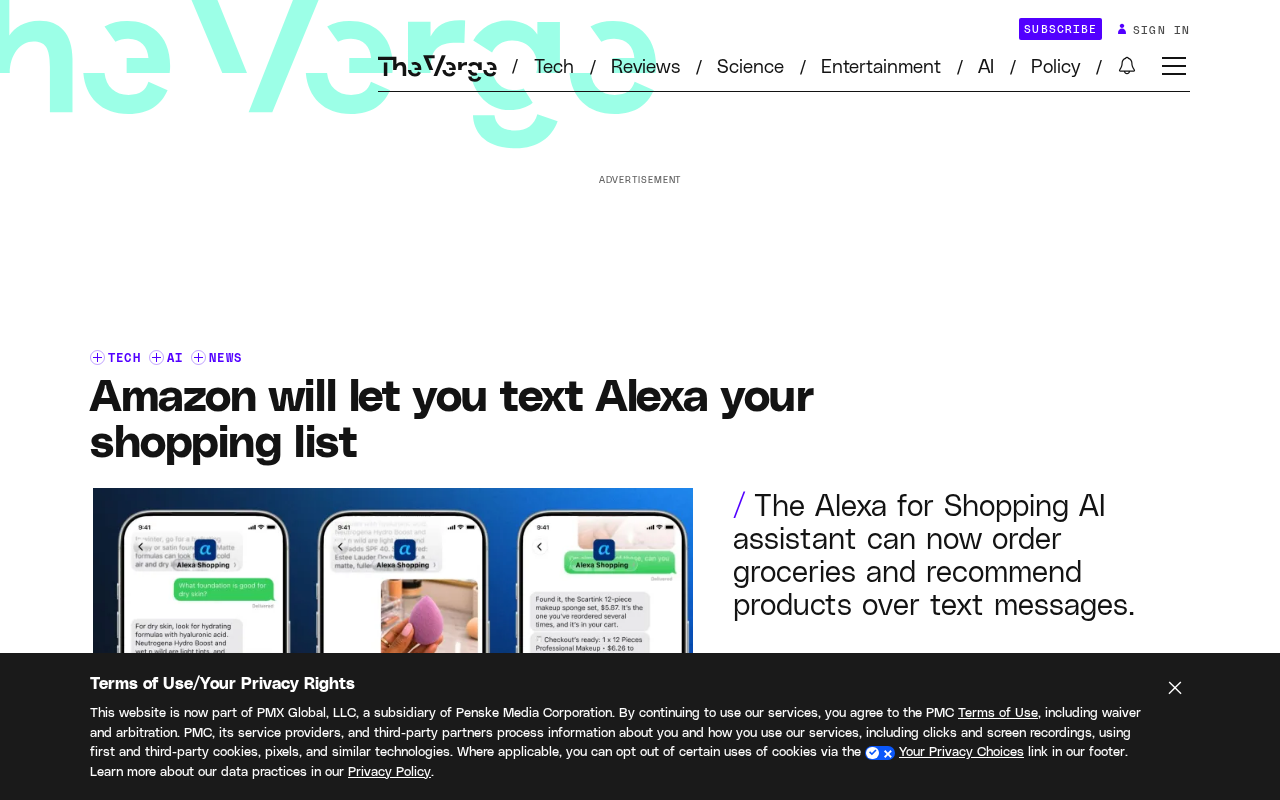
Amazon's Alexa for Shopping adds text message shopping with support for text and image product search.
Amazon has added text message shopping to Alexa for Shopping, allowing users to search for products by text description or photo, with the system matching against Amazon's catalog and replying with recommendations via text. This extends the shopping entry point from voice speakers and the app to the most widely covered text messaging channel, lowering the barrier to use and suiting middle-aged, elderly, and light online shoppers. Image input alleviates ambiguity in text descriptions, aligning with the e-commerce multimodal search trend. However, text messaging lacks interface capabilities such as lists, price comparison, and shopping carts, making the conversion chain longer; success depends on recommendation precision and redirect design. The article argues that AI shopping assistant competition is shifting toward omnichannel entry point coverage, and the degree of product information structuring will directly affect exposure opportunities.
From Voice to Text: Alexa's Shopping Entry Point Expands Again
Amazon is adding a new capability to its AI shopping assistant, Alexa for Shopping: users can now converse with it directly via text message to complete purchases. According to official disclosures, users can describe the product they want in text or send a photo, and Alexa for Shopping will search Amazon's product listings for matching results and reply with recommendations via text message. This means the shopping entry point is extending from voice speakers and the app to the most basic communication scenario of all—text messaging.
From a product logic standpoint, this is a "downgrade" of the entry point rather than an "upgrade." Text messaging requires no app installation, no wake word, and no specific hardware, making it friendlier to users who are unaccustomed to voice interaction or who are in noisy environments. Amazon clearly wants to compress the path from "think of something, buy it" to the shortest possible: open a text, type a few words, receive a recommendation, complete the order.
Image Recognition Fills the "Can't Describe It" Shopping Gap
The more noteworthy aspect of this feature is image input. Describing a product in words is often ambiguous—"that glass with markings" could be a measuring cup or a coffee sharing pot. Users can simply take a photo and send it to Alexa, and the system performs visual matching in the product catalog, significantly reducing communication costs and getting closer to the natural experience of "pointing at something and asking" in offline shopping.
This aligns with the multimodal search direction that e-commerce platforms have been pushing in recent years: shifting search from keyword matching to intent understanding. For Amazon, both the text and images in text messages are signals of shopping intent, and the model needs to determine whether the user wants to buy the same item, a similar item, or a complementary product. Replying with a "recommendation" is only the first step; the real challenge is that the recommendations must be accurate enough, otherwise users will quickly return to the app to search on their own.
Multimodal search refers to systems that simultaneously process multiple input forms such as text, images, and voice, and map them uniformly into the same semantic space for matching. In e-commerce scenarios, it typically relies on a visual encoder to convert product images into vectors, then performs nearest-neighbor retrieval against image vectors in the product catalog; text is encoded through a language model, and once the two are aligned, "search by image" or "mixed image-text queries" become possible. Compared with keyword matching, multimodal search is better at handling vague descriptions and same-item identification, but it also depends more heavily on high-quality product images and structured annotations.
Product Considerations Behind Text Message Shopping
Putting a shopping assistant into text messages—Amazon's calculation is not hard to understand. Text messaging is one of the most widely covered and lowest-barrier messaging channels, particularly suitable for middle-aged and elderly users and light online shoppers. Compared with asking users to specifically open the Amazon app, text message outreach is closer to a "casual question," capable of capturing vague needs that have not yet formed a clear purchase decision.
But the limitations of text messaging are equally obvious. It lacks interface capabilities such as product lists, price comparison, and shopping carts; information presentation can only rely on text and links, and the conversion chain is longer than in the app. Alexa for Shopping needs to send users back into the Amazon ecosystem to complete transactions through precise recommendations and smooth redirects. Whether this path works depends on recommendation quality and the interaction design of replies.
Technically, the text message channel belongs to carrier messaging services. Unlike in-app messages or web pages, it does not support rich interactive components and can only carry text, short links, and a small amount of media. This means text message shopping inherently lacks shopping cart, filtering, and price comparison capabilities, and users must re-establish context with each interaction. In addition, text messaging is affected by carrier compliance, sending frequency, and regional coverage differences, so cross-regional availability is not uniform—which is one reason Amazon has not yet announced the rollout scope.
Shopping Assistant Competition Enters the "Omnichannel" Phase
This update to Alexa for Shopping reflects a shift in the focus of AI shopping assistant competition: it is no longer about whose conversation is smarter, but about who can appear in every scenario where users develop shopping intent. Voice, app, text messaging, image search—the more dispersed the entry points, the higher the consistency requirements for backend product understanding and recommendation systems.
For sellers and brands, this also means that the degree of product information structuring will directly affect exposure opportunities—whether images are clear and whether titles and attributes are accurate will all influence visual matching and semantic retrieval results. The more widespread shopping assistants become, the more critical products' ability to be "understood by machines" will be.
Currently, Amazon has not disclosed the full rollout schedule or applicable scope of this feature. The actual experience of text message shopping, recommendation accuracy, and availability in different regions still require further observation.
Product information structuring refers to organizing titles, attributes, specifications, images, etc. as machine-parseable fields rather than piling them into free text. AI shopping assistants rely on these fields for semantic retrieval, visual matching, and recommendation ranking; missing or incorrect fields will directly cause products not to be recalled in conversation results. For sellers, this means that the completeness and accuracy of SKU data is changing from an "optimization item" to an "admission requirement"—image clarity, attribute completeness, and category accuracy will all affect the probability of being selected by AI.
Related articles
 Tech Frontiers
Gemini Omni 1.2 Flash: AI Video Moves Toward Draft-Style Editing
Google's Gemini Omni 1.2 Flash update enables conversational, draft-style editing of the same video—swap scenes while keeping products, adjust lighting while keeping characters. Clips up to 15s, 720p costs 30% less than the previous Flash—ideal for e-commerce ads, previs, and short-asset production.

Codex Tutorial: One-Command Install and Run Your First Task
Codex tutorial: one-command install and run your first task. Covers the four Codex forms, sandbox and approval guardrails, AGENTS.md and MCP configs, cloud network policy, and the iron rule of human review—everything you need to get started with this autonomous coding agent.
 Tech Frontiers
Localix: An Open-Source Agentic Development Environment with Multi-Model and Local AI Integration
Localix is an MIT open-source Agentic Development Environment (ADE) supporting seamless Claude Code plugin loading, multi-model cloud and local execution, Mini Apps extensions, and agent context management—an open AI collaboration workbench for developers.