Amazon Bets on Nuclear: 12 Small Reactors to Be Built in Indiana

Amazon and X-energy sign to build 12 SMRs at an Indiana retired coal plant, nearly 1 GW total, locking in low-carbon baseload power for AI data centers.
Amazon has agreed with nuclear technology company X-energy to build 12 small modular reactors at a retired coal plant site in Indiana, with total capacity near 1 gigawatt. Reusing the site's grid and community infrastructure lowers engineering and interconnection costs. The deal extends Amazon's nuclear strategy on a larger scale, driven by AI data centers' demand for stable low-carbon baseload power. SMRs allow phased construction but face regulatory delays, first-of-a-kind cost risks, and immature supply chains; the deal also signals tech firms moving into direct nuclear development and financing.
Amazon has scored another win in its clean energy push. According to an RSS source, Amazon has reached a new agreement with nuclear technology company X-energy to build 12 small modular reactors (SMRs) at the site of a retired coal plant in Indiana, with total installed capacity approaching 1 gigawatt. This is not only another step up in Amazon's nuclear ambitions but also marks a new phase in the race among tech giants to secure stable, low-carbon power for AI data centers.
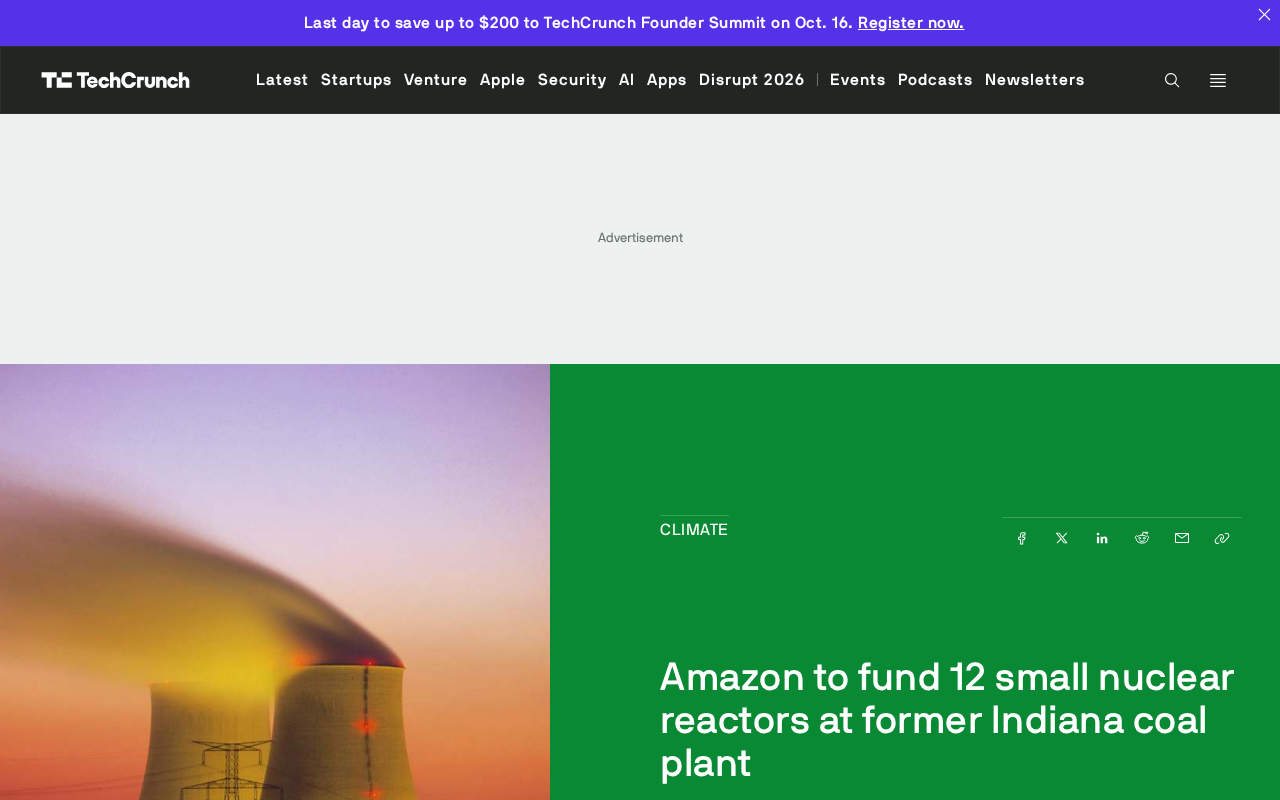
From Coal to Nuclear: The Energy Transition of a Power Plant
Choosing a retired coal plant as the project site is itself highly symbolic. Coal plants typically come with mature grid interconnection conditions and community infrastructure, and converting them into nuclear facilities can greatly reduce upfront engineering difficulty and grid-connection costs. For tech companies eager to lock in long-term power, this "new wine in old bottles" approach is more efficient than siting from scratch.
The scale of 12 small reactors is a relatively large undertaking in SMR deployment. A single SMR usually ranges in the tens of megawatts, and 12 units together approach 1 gigawatt—equivalent to the output of one large conventional nuclear unit. The advantage of modular design lies in the ability to build in phases and commission progressively, reducing single-investment risk and engineering complexity.
Amazon's Nuclear Puzzle: More Than One Partner
This is not Amazon's first foray into nuclear power. The company has previously established partnerships with several nuclear firms, including investing in SMR developers and signing power purchase agreements. The X-energy deal is a continuation of its nuclear strategy, but on a more considerable scale.
Tech giants' enthusiasm for nuclear power stems from AI computing's hunger for electricity. Training and running large models requires a continuous, stable, and low-carbon power supply, while wind and solar have intermittent shortcomings due to weather. Nuclear power happens to provide baseload electricity with both zero-carbon attributes and high utilization, making it an ideal choice for data center operators. In recent years, Amazon, Microsoft, Google, and others have all bet on nuclear power, forming a wave of "tech company nuclear power."
Baseload power provided by nuclear energy refers to a power source that can output continuously and stably 24 hours a day, unaffected by weather or day-night cycles, with a capacity factor (the ratio of actual generation to theoretical maximum generation) typically above 90%, far higher than wind power's roughly 35% and solar PV's roughly 25%. The load characteristics of AI data centers match baseload power highly: training tasks require GPU clusters to run at full load for extended periods, and any power fluctuation can affect the stability of computing tasks and hardware lifespan. Although wind and solar are low-cost, they require large-scale energy storage or natural gas peaking to meet data centers' reliability requirements, whereas nuclear power can directly provide smooth zero-carbon electricity—this is the key technical logic behind tech giants turning to nuclear.
SMR Technology Path: Opportunities and Uncertainties Coexist
Small modular reactors are highly anticipated, with supporters arguing that this technology can shorten construction cycles, lower unit investment, and improve safety. X-energy's high-temperature gas-cooled reactor technology path theoretically possesses inherent safety characteristics and is suitable for industrial energy supply and power generation scenarios.
However, large-scale commercialization of SMRs still faces obstacles. Regulatory approval processes are lengthy, first-of-a-kind construction costs often exceed expectations, and supply chains and fuel supply systems are not yet mature. Whether a gigawatt-scale deployment plan can be implemented on schedule depends largely on the Nuclear Regulatory Commission's licensing progress and project execution capability. Historically, cases of nuclear project delays and cost overruns are not uncommon, and this is a test that all SMR promises must face.
High-temperature gas-cooled reactors (HTGRs) use graphite as a moderator and helium as a coolant, with core outlet temperatures reaching above 750°C, far higher than the roughly 300°C of conventional light-water reactors. This characteristic allows them, in addition to power generation, to provide high-temperature heat sources for industrial processes such as chemicals and steel. The so-called "inherent safety characteristics" mainly refer to the ability of their ceramic-coated particle fuel to retain radioactive material even under extreme accidents, and the large core heat capacity and low power density mean that even with loss of active cooling, core melting is unlikely. X-energy's Xe-100 single-unit design power is about 80 megawatts (electric), using a pebble-bed core and helium turbine cycle, belonging to one of the Generation IV reactor technology paths. There is currently no commercial precedent at the same scale globally; the first-of-a-kind demonstration project is part of the U.S. Department of Energy's Advanced Reactor Demonstration Program.
Small modular reactors (SMRs) refer to nuclear reactors typically with electric power below 300 megawatts, manufactured modularly in factories and assembled on site. Compared with conventional large nuclear units, the core selling points of SMRs are the potential for cost reduction through batch manufacturing, shorter construction cycles, and more flexible grid adaptability. Modular design allows building a few modules first and expanding gradually as demand grows, thereby spreading investment risk. But this economic advantage has not yet been verified by actual projects: most SMRs worldwide are still in the design or first-of-a-kind construction stage, and whether unit costs can decline with economies of scale is the focus of industry debate. The U.S. Nuclear Regulatory Commission (NRC)'s licensing review framework for SMRs is still being refined, and first-of-a-kind applications often take years.
Far-Reaching Impact on AI Infrastructure
If the project proceeds smoothly, these 12 reactors will provide long-term stable power security for Amazon's cloud services and AI infrastructure. At a time when electricity has become a bottleneck for AI development, locking in large-scale low-carbon power is equivalent to holding the key to computing expansion.
This deal also sends a signal: tech companies are no longer satisfied with buying renewable energy certificates or signing wind and solar PPAs, but are directly intervening in the development and financing of nuclear projects. This deep participation model will reshape the energy investment landscape and may also spark discussion about tech giants' influence in the energy sector.
For Indiana, a retired coal plant gaining nuclear rebirth means continuation of jobs and the tax base. But nuclear waste disposal and community acceptance remain long-term issues to face. Whether this deal can become a model for scaled SMR deployment is worth continued attention.
One-line Summary
Amazon signed with X-energy to build 12 SMRs at a retired coal plant in Indiana, with total capacity near 1 gigawatt, locking in low-carbon baseload power for AI data centers.
Paragraph Summary
Amazon has reached an agreement with nuclear technology company X-energy to build 12 small modular reactors at the site of a retired coal plant in Indiana, with total installed capacity approaching 1 gigawatt. Siting at a retired coal plant leverages existing grid interconnection and community infrastructure to reduce engineering difficulty and grid-connection costs. This continues Amazon's nuclear strategy on a larger scale, driven mainly by AI data centers' enormous demand for stable, low-carbon baseload power. SMRs use modular design, allowing phased construction and progressive commissioning, but commercialization still faces uncertainties such as lengthy regulatory approval, first-of-a-kind cost overruns, and immature supply chains. The deal also signals that tech companies are shifting from buying green power certificates to directly participating in nuclear development and financing, reshaping the energy investment landscape.
Related articles

Chain of Thought Isn't Just for AI: How Humans Can Use CoT to Improve Thinking Quality
Chain of Thought isn't just a prompt trick for large models. Starting from a Hacker News discussion, this article analyzes why CoT works for human thinking too, breaks down actionable ways to transfer it, and highlights the key differences between human CoT and machine CoT.
Cloudflare Teams Up with OpenAI: Closi…
Cloudflare Teams Up with OpenAI: Closing the Loop from Vulnerability Discovery to Defense with AI
Cloudflare uses OpenAI Daybreak to investigate security vulnerabilities and generate reviewable remediation plans, while developers use Codex to boost coding efficiency and quality.

Orca Multi-Agent Orchestration in Practice: A Guide to Parallel Collaboration with Claude and Codex
Orca is Stable AI's free open-source agent workbench supporting 34 agents like Claude Code and Codex in parallel. Learn its Git worktree isolation, multi-model orchestration, and mobile management.