Amazon Delivery Drivers' Smart Glasses Spark Privacy Concerns Over 'Near-Constant' Photography

Amazon's delivery driver smart glasses capture thousands of photos per shift, sparking privacy concerns over passersby and private property.
According to Bloomberg, Amazon is deploying smart glasses for delivery drivers that capture footage 'almost without interruption' during shifts, producing thousands of photos per shift covering passersby, homes, and private property. These images are uploaded to Amazon's AI systems, likely for optimizing deliveries and training computer vision models. The core controversy lies in the device's indiscriminate, high-frequency mobile recording: those captured have no opportunity for awareness or consent, and Amazon has yet to clarify image retention periods or intended uses. The situation highlights the recurring tension tech companies face when collecting AI training data — the commercial and technical logic is clear, but social acceptance and privacy compliance remain significant obstacles.
Smart Glasses Enter the Delivery Scene
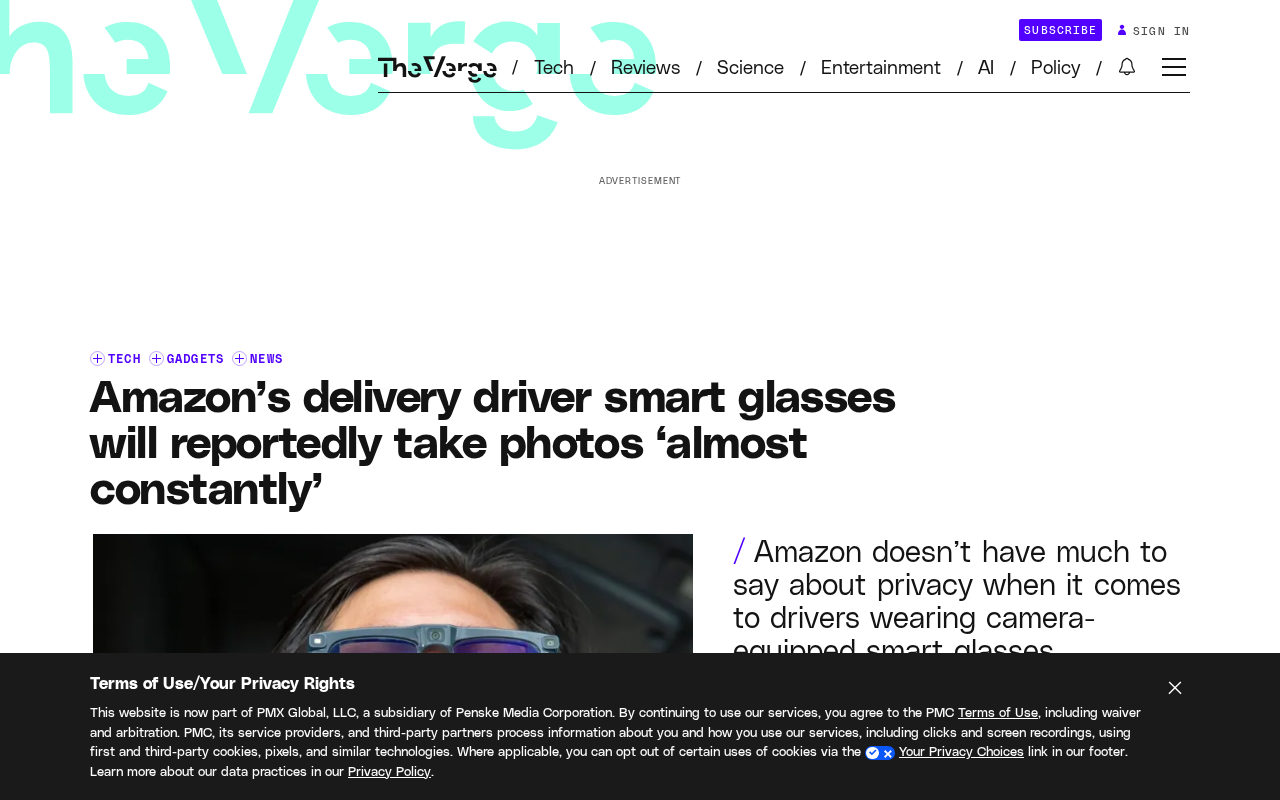
According to Bloomberg, Amazon is deploying a smart glasses device for its delivery drivers — and the feature drawing the most attention is that the device captures everything within the driver's field of view "almost without interruption" throughout their shift, including passersby and private property.
The report notes that a single driver's typical shift could produce "several thousand captures." This staggering volume of image collection means Amazon's delivery network would effectively become a continuously operating visual data-gathering system.
Photos to Be Uploaded to Amazon's AI Systems
According to Bloomberg's reporting, the massive volume of photos captured by these glasses will be uploaded to Amazon's AI systems. While the specific use cases haven't been fully detailed in available coverage, within the context of deliveries, this kind of image data would likely be used to optimize delivery workflows, verify package drop-off status, and train computer vision and AI models.
For Amazon, the delivery segment has always been a central battleground for efficiency and cost control. Smart glasses could free up drivers' hands, making navigation, package scanning, and address confirmation more efficient. But when an "efficiency tool" doubles as a "continuously recording camera," questions about its boundaries naturally arise.
Training computer vision models is heavily dependent on large volumes of real-world scene images — especially "last-mile" data containing details like address numbers, porch layouts, and package placement environments. Amazon has previously installed cameras inside delivery vehicles (such as the Driver monitoring system developed with Netradyne) to assess driver behavior in real time. The glasses camera extends the capture perspective from inside the vehicle to the "last few dozen meters" of on-foot delivery. First-person view (FPV) images like these are extremely valuable for training models that recognize address numbers, confirm package receipt, and detect obstacles — something street-view maps or satellite imagery simply cannot replicate. This is why delivery workers themselves become a low-cost, high-coverage mobile data collection node. The business logic is crystal clear, but it also makes the privacy controversy harder to sidestep.
The Core of the Privacy Controversy
What makes this device alarming is the combination of indiscriminate and high-frequency capture. Unlike a fixed-angle surveillance camera, glasses worn by a driver move through all manner of private and public spaces — residential doorsteps, neighborhood interiors, pedestrians on the street — all of whom may be recorded without any ill intent on the driver's part.
Key concerns include:
- Lack of awareness and consent among those photographed: Passersby and residents typically have no idea they are being continuously recorded by a pair of glasses.
- Data ownership and retention: How images uploaded to Amazon's AI systems will be stored, how long they'll be kept, and whether they'll be used for other purposes remains unclear.
- Large-scale data centralization: With tens of thousands of drivers each producing thousands of photos daily, Amazon would effectively hold a dynamic image database covering vast swaths of communities.
Rebalancing Efficiency and Privacy
This situation reflects a tension tech companies repeatedly encounter when deploying AI in the real world: solutions that are technically feasible and commercially valuable often face resistance on social acceptance and privacy compliance grounds.
Wearable camera devices are nothing new, but deploying them at scale in public-facing delivery scenarios makes ordinary people passive subjects of data collection in their everyday lives. This is fundamentally different from the use of law enforcement body cameras or personal dashcams — the latter typically operate within well-defined contexts and legal frameworks, whereas the routine recording by delivery drivers' smart glasses remains in a regulatory gray zone.
As AI's demand for high-quality real-world image data continues to grow, similar "edge-collection" devices will likely proliferate. Finding a balance between commercial efficiency, AI training needs, and the public's right to privacy will be the decisive factor in whether such products gain broad acceptance.
The widespread adoption of body cameras by law enforcement offers a useful regulatory precedent: multiple U.S. states require encrypted storage of footage, set retention limits, and allow affected parties to request access to or deletion of relevant clips. The EU's General Data Protection Regulation (GDPR) explicitly classifies images that can identify individuals as "personal data," requiring collectors to have a lawful basis and fulfill notification obligations. By contrast, the U.S. currently lacks a unified federal privacy law governing facial or image data — only a handful of state laws, such as Illinois' Biometric Information Privacy Act (BIPA), impose strict restrictions on biometric data. This fragmented regulatory landscape is precisely the institutional soil in which "delivery driver smart glasses" are able to advance rapidly in a gray zone.
Conclusion
The available information primarily comes from Bloomberg's reporting, and Amazon has yet to make a comprehensive public statement about the device's specific data handling policies. For ordinary consumers and residents in communities served by delivery drivers, the key questions to watch are: the scope of image collection, how long images are retained, and whether an opt-out mechanism will be provided. The convenience smart glasses bring to deliveries is undeniable — but the privacy boundaries they push will inevitably subject this technology to considerable scrutiny and debate as it rolls out.
Related articles

Workbuddy for Absolute Beginners: How a Desktop AI Agent Fits Into Real Workflows
A beginner's guide to the Workbuddy desktop AI agent: installation, claiming credits, file management, and building automated workflows—compared with CodeX for fit and cost, helping professionals shift from AI question-askers to AI managers.

OpenAI's New Agent Stack: Computer Use, Decisions API, and Ultra-Fast Workflows
OpenAI Dev Day unveiled a new agent stack: Computer Use outperforms humans, Decisions API delivers ultra-low-latency classification via Luna, Agents API opens the same Computer Use capabilities, and GPT-6.1 Sol costs only one-seventh of Astra. Core updates, benchmark data, and developer insights.

Liang Wenfeng Open-Sources DeepInfo Inference Framework, Takes On U.S. Ban
DeepSeek open-sources its DeepInfo inference framework after its models, featuring GPU/CPU cross-pipelining, small-model prediction with large-model verification, and full Huawei Ascend and NVIDIA chip support—facing the U.S. federal ban head-on. This article analyzes its significance for AI deployment and open-source strategy.