Amazon Devices Chief Panos Panay: AI Devices Will Replace the App Era

Amazon devices chief Panay predicts AI devices will shift from passive response to proactive anticipation, weakening the app gateway.
At TechCrunch Disrupt, Amazon devices chief Panos Panay said future AI devices will shift from command-based interaction to anticipatory service, working in the background rather than waiting for users to open apps. This ambient AI vision means device form factor matters less than the AI understanding and service orchestration behind it. The article argues this signals not the death of apps but a migration of the interaction gateway: AI agents become the intermediary layer for services, weakening apps' gateway value. Amazon has an edge with Echo and Alexa, but must balance anticipation accuracy, privacy, and user control.
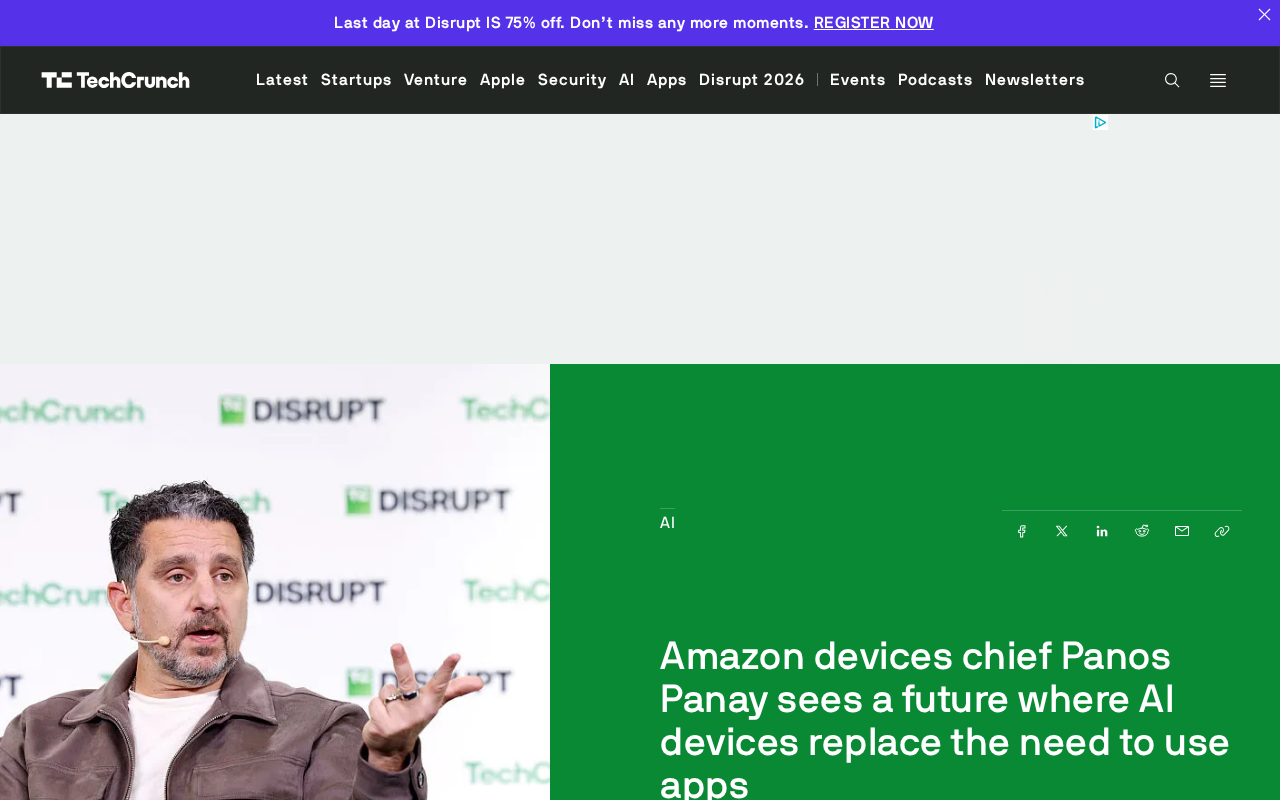
At TechCrunch Disrupt, Panos Panay, who heads Amazon's devices business, made a striking prediction: future AI devices will no longer wait for users to open an app and tap a button. Instead, they will work quietly in the background, anticipating your needs before you express them. It sounds like a plot device from a sci-fi film, but coming from the executive who oversees product lines like Echo, Kindle, and Fire TV, the claim carries considerably more weight.
From "Command-Based Interaction" to "Anticipatory Service"
The core scenario Panay described in conversation is not complicated: today's smart devices remain fundamentally passive—you need to wake them, give them instructions, and wait for a response. The next generation of devices he envisions should function like an assistant with great rapport, having everything arranged before you even speak.
This idea of "ambient AI" is not unique to Amazon. But Panay's remarks signal something important: Amazon is shifting the center of gravity of its device strategy from "innovation in hardware form factor" to "AI-driven, frictionless interaction." In other words, the physical form of the device may no longer be the most important competitive dimension. What matters is the AI's ability to understand and orchestrate services behind it.
Ambient AI refers to a class of intelligent systems that do not depend on users actively waking them up, but instead continuously perceive the environment and proactively provide services. Its technological foundations include always-on sensor fusion, low-power on-device inference, and context-understanding models. Unlike today's "wake word → command → response" model, ambient AI emphasizes "presence as service": through multimodal inputs such as vision, sound, location, and physiological signals, the device continuously builds a model of the user's current state, then intervenes at the right moment in a low-disruption way. The concept was first proposed by Xerox PARC in the 1990s, and only in recent years has it become truly viable thanks to falling inference costs for large models and rising edge compute power. Its biggest challenge is not perception accuracy, but judging the timing of intervention—when to act proactively and when to stay silent determines whether the experience feels "thoughtful" or "intrusive."
Will Apps Disappear? It's Not That Simple
The phrase "AI devices replace apps" is easy to misunderstand. Panay is not predicting that apps will vanish completely like pagers. He is pointing to a shift in interaction paradigm: users will no longer need to actively think, "I need to open a certain app to do something." Instead, AI will complete the task directly.
The impact on the developer ecosystem is profound. If users no longer enter services through app icons, then the "gateway value" of apps will be substantially weakened, potentially replaced by AI agents calling various services. This also explains why Amazon has continued to double down on Alexa+ and AI assistant capabilities in recent years—it needs its AI to become that "central dispatcher."
AI agent in the context of large models refers to a system capable of autonomous planning, tool invocation, and completing multi-step tasks. It typically consists of a planner, a tool-calling interface (such as function calling or the MCP protocol), and a memory module. When a user says, "Help me book a flight to Shanghai next week and arrange airport pickup," the agent will autonomously complete a series of actions including searching and comparing prices, placing the order, and notifying the driver—without the user having to open Ctrip, an airline app, and a ride-hailing app one by one. This is precisely the technical logic behind "the weakening of app gateway value": users no longer face application interfaces, but an intermediary layer capable of orchestrating across services. Current mainstream forms include system-level agents from phone manufacturers, standalone agent apps, and platform-embedded agents. The competitive focus lies in the range of callable services and permission boundaries. Whoever controls more callable service interfaces moves closer to the position of "central dispatcher."
Amazon's Strengths and Challenges
Amazon does have unique advantages in pursuing this. Echo devices have already entered tens of millions of households, and Alexa has accumulated long-term voice interaction data and smart home control experience. From smart speakers to Ring doorbells and the Astro robot, Amazon's hardware matrix covers multiple touchpoints in the home scenario.
But the challenges are equally clear. The core difficulty of ambient AI lies in "the accuracy of anticipation"—guess right and it feels thoughtful; guess wrong and it feels intrusive. Users' sensitivity to privacy and their threshold for accepting proactive AI behavior are variables that require fine balancing. In addition, how to maintain the user's sense of control in anticipatory interaction, rather than making AI seem to be "acting on its own initiative," is another question Panay and his peers must answer.
Alexa+ is Amazon's next-generation voice assistant launched in 2025, rebuilt on large language models and fundamentally different from the original Alexa's rule-based and intent-slot architecture. The old Alexa relied on predefined "intent recognition," requiring users to phrase things in relatively fixed ways to trigger the corresponding skills. Alexa+ has multi-turn dialogue, contextual memory, and generative response capabilities, and can autonomously call third-party services through "skill orchestration." It is also a key hub for Amazon's device ecosystem—Echo, Fire TV, Ring, and other hardware share the same AI backend, so user preferences and history can carry across devices. The significance of this architecture is that when interaction shifts from "opening an app" to "issuing intent to AI," whoever owns the user's long-term context owns the initiative in service distribution.
Industry Signal: The Battle for the Interaction Gateway Is Escalating
Seen against the broader industry backdrop, Panay's remarks reflect a consensus: tech giants are all betting on a "post-app era" of interaction. Whether through voice, vision, or environmental perception, the goal is to make AI the intermediary layer between users and the digital world.
The key to this competition is not whose hardware is cooler, but who can understand user intent more accurately and connect services more seamlessly. This judgment from Amazon's devices chief is essentially setting the tone for Amazon's AI-first strategy—devices are the vehicle, but AI is the soul.
"Post-app era" does not mean apps will disappear, but rather that apps will degrade from "interfaces users open directly" to "backend capabilities invoked by AI." There are already concrete signals of this trend across the industry: Apple is advancing the App Intents framework in iOS, allowing system agents to directly call functions inside apps; Google's Gemini is gradually taking over system-level operations on Android; OpenAI has partnered with multiple service providers to let ChatGPT directly complete tasks such as ordering food and shopping. For developers, this means a restructuring of traffic distribution logic—in the past, customer acquisition depended on app store rankings and icon exposure; in the future, it may depend more on "whether my service can be preferentially called by mainstream agents." The battle for the gateway is shifting from "whose icon is on the home screen" to "whose API is in the agent's tool list."
One-line Summary
Amazon devices chief Panay predicts AI devices will shift from passive response to proactive anticipation, potentially weakening the gateway value of apps.
Paragraph Summary
At TechCrunch Disrupt, Amazon devices chief Panos Panay proposed that the interaction paradigm of future AI devices will shift from "command-based" to "anticipatory"—devices will work continuously in the background, meeting user needs in advance rather than waiting for users to open an app and tap a button. This "ambient AI" concept means device form factor will no longer be the core competitive dimension; what matters is the AI understanding and service orchestration behind it. The article notes that this is not a prediction that apps will die, but a migration of the interaction gateway: users will no longer actively enter apps, and AI agents will become the intermediary layer for invoking various services, thereby weakening the gateway value of apps. Amazon has a first-mover advantage thanks to its Echo hardware matrix and Alexa ecosystem, but balancing anticipation accuracy, privacy boundaries, and the user's sense of control remains a difficult question it must answer.
Related articles

Chain of Thought Isn't Just for AI: How Humans Can Use CoT to Improve Thinking Quality
Chain of Thought isn't just a prompt trick for large models. Starting from a Hacker News discussion, this article analyzes why CoT works for human thinking too, breaks down actionable ways to transfer it, and highlights the key differences between human CoT and machine CoT.
Cloudflare Teams Up with OpenAI: Closi…
Cloudflare Teams Up with OpenAI: Closing the Loop from Vulnerability Discovery to Defense with AI
Cloudflare uses OpenAI Daybreak to investigate security vulnerabilities and generate reviewable remediation plans, while developers use Codex to boost coding efficiency and quality.

Orca Multi-Agent Orchestration in Practice: A Guide to Parallel Collaboration with Claude and Codex
Orca is Stable AI's free open-source agent workbench supporting 34 agents like Claude Code and Codex in parallel. Learn its Git worktree isolation, multi-model orchestration, and mobile management.