Amazon Drops Grubhub for Uber Eats, Swapping Prime Member Food Delivery Benefits

Amazon swaps Grubhub for Uber Eats as its Prime member restaurant delivery partner in the US.
Amazon has established Uber Eats as the official restaurant food delivery partner for US Prime members, replacing Grubhub. This change involves three parties: Amazon uses an established delivery network to lower self-operated costs and maintain membership appeal; Uber Eats gains a high-value user entry point and strengthens its competition with DoorDash; Grubhub loses an important traffic channel. The specific discount forms, scope, and timeline for Prime benefits have not been announced, and users may face a transition period. The article argues Amazon's choice to leverage rather than fully build in-house is a bellwether for the industry and has indirect implications for sellers and developers, but details remain to be observed.
Amazon's food delivery partnership strategy in the US market has undergone a major shift. According to RSS sources, Amazon has established Uber Eats as the official restaurant food delivery partner for Prime members, replacing its previous partnership with Grubhub.
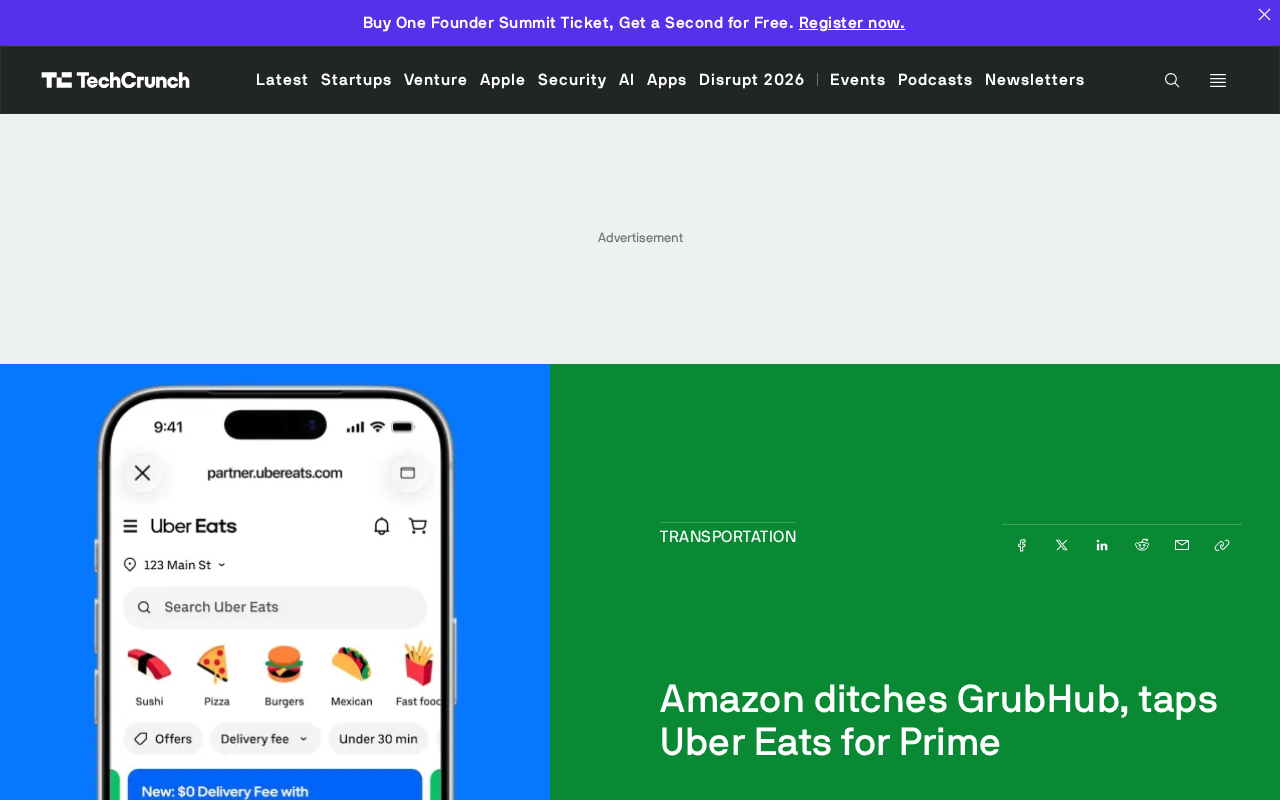
A Partnership Swap, Two Platforms' Strategic Pivots
On the surface, this change is simply Amazon switching food delivery partners, but it actually involves the interests of three parties. For Amazon, the food delivery benefit within Prime membership has always been one means of boosting member retention, and choosing Uber Eats means it values the latter's delivery network coverage and user scale more. For Uber Eats, securing this high-value user entry point through Amazon Prime is an important reinforcement in its competition with DoorDash in the US food delivery market. For Grubhub, losing this partnership channel with Amazon means losing a heavyweight ally in traffic acquisition.
Interestingly, Amazon has not completely abandoned building its own food delivery capabilities; this partnership is more of a trade-off between third-party delivery and its own services. Choosing an established external platform to handle Prime members' food delivery needs can reduce the operational costs of self-operated delivery while maintaining the appeal of membership benefits.
Grubhub is a veteran US food delivery platform that once merged with Seamless, was acquired by Just Eat Takeaway in 2020, and was resold to Wonder in 2024. It has strong penetration in cities like New York, but its nationwide coverage and user scale fall short of DoorDash and Uber Eats. Amazon previously partnered with Grubhub to offer Prime members free Grubhub+ membership, essentially using food delivery benefits to enhance member retention. This shift to Uber Eats shows that Amazon places more value on the latter's nationwide delivery network and high-frequency user entry point.
Uber Eats is Uber's food delivery business, relying on Uber's driver network and global operational experience, and has long ranked second in the US market, forming a duopoly competition with DoorDash. For Uber Eats, connecting to the Prime membership system means gaining access to a high-value, high-repeat-purchase user source, which helps increase order density and courier efficiency and further narrow the gap with DoorDash.
How Prime Member Benefits Will Change
For ordinary Prime members, the most direct concern is: will the existing Grubhub benefits continue, and what will the new Uber Eats benefits include? According to the original information, Uber Eats has become the official restaurant food delivery partner for Prime members in the US, but the specific form of membership discounts, scope of application, and timeline for implementation are not detailed in the source material.
This means members may experience a transition period of benefit switching in the short term. Prime users are advised to watch for benefit updates on their Amazon account page and check whether a dedicated entry point for Prime members appears within the Uber Eats app. During partnership transitions, the time gap between the discontinuation of old benefits and the launch of new ones is often where users are most likely to encounter pitfalls.
Chain Reactions in the US Food Delivery Market Landscape
The US food delivery market has long seen major competition among DoorDash, Uber Eats, and Grubhub. Amazon's shift in partnership focus from Grubhub to Uber Eats may further widen the gap between the leading platforms. With traffic brought in through Prime membership, Uber Eats is expected to see gains in order density and user activity; Grubhub, meanwhile, will need to find new traffic partners to fill the gap.
From an industry perspective, such partnership swaps between platforms are not uncommon, but Amazon's choice carries a certain bellwether significance—it shows that even a giant with strong logistics and a membership system tends to leverage the local delivery networks of established food delivery platforms rather than building everything itself. This is a case worth considering for other tech companies contemplating entry into food delivery or local life services.
DoorDash is the leader in the US food delivery market, holding the highest market share thanks to a large user base and delivery network. Its advantages lie in broad coverage, many merchants, and stable delivery times, and it locks in high-frequency users through its DashPass membership system. Amazon's choice to partner with Uber Eats rather than DoorDash avoids overly strengthening the leading competitor on the one hand, and on the other hand secures more favorable partnership terms by leveraging Uber Eats' competitive positioning.
The Prime membership system is Amazon's core asset, with more than 200 million members worldwide. Prime benefits typically include fast delivery, video and music services, exclusive discounts, and more; food delivery benefits are a retention tool added in recent years. Outsourcing membership benefits to third-party food delivery platforms rather than building its own restaurant delivery reflects Amazon's pragmatic strategy in local life services: exchange partnership for coverage, exchange traffic for benefits, and reduce the fixed costs and operational risks of self-operated delivery.
Indirect Impact on Developers and Sellers
Changes in food delivery partnerships may seem unrelated to e-commerce sellers, but there are indirect connections. Changes in the mix of Prime membership benefits will affect members' willingness to renew, which in turn affects the scale of active buyers on the Amazon platform. At the same time, if the Uber Eats-Amazon partnership extends to advertising or data, it could bring new exposure channels for local life merchants. At present, these extensions remain speculative; the original source material only confirms the replacement of the official food delivery partner.
For practitioners who follow platform ecosystems, it is advisable to continue tracking the specific implementation forms of the partnership between the two sides, especially how Prime membership benefits are integrated and the settlement rules—these details often determine the actual value of the partnership.
Questions to Watch
Several key pieces of information are still missing from this partnership change: the specific discount level for Prime members on Uber Eats, whether the partnership covers non-restaurant delivery, and the timetable for phasing out existing Grubhub Prime benefits. These details will determine the actual impact of this leadership change on user experience. Until official rules are announced, these questions can only remain under observation.
One-line Summary
Amazon is replacing Grubhub with Uber Eats as its Prime member restaurant food delivery partner in the US.
Paragraph Summary
Amazon has established Uber Eats as the official restaurant food delivery partner for US Prime members, replacing Grubhub. This change involves the interests of three parties: Amazon leverages an established delivery network to lower self-operated costs and maintain the appeal of membership benefits; Uber Eats gains a high-value user entry point and strengthens its competition with DoorDash; Grubhub loses an important traffic channel. The specific discount forms, scope of application, and timeline for Prime member benefits have not yet been announced, and users may experience a transition period of benefit switching. The article argues that Amazon's choice to leverage rather than fully build in-house has bellwether significance for the industry and indirect implications for sellers and developers, but partnership details remain to be observed.
Related articles
 Tech Frontiers
Gemini Omni 1.2 Flash: AI Video Moves Toward Draft-Style Editing
Google's Gemini Omni 1.2 Flash update enables conversational, draft-style editing of the same video—swap scenes while keeping products, adjust lighting while keeping characters. Clips up to 15s, 720p costs 30% less than the previous Flash—ideal for e-commerce ads, previs, and short-asset production.

Codex Tutorial: One-Command Install and Run Your First Task
Codex tutorial: one-command install and run your first task. Covers the four Codex forms, sandbox and approval guardrails, AGENTS.md and MCP configs, cloud network policy, and the iron rule of human review—everything you need to get started with this autonomous coding agent.
 Tech Frontiers
Localix: An Open-Source Agentic Development Environment with Multi-Model and Local AI Integration
Localix is an MIT open-source Agentic Development Environment (ADE) supporting seamless Claude Code plugin loading, multi-model cloud and local execution, Mini Apps extensions, and agent context management—an open AI collaboration workbench for developers.