Amazon Open-Sources Strands Decider 2B: Local Deployment Becomes the New Trend

AI shifts from scale to deployment: lightweight models, self-iteration, fraud risks, and infra leverage all converge.
This roundup covers several AI developments pointing to one shared trend: the scale race is giving way to practical deployment. Amazon's 2B-parameter Strands Decider focuses on local deployment and data privacy; AI appliance competition has shifted from parameter count to full-stack integration. Meanwhile, GPT-5.3 Codex reportedly used AI to assist in developing subsequent versions — hinting at self-iteration in model development. On the risk side, AI-powered romance scams have gone mass-scale at near-zero marginal cost, and real-time deepfakes have cracked the video Turing test. Researchers also warn of systemic leverage risks in AI infrastructure financing. Balancing efficiency and safety is now the defining challenge ahead.
Amazon Enters the Open-Source Decision Model Space
Amazon recently released an open-source decision model called Strands Decider 2B, with local deployment as its core selling point. According to the release brief, this 2-billion-parameter model demonstrates strong accuracy and efficiency on the JetBench public benchmark.
Compared to general-purpose LLMs with tens or hundreds of billions of parameters, a lightweight 2B-scale model better fits enterprise needs around data security, inference cost, and latency. Decision-making tasks don't require vast world knowledge — they require stable, controllable judgments in specific contexts. That's exactly where small, purpose-built models shine. The combination of open-source licensing and local deployment also means enterprises can run a fully private pipeline on their own infrastructure, without sending sensitive business data to the cloud.
This move aligns with a broader industry-wide push to reduce costs. Rather than chasing parameter count, models are converging toward scenario-specific, deployable solutions.
All-in-One AI Appliances Stop Competing on Parameter Count
On the hardware side, there's a parallel shift underway. According to the brief, large model appliances are beginning to "slim down" — not as a sign of weakness, but as a reflection of how the competitive logic is changing.
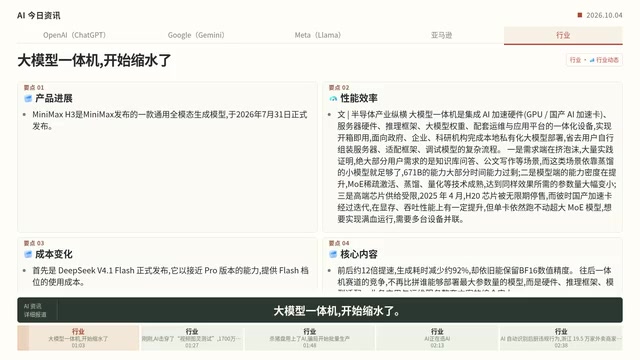
Taking general-purpose generative models like MiniMax H3 as an example, the appliance market is no longer about who can deploy the largest model. Competition is shifting toward integrated capabilities: hardware, inference frameworks, model optimization, business integration, and managed operations — the full stack. In short, the era of simply stacking parameters is fading. The winners will be those who can run models efficiently on the right hardware and genuinely embed them into business workflows.
This mirrors the same path Amazon's Strands Decider 2B is taking: lightweight, deployable, and highly adaptable. A small model paired with an optimized inference framework can deliver far more practical value in edge and private environments than its parameter count might suggest.
AI Is Now Building AI
Another noteworthy signal in the brief comes from OpenAI. According to the release notes for GPT-5.3 Codex, early versions of the model were reportedly used by the team to help develop subsequent versions — the AI debugged its own training process, managed its own deployments, and diagnosed test results and evaluations.
This means AI's role is evolving from "a coding assistant" to an Agent capable of independently completing the full loop: discovery, localization, fixing, and verification. If accurate, this marks the emergence of self-iteration within the model development cycle — something that could significantly reshape the efficiency curve of AI R&D over the long term. That said, claims in release notes should be taken with caution; the actual degree of autonomy and its boundaries remain unclear.
Background: What Is "AI Self-Iteration"? In technical terms, AI self-iteration typically refers to a model participating in its own training data generation, hyperparameter tuning, or evaluation pipelines — forming a partial closed loop. This differs from traditional software "automated testing," which relies on manually predefined rules and test cases. When an AI Agent enters the development loop, it can observe model behavior, generate counterexamples, and identify failure patterns without explicit rules. Academics refer to this direction as AutoML (Automated Machine Learning) or Meta-Learning. However, large language models acting as engineering agents to help build their own successor versions is a practice that has only emerged in recent years. It's worth noting that such systems still depend on human engineers to set objective functions and safety boundaries — models cannot autonomously decide "I need to get better" without supervision. For now, this is closer to a "highly automated toolchain" than true autonomous evolution.
The AI Fraud Problem and the Governance Dilemma
The flip side of technological progress is that misuse risks are expanding rapidly.
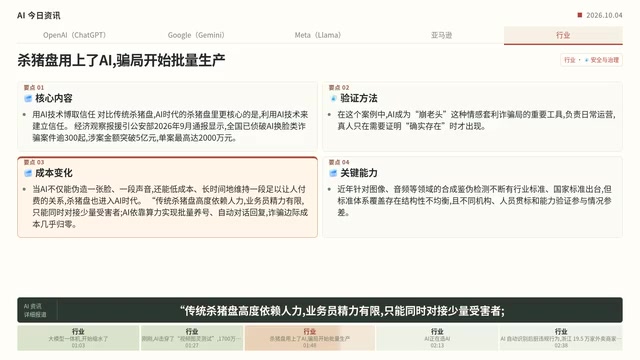
The brief notes that so-called "pig butchering" scams (romance investment fraud) have begun leveraging AI for mass production. Traditional scams were heavily labor-dependent — operators had limited bandwidth and could only manage a small number of victims at a time. AI, powered by compute, enables mass account farming and automated conversational replies, bringing the marginal cost of fraud close to zero. The key shift: scammers are using AI to build trust at scale.
At the same time, AI has reportedly broken through the "video Turing test," drawing around 17.36 million viewers online. For context, a previous-generation system under the same experimental conditions only fooled 1 out of 41 evaluators — a 2.4% pass rate. As the line between real and fake blurs, real-world disputes are emerging. One reported case involves an Airbnb host using AI-generated images to extort guests for fabricated repair costs — the guest successfully exposed the fraud using a watermark detector. The lesson for ordinary users: photos online may already have been AI-manipulated and may not reflect reality.
Background: The "Video Turing Test" The video Turing test is an extension of the classic Turing test. The original version uses text-only conversation to determine whether the other party is human; the video version requires AI to generate or manipulate a real-time video stream, subject to visual and behavioral judgment by human evaluators. Since humans are highly sensitive to micro-expressions, eye contact synchronization, and lip-audio matching, the video Turing test has long been considered far more challenging than its text-based counterpart. The 2.4% pass rate of the previous-generation system confirms this difficulty. The fact that a newer system can significantly raise the "convincingly fake" rate suggests real-time deepfake technology has crossed a critical threshold. This poses a direct challenge to identity verification scenarios — video job interviews, remote notarization, video customer service — where simply "seeing is believing" is no longer a reliable trust model.
Adjustments on Devices and Infrastructure
There are changes on the device side too. Huawei's Harmony OS 7.0 is modifying the "Xiao Yi" assistant agent feature, which will no longer support newly added devices going forward. Originally launched as an exploratory feature in Harmony OS 6.0, the agent — along with personal skills and scheduled tasks — will not be transferable via data migration to unsupported devices. This kind of iterative trade-off on experimental features reflects manufacturers' ongoing trial-and-error as they navigate paths to practical agent deployment.
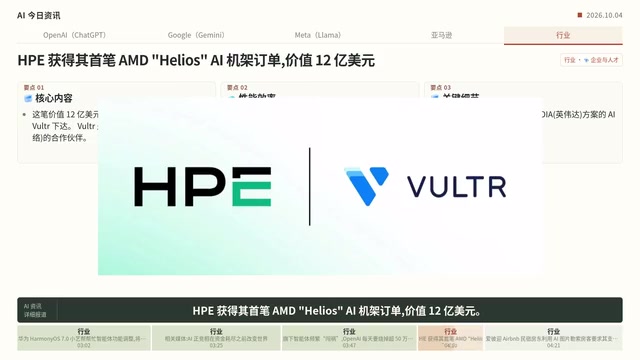
Under the surface on the infrastructure side, tensions are building. Researchers have flagged in conference papers that AI infrastructure carries significant debt financing with high leverage ratios — even a modest softening in demand, project delays, or asset price declines could lead to amplified losses. Against this backdrop, HPE has secured a $1.2 billion AI rack order, while Meta has open-sourced MUSE Gadgets, inviting developers to build their own AI peripherals — MUSE handles the intelligence layer, developers create the hardware form factors.
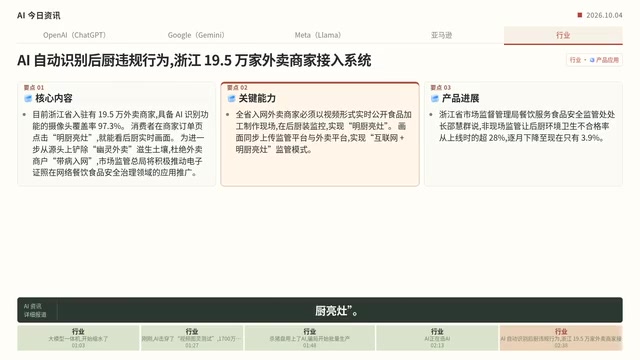
Regulatory oversight is also intensifying: in Zhejiang Province, 195,000 food delivery merchants have been connected to AI recognition systems, with AI-enabled cameras covering 97.3% of establishments, requiring real-time video disclosure of kitchen operations.
Background: Leverage Risk in AI Infrastructure Debt-financed AI infrastructure is a topic financial circles have recently begun to flag. A large number of current data center expansion projects rely on project finance or leveraged buyout structures, with repayment cash flows heavily dependent on long-term stability of GPU compute leasing contracts. If model inference efficiency improves dramatically (e.g., more efficient inference frameworks reducing per-call costs), demand growth slows, or major cloud tenants scale back orders, the underlying assets' cash flows may no longer cover debt service costs. Similar leverage risks have played out repeatedly in the telecom infrastructure bubble (early 2000s) and shale oil boom cycles. HPE's $1.2 billion rack order is a short-term signal of robust demand, but against a backdrop of high interest rates and still-disputed AI ROI, the overall balance sheet health of the industry warrants continued scrutiny.
Conclusion
From Amazon's open-source decision model, to the shifting competitive logic of AI appliances, to AI self-iteration and misuse governance — this wave of news collectively sketches out a clear trend: AI is moving from "showing off" to "shipping." Lightweight, deployable, and well-regulated are becoming the defining keywords. Technological dividends and risks are expanding in lockstep. How to strike the right balance between efficiency and safety will be the central challenge of the next phase.
Related articles

JobRunner MCP Server: AI Agents Can Now Fix Failed Java Jobs
JobRunner launches an open-source MCP server enabling AI agents to view cluster status, diagnose failures, and recover Java jobs—incident response from any cloud coding environment or existing agent.

MLAI Digital Launches 9 Security Agents: MCP Server Safeguards the Full Lifecycle of Agentic AI
MLAI Digital launches Security MCP Server with nine built-in specialized security agents covering vulnerability discovery, attack simulation, prompt injection detection, API and infrastructure assessment, and accelerated remediation—embedding security validation across the full Agentic AI lifecycle from development to production.

Running Isaac Lab on H100 GPUs: Exploring Better Approaches
Exploring optimization methods for running Isaac Lab on NVIDIA H100 GPUs, including MIG configuration, mixed precision, TensorRT acceleration, and community experience to improve robotics simulation and reinforcement learning efficiency.