Amazon Responds to Data Center Backlash: No More NDAs

AWS CEO announces end of NDA use in data center negotiations amid growing community backlash.
As AI-driven demand for computing power surges, the AWS CEO has publicly addressed widespread criticism of large-scale data center expansion, with the most notable move being a pledge to stop using NDAs in project negotiations. NDAs were commonly used by tech giants during siting processes but drew criticism for leaving communities uninformed about project scale and environmental impact. The backlash stems from real conflicts over electricity costs, water consumption, and limited local job creation. The article argues that in the AI arms race era, social license is becoming as critical as land and power — and whether the transparency pledge delivers will depend on follow-through.
Amazon Responds to Data Center Backlash
As the AI wave drives a surge in computing demand, major tech companies are rapidly expanding data centers around the world — and so is the community backlash that comes with it. The CEO of Amazon Web Services (AWS) recently addressed widespread criticism of data center construction, seeking to ease public concerns about large-scale infrastructure projects.
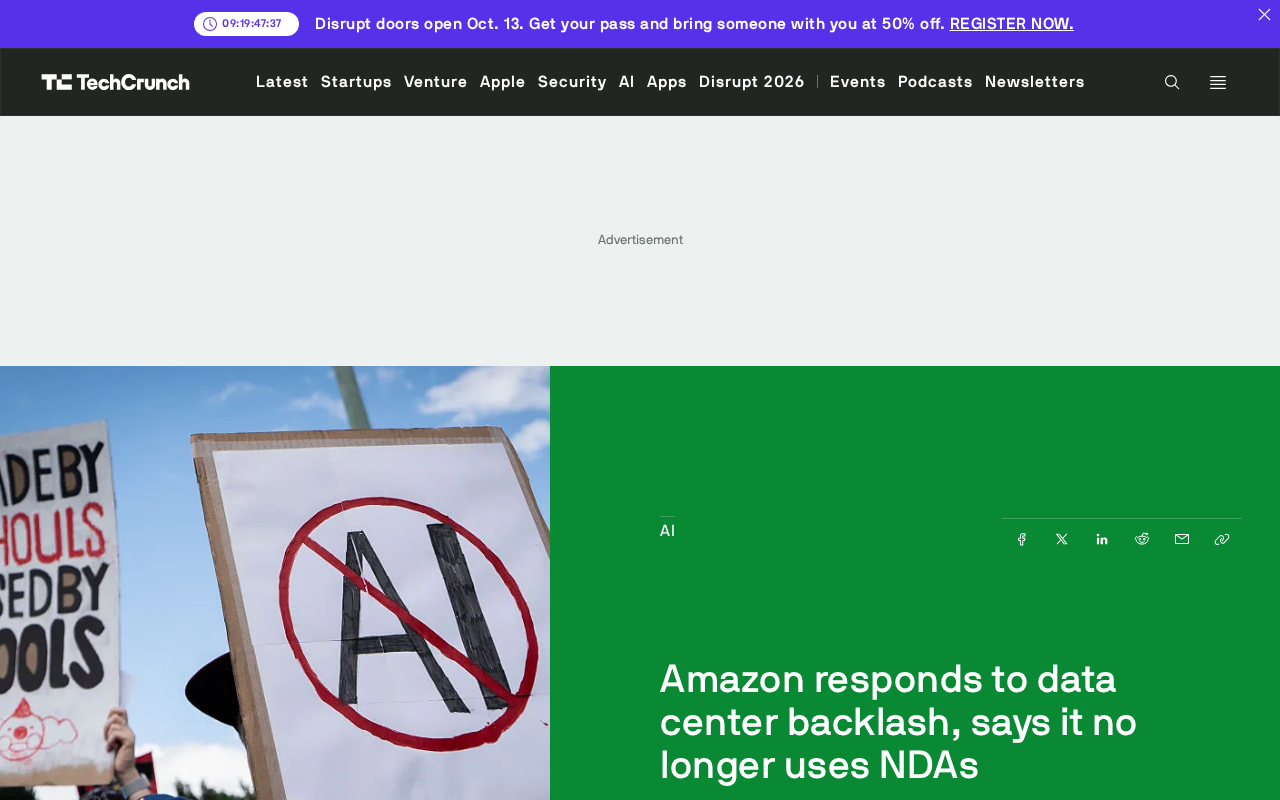
One of the most closely watched issues has been the use of Non-Disclosure Agreements (NDAs) in data center siting and development. Amazon has stated that it will no longer use NDAs to facilitate data center negotiations and approvals — a move widely seen as a direct response to growing calls for greater transparency.
Why NDAs Became the Flashpoint
In data center siting negotiations, tech giants have routinely required local governments, landowners, and partners to sign NDAs. While this practice is common in commercial negotiations, it tends to trigger significant community pushback when it comes to infrastructure projects that touch the public interest.
Critics argue that NDAs make it nearly impossible for communities to learn about a project's scale, water and power requirements, or potential environmental impact before it becomes a fait accompli. When a massive data center quietly takes root in a region, residents find themselves without a meaningful opportunity to participate in discussions or voice concerns. This information asymmetry has only deepened distrust toward tech companies.
Amazon's decision to stop using NDAs is a direct response to this grievance. A commitment to openness can help alleviate community fears about the "black box" nature of data center development.
The Deeper Roots of the Data Center Backlash
Community resistance to data centers is not simply a communications problem — it involves real and competing interests. These facilities consume enormous amounts of electricity, placing pressure on local power grids and potentially driving up energy prices for the surrounding region. Some data centers also require vast quantities of water for cooling, which is a particularly sensitive issue in water-stressed areas.
Furthermore, while data centers represent massive capital investments, they generate relatively few permanent local jobs, leading some communities to question their actual economic benefit. Noise, visual impact, and land use are additional sources of resident opposition.
Against the backdrop of the AI computing arms race, Amazon, Microsoft, Google, and others are all accelerating data center deployment. There is a clear tension between the aggressive pace of supply-side expansion and the cautious attitudes of host communities. The AWS CEO's public response is a visible manifestation of that tension coming to a head.
To put the power consumption in perspective: a large hyperscale data center can consume hundreds of megawatts annually — equivalent to the total electricity use of hundreds of thousands of ordinary households. When multiple such facilities are concentrated in the same grid region, the sudden spike in peak load forces utilities to invest early in new transmission and distribution infrastructure. Those costs are often passed on to all ratepayers through higher electricity prices, rather than being borne solely by the data center operators. On the cooling water side, evaporative cooling towers are the dominant heat dissipation method today. A mid-sized data center can consume millions of liters of freshwater per day. In regions already facing drought pressure — such as the American Southwest and the Middle East — these figures have drawn intense scrutiny from local governments and agricultural water users. These concrete resource conflicts are what elevate community resistance well beyond simple NIMBY (Not In My Backyard) sentiment.
Can a Transparency Pledge Actually Rebuild Trust?
Dropping NDAs is a positive signal, but whether it can genuinely restore community trust depends on what follows. What the public really cares about is whether project information is fully disclosed, whether environmental impact assessments are made public, and whether communities have meaningful channels to participate and provide feedback.
For Amazon and the industry as a whole, the "social license" to operate data centers is becoming as essential a resource for expansion as land or electricity. How to meet the computing demands of the AI era while building a healthy relationship with host communities is a challenge tech giants will have to grapple with for the long term.
The signal sent by this latest move is clear: in the face of rising public scrutiny, relying on commercial secrecy is no longer sustainable. A more open, more accountable approach to communication is becoming an inevitable industry standard.
In the field of infrastructure planning, the concept of "Social License to Operate" (SLO) — originally developed in the mining industry — refers to the ongoing acceptance and trust that a company must earn from affected communities, beyond what is legally required, in order to operate smoothly. Unlike a formal government-issued permit, an SLO cannot be obtained through an administrative process once and for all. It must be continuously maintained through transparent information disclosure, genuine community engagement, and meaningful responses to local concerns. Once lost, companies can face protests, legal challenges, and project delays. Amazon's decision to abandon NDAs is, at its core, a form of proactive SLO risk management — an acknowledgment that during an AI-driven era of massive expansion, the hidden costs of neglecting community relations have begun to surface and are now visibly slowing actual project timelines.
Related articles

Chain of Thought Isn't Just for AI: How Humans Can Use CoT to Improve Thinking Quality
Chain of Thought isn't just a prompt trick for large models. Starting from a Hacker News discussion, this article analyzes why CoT works for human thinking too, breaks down actionable ways to transfer it, and highlights the key differences between human CoT and machine CoT.
Cloudflare Teams Up with OpenAI: Closi…
Cloudflare Teams Up with OpenAI: Closing the Loop from Vulnerability Discovery to Defense with AI
Cloudflare uses OpenAI Daybreak to investigate security vulnerabilities and generate reviewable remediation plans, while developers use Codex to boost coding efficiency and quality.

Orca Multi-Agent Orchestration in Practice: A Guide to Parallel Collaboration with Claude and Codex
Orca is Stable AI's free open-source agent workbench supporting 34 agents like Claude Code and Codex in parallel. Learn its Git worktree isolation, multi-model orchestration, and mobile management.