Amazon's Reported $7B Decart Deal: More Than Just Generative Video

Amazon's reported $7B Decart bid targets real-time video generation and hardware-agnostic AI scheduling software.
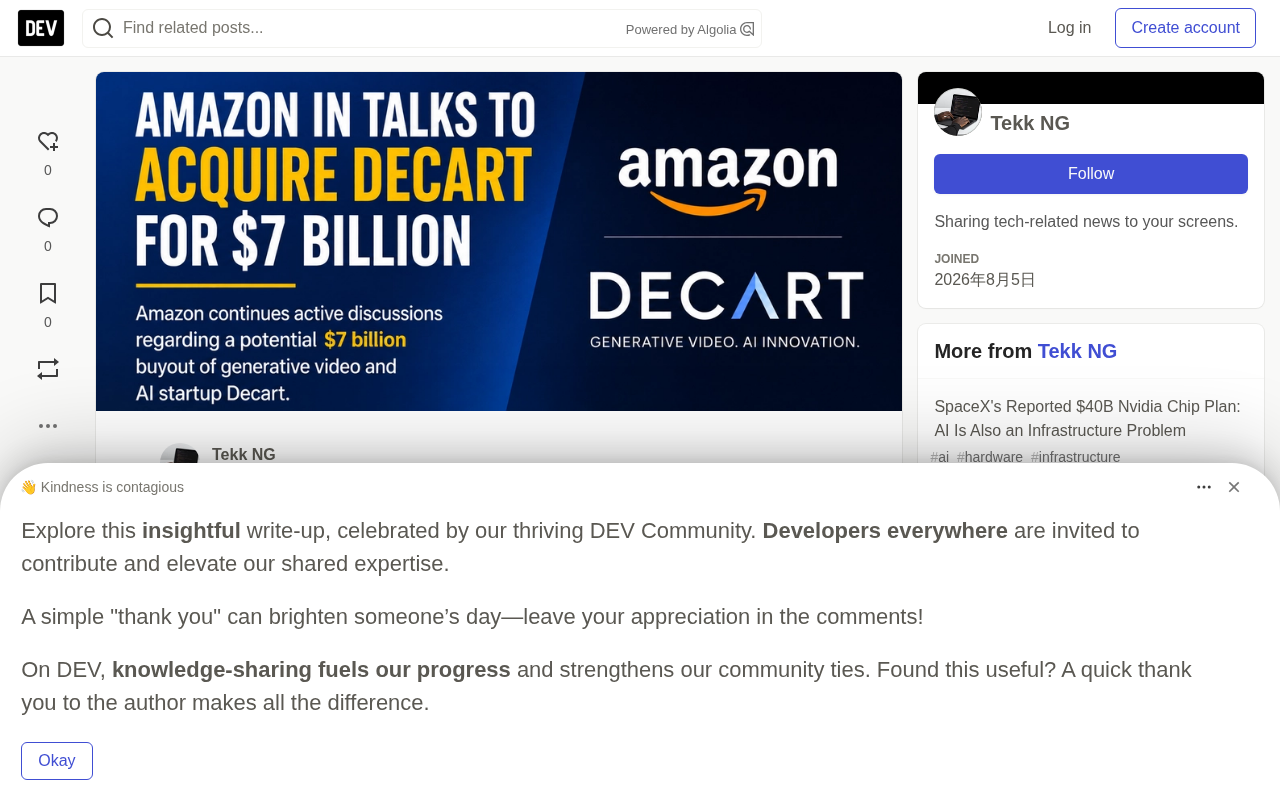
Amazon is reportedly in talks to acquire AI company Decart for approximately $7 billion, though no deal has been finalized. Decart's core assets include two capabilities: the Lucy model for real-time video editing, and hardware-agnostic scheduling software that helps AI workloads run efficiently across different processors. The article argues the real challenge in real-time video isn't model quality but latency, throughput, and cost at scale — while the hardware-agnostic software could strategically complement Amazon's Trainium chips. The piece concludes that infrastructure software, though invisible to users, often holds the greatest strategic value in any AI acquisition.
Acquisitions in AI often make headlines because of their price tags, but for developers, the more important question is: what technical capabilities is the acquirer actually trying to get?
According to reports from The Wall Street Journal and Reuters, Amazon is in talks to acquire Decart for approximately $7 billion, though no final agreement has been reached. Decart is working on two fronts simultaneously — generative video and "hardware-agnostic" AI workload scheduling software — and it's this combination that makes the potential deal worth examining from both an application development and infrastructure perspective.
Generative Video Is Moving Toward Real-Time Interaction
Decart's Lucy model supports real-time video editing and transformation. Traditional video generation workflows typically involve submitting a prompt, waiting for results, and iterating — real-time systems aim to make the experience far more responsive, letting users see changes happen as they interact.
This means the engineering challenges go well beyond model quality alone, including:
- Latency and responsiveness
- Throughput under concurrent usage
- Compute cost per session
- Streaming and distribution architecture
- Consistency and quality of generated output
- User privacy and content safety
An impressive demo is one thing; delivering a stable, cost-controlled production service is something else entirely. The hardest part of real-time video generation isn't getting the model to "work" — it's making it economical and reliable when thousands of users are running it simultaneously.
The core technical bottleneck in real-time video generation is what's known as the "perceptual latency threshold." Humans typically tolerate no more than 100 milliseconds of delay in interactive feedback; beyond that, users clearly perceive lag and discontinuity. For generative video, the inference computation per frame vastly exceeds that of text generation. Compressing per-frame inference time while maintaining frame rate continuity requires co-optimization across model architecture, batching strategies, hardware scheduling, and network transmission.
The direction Lucy represents is what the industry typically calls "streaming generation" or "incremental inference" — rather than waiting for a complete video to render before outputting, the model streams partial results as it generates. This is analogous to streaming tokens in large language models, but the data volume and temporal consistency requirements for video are considerably more complex. Achieving low-latency output while maintaining semantic coherence across frames is one of the most challenging engineering problems in generative video today.
Why Hardware-Agnostic AI Software Matters
Decart also develops software that helps AI workloads run efficiently across different processors. This matters because AI infrastructure isn't built around a single universal chip — cloud providers and hardware vendors use a variety of processors, software stacks, and optimization approaches.
Getting a workload to run efficiently across different hardware platforms often requires adjustments to execution patterns, memory management, model serving, and performance tuning. For cloud providers, software that reduces the friction between AI applications and underlying hardware makes their infrastructure more attractive to developers.
As part of its AWS strategy, Amazon has already developed custom AI chips including Trainium. If the acquisition goes through, one potential strategic benefit would be gaining technology that complements this hardware ecosystem — though the specifics of any integration haven't been announced.
The concept of "hardware-agnostic" has a specific meaning in AI engineering. The mainstream AI compute hardware today includes NVIDIA GPUs (with the CUDA stack), Google TPUs, AMD GPUs (with ROCm), and custom accelerators like Amazon Trainium and Intel Gaudi. Each has its own programming interfaces, memory architecture, and performance characteristics. Developers who want to deploy the same model across different hardware typically need to rewrite low-level optimization code for each platform — a costly process.
The core idea behind hardware-agnostic software is inserting an abstraction layer between the model and the hardware — similar to how an operating system abstracts away hardware differences — allowing the same workload scheduling logic to automatically adapt and optimize across different processors. This is especially valuable for cloud providers: offering developers a consistent development experience across hardware not only reduces vendor lock-in concerns, but also allows platforms to flexibly shift resources when proprietary chip supply is constrained, significantly improving overall infrastructure utilization and commercial competitiveness.
The AI Stack Is Becoming the Competitive Battleground
A simplified AI product can be broken down into several layers:
- Product layer: Web apps, APIs, and user-facing experiences
- Model layer: Generative models and inference pipelines
- Runtime layer: Serving, scheduling, and workload optimization
- Compute layer: CPUs, GPUs, and specialized accelerators
- Infrastructure layer: Networking, storage, cloud services, and power
- Operations layer: Monitoring, reliability, security, and cost management
Improvements at any layer ripple through the entire product's performance and economics. A more efficient inference pipeline reduces cost per request; better hardware utilization lets a team serve more users with the same resources; lower latency directly improves the experience of interactive applications.
This is why AI infrastructure software — even when it's invisible to end users — can carry enormous strategic value. What Amazon likely cares about isn't a flashy video demo, but the underlying engineering capabilities that make a video service possible at scale.
The "inference pipeline" mentioned above is a key concept for understanding AI infrastructure value. Once a model is trained, each instance of serving a prediction or generation is called "inference." The inference pipeline covers request intake, input preprocessing, forward computation through the model, post-processing, and response delivery. In production environments, inference costs typically far exceed the amortized cost of training — especially in high-concurrency consumer-facing scenarios, where compute consumption during inference directly determines cost per query.
This is why optimizations at the runtime and compute layers often deliver more immediate commercial impact than model-layer improvements: the same model, through quantization, operator fusion, or batching schedule optimization, can run several times faster at dramatically lower cost. It explains why infrastructure companies focused on inference optimization and workload scheduling — even without their own foundation models — are highly valued by cloud providers.
What Developers Can Learn From This
You don't need a massive GPU cluster to understand the engineering principles behind this story. For developers looking to build a solid foundation, here are a few directions worth exploring:
- Building applications that integrate AI APIs
- Measuring latency, throughput, and request costs
- Deploying services reliably in cloud environments
- Handling data pipelines and model serving endpoints
- Protecting user data and managing access controls
- Comparing technical performance against real business value
Whether you're building AI-powered web apps, developer tools, or larger production systems, these fundamentals apply equally. The key is developing the habit of letting numbers do the talking — keeping latency, cost, and throughput in your daily thinking rather than focusing solely on model capabilities.
A $7B Price Tag Doesn't Guarantee a $7B Outcome
The reported valuation is striking, but the acquisition price alone says nothing about whether a deal will succeed. The acquirer must complete technical integration, retain key talent, support existing products, and create enough value to justify the cost. Technical differentiation ultimately has to translate into real-world usefulness.
Until negotiations conclude, this acquisition remains a possibility, not a done deal. History is full of high-price acquisitions followed by failed integration and talent exodus — a large price tag is more of a starting point than a finish line.
Closing Thoughts
Amazon's reported interest in Decart highlights two areas developers should be paying attention to: interactive generative AI, and the software that makes AI workloads run more efficiently across different chips.
The next wave of AI products will succeed not just because of more powerful models, but because of the engineering systems that make those models responsive, cost-effective, and reliable. If you were building an AI platform today, which would you prioritize first: better models, lower inference costs, or infrastructure flexibility?
Related articles

JobRunner MCP Server: AI Agents Can Now Fix Failed Java Jobs
JobRunner launches an open-source MCP server enabling AI agents to view cluster status, diagnose failures, and recover Java jobs—incident response from any cloud coding environment or existing agent.

MLAI Digital Launches 9 Security Agents: MCP Server Safeguards the Full Lifecycle of Agentic AI
MLAI Digital launches Security MCP Server with nine built-in specialized security agents covering vulnerability discovery, attack simulation, prompt injection detection, API and infrastructure assessment, and accelerated remediation—embedding security validation across the full Agentic AI lifecycle from development to production.

Running Isaac Lab on H100 GPUs: Exploring Better Approaches
Exploring optimization methods for running Isaac Lab on NVIDIA H100 GPUs, including MIG configuration, mixed precision, TensorRT acceleration, and community experience to improve robotics simulation and reinforcement learning efficiency.