AMD's New 256-Core EPYC Arrives: 16-Channel DDR5-12800 Approaches RTX 5090 Memory Bandwidth

AMD's 256-core EPYC approaches RTX 5090 bandwidth, but sky-high costs keep it in enthusiast-only territory.
AMD's newly leaked EPYC processor combines 256 physical cores with 16-channel DDR5-12800 memory to push theoretical CPU platform bandwidth to 91% of the NVIDIA RTX 5090, generating widespread discussion in the LocalLLaMA community. While the specs open new possibilities for running massive models in system RAM without GPU VRAM constraints, two hard realities emerged from community debate: bandwidth parity doesn't equal inference performance parity — GPUs still hold fundamental advantages in parallel compute and memory latency — and assembling terabytes of high-frequency RDIMM memory comes at a staggering cost. This chip is a landmark product showcasing server CPU ambitions in AI workloads, but it remains firmly an enterprise and elite enthusiast solution rather than a practical option for everyday users.
AMD Pushes Server CPU Limits Once Again
AMD's newly leaked EPYC processor sports a jaw-dropping spec sheet: 256 physical cores, 16-channel DDR5-12800 memory support, and memory bandwidth reportedly reaching 91% of the NVIDIA RTX 5090. For a CPU platform, that figure is exceptionally rare — and it's exactly what's been driving heated discussion in Reddit's LocalLLaMA community.
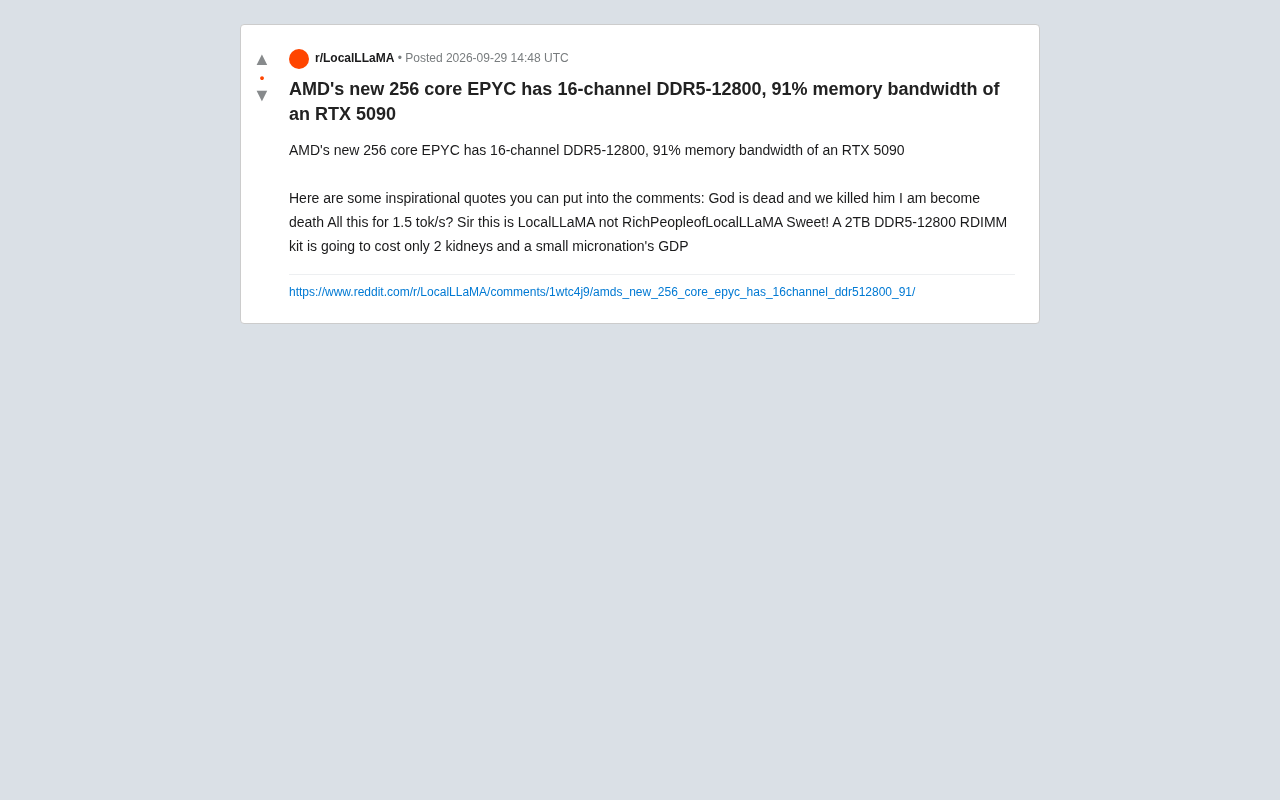
For local inference enthusiasts who have long relied on GPU VRAM bandwidth to run large models, a CPU platform that can approach the bandwidth of a flagship consumer graphics card represents an entirely new deployment paradigm — one where massive system RAM absorbs enormous models, bypassing the hard ceiling of GPU VRAM capacity.
What 16-Channel DDR5-12800 Actually Means
Typical consumer platforms offer only dual-channel memory, making the jump to 16 channels on this EPYC a dramatic leap. Combined with DDR5-12800's high transfer rates, the theoretical bandwidth reaches unprecedented territory. Bandwidth is one of the key bottlenecks in large language model inference: model weights must be read repeatedly during every forward pass, so higher bandwidth generally translates to faster token generation speeds.
Reaching 91% of the RTX 5090's bandwidth means this platform can genuinely compete with top-tier consumer GPUs on that single metric. That said, CPUs and GPUs differ fundamentally in compute architecture — GPUs have vastly superior parallel floating-point throughput — so comparable bandwidth does not equal comparable inference performance.
The "12800" in DDR5-12800 refers to the module's transfer rate: 12,800 MT/s (megatransfers per second), corresponding to a memory clock of approximately 6,400 MHz. By comparison, mainstream consumer DDR5 typically runs at 4,800–6,400 MT/s, while server platforms push frequencies higher through more robust power delivery and stricter signal integrity requirements. 16 channels means 16 independent data pathways operating simultaneously between the processor and its memory controllers. Taking DDR5-12800 as an example, a single channel's theoretical peak bandwidth is around 102.4 GB/s — multiply by 16 and the total theoretical bandwidth exceeds 1.6 TB/s. This dwarfs typical consumer quad-channel platforms (usually in the 150–200 GB/s range) and is the fundamental reason it can be mentioned in the same breath as the RTX 5090's memory bandwidth. High channel-count designs like this are typically found on enterprise multi-socket platforms such as Intel Xeon or AMD EPYC, and require registered RDIMM or LRDIMM memory rather than standard consumer DIMMs.
The Community's Jokes Mask Real Cost Anxiety
The Reddit comment section delivered its usual brand of dark humor. One user quipped "All of this just for 1.5 tok/s?", while another joked, "Sir, this is LocalLLaMA, not RichPeopleofLocalLLaMA."
The most cutting comment went straight for the wallet: "A 2TB kit of DDR5-12800 RDIMMs costs only two kidneys and the GDP of a small micro-nation."
Behind these jokes lies a very real pain point for local LLM enthusiasts. To fully unlock what a 256-core EPYC can offer, you need large-capacity, high-frequency RDIMM modules — and enterprise-grade high-frequency memory is extraordinarily expensive. No matter how impressive the theoretical bandwidth looks on paper, if you can't fully populate the memory slots, real-world performance will fall well short of the spec sheet.
High Core Count Doesn't Mean Fast Inference
The "1.5 tok/s" jab highlights a commonly overlooked reality: even with 256 cores and staggering memory bandwidth, raw token throughput on a CPU running a very large model is often still disappointing. There's a delicate balance between the parallelism that core count provides, available memory bandwidth, and the compute demands of the model itself — throwing more hardware at the problem doesn't linearly translate into speed.
LLM inference can be broken down into two main phases: prefill and decode. The prefill phase processes all input tokens at once and is compute-intensive, making good use of many parallel cores. The decode phase, however, generates one new token at a time — a classic memory-bandwidth-bound operation, because every token generated requires loading the entire model's weights from memory. No matter how many cores you have, you can't hide the latency caused by that data movement. This is why even a 256-core CPU can still produce disappointing tok/s figures — the bottleneck is the per-decode data transfer requirement, not compute capacity. GPUs hold an advantage in inference not only because of higher bandwidth, but also because GPU memory (HBM) sits physically very close to the compute units, resulting in far lower access latency than the multi-level bus topology CPUs use to reach system RAM.
What This Actually Means for Local LLM Enthusiasts
This EPYC represents a broader trend of server-class platforms converging with AI workloads. For users who want to run very large parameter models but are unwilling or unable to stack multiple high-end GPUs, a high-bandwidth CPU platform offers a genuine alternative — particularly in scenarios where you need massive memory capacity to hold a complete set of model weights.
From a consumer and practical standpoint, however, this remains firmly an enterprise and hardcore enthusiast solution. The steep cost of the CPU itself, plus terabytes of high-frequency registered memory, puts it out of reach for the vast majority of individual users. It's better understood as a benchmark product that demonstrates the outer limits of hardware capability, rather than a practical first choice for personal local deployment.
Closing Thoughts
256 cores, 16-channel DDR5-12800, memory bandwidth approaching that of the RTX 5090 — the numbers alone are stunning, and they paint a picture of AMD's continuing ambition to push server CPUs further into AI-relevant territory. But as the community comments remind us, there's still a meaningful gap between the glamour of a spec sheet and the realities of cost and real-world inference experience. For the local LLM community, this is simultaneously an exciting technical showcase and a sober conversation about whether throwing more hardware at the problem is actually worth it.
Related articles

Workbuddy for Absolute Beginners: How a Desktop AI Agent Fits Into Real Workflows
A beginner's guide to the Workbuddy desktop AI agent: installation, claiming credits, file management, and building automated workflows—compared with CodeX for fit and cost, helping professionals shift from AI question-askers to AI managers.

OpenAI's New Agent Stack: Computer Use, Decisions API, and Ultra-Fast Workflows
OpenAI Dev Day unveiled a new agent stack: Computer Use outperforms humans, Decisions API delivers ultra-low-latency classification via Luna, Agents API opens the same Computer Use capabilities, and GPT-6.1 Sol costs only one-seventh of Astra. Core updates, benchmark data, and developer insights.

Liang Wenfeng Open-Sources DeepInfo Inference Framework, Takes On U.S. Ban
DeepSeek open-sources its DeepInfo inference framework after its models, featuring GPU/CPU cross-pipelining, small-model prediction with large-model verification, and full Huawei Ascend and NVIDIA chip support—facing the U.S. federal ban head-on. This article analyzes its significance for AI deployment and open-source strategy.