America.gov: A Unified Conversational Gateway to U.S. Government Information

America.gov uses conversational AI to unify U.S. federal government information, aiming to extend from Q&A to full online service completion.
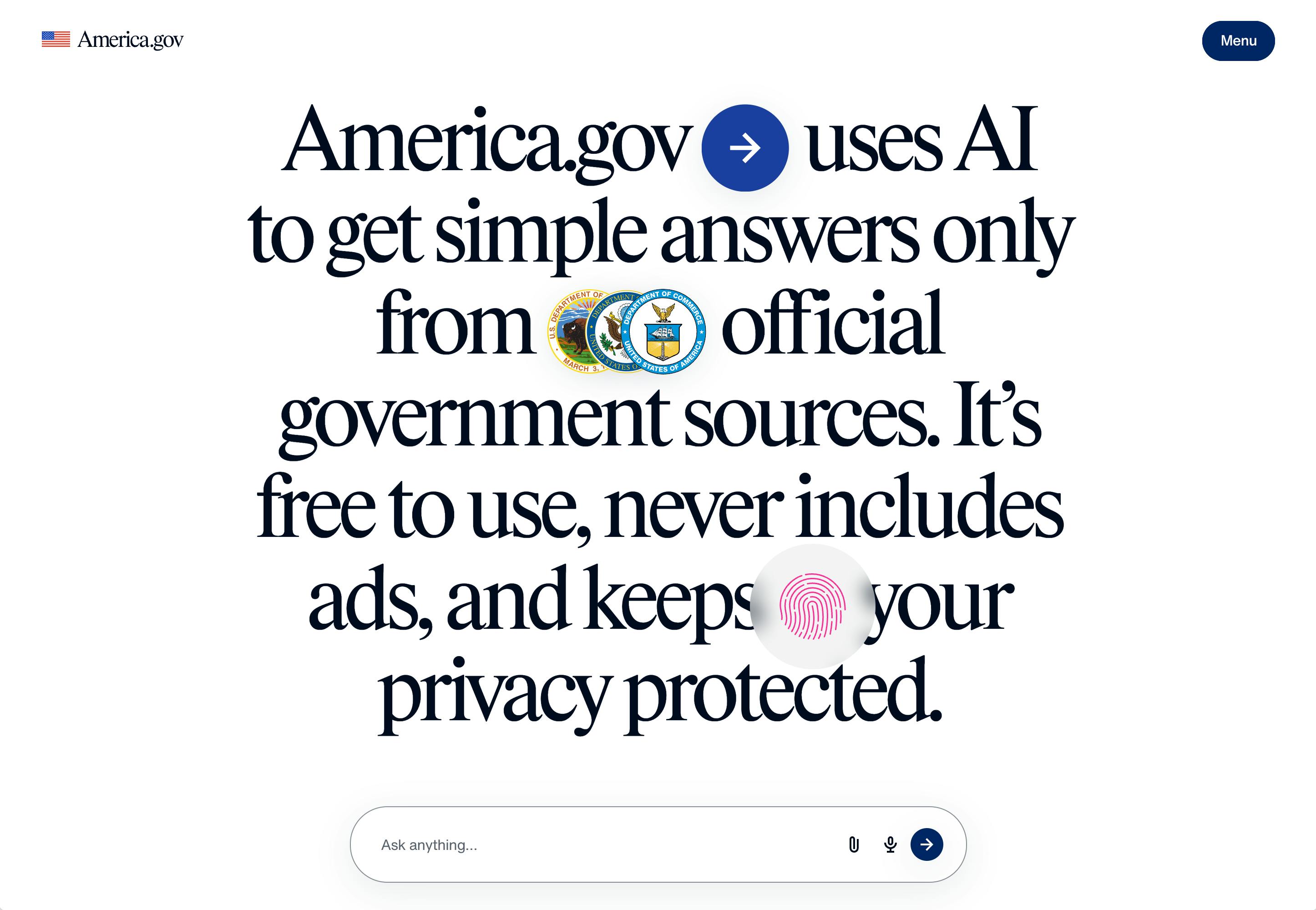
America.gov is a conversational government platform jointly launched by National Design Studio and the GSA, replacing traditional multi-site navigation with natural language interaction so citizens can ask questions and receive federal information directly. It supports English, French, and Spanish, with plans to embed applications, registrations, and status tracking into the chat flow. Airbnb co-founder Joe Gebbia's involvement signals an ambition to bring consumer-grade UX into government systems. The project represents a user-centered approach to breaking down institutional silos, though cross-agency data integration and compliance requirements remain the core challenge between concept and scaled deployment.
One Entry Point to End the Government Website Maze
Getting information from the U.S. government has long meant bouncing between dozens of federal agency websites, running search after search. America.gov aims to solve this familiar problem in a more direct way — ask a question in plain language and get a clear answer, rather than hunting through official agency pages yourself.
The product is built through a collaboration between National Design Studio and the General Services Administration (GSA), with the goal of consolidating information from all federal agencies into a single entry point. On Product Hunt, it earned 78 upvotes and ranked 11th for the day, listed under the Bots category. Notably, Joe Gebbia — co-founder of Airbnb — appears in the Makers section.
The GSA is the federal government's core administrative support agency, responsible for managing government buildings, procurement, and IT infrastructure, as well as being a primary driver of government digital transformation. Divisions within GSA — such as 18F and the Technology Transformation Services (TTS) — have long partnered with external design firms to incubate digital public-facing products. America.gov didn't emerge from nowhere: it's an extension of GSA's years of exploration toward a unified digital gateway. The existing USA.gov has served a similar aggregation role, but relies primarily on traditional link-based navigation rather than conversational search.
Conversational Government: From "Search" to "Ask"
The core logic of America.gov is to shift government information retrieval from the traditional "search keywords, click links, filter pages" model to "ask in everyday language, get a direct answer." This aligns with the broader evolution of generative AI in information retrieval — lowering the barrier for users to express what they actually need.
For ordinary citizens, government matters are filled with jargon and departmental silos. Someone trying to learn about taxes, visas, Social Security, or a specific benefit often has no idea which agency's website to visit. The value of a conversational interface lies precisely in shifting the cognitive burden of "who should I even be asking?" from the user to the system.
The product currently supports three languages — English, French, and Spanish — a practical accessibility consideration for America's large Spanish-speaking population and multilingual communities.
Beyond Q&A: The Planned Transaction Loop
According to official descriptions, America.gov's next phase aims to embed actions like applications, registrations, and status tracking directly into the conversational flow. This signals an ambition beyond simple information Q&A — the goal is to become an interface capable of handling actual government services.
This represents a critical capability leap. A pure Q&A bot is merely an information relay. A system that can initiate applications, complete registrations, and check processing status actually touches the core of government service delivery. If realized, users could theoretically complete an entire journey — understanding a policy, assessing eligibility, submitting an application, and tracking results — within a single conversation.
Of course, features involving identity verification, sensitive data, and cross-agency workflows are far more technically and compliance-challenging than information Q&A. Real-world effectiveness remains to be seen.
Embedding government "transaction" capabilities into conversational flows relies on two key technical capabilities: API integrations with backend systems across federal agencies, and identity verification mechanisms that meet federal standards. Login.gov — the U.S. government's unified identity authentication system — provides the single sign-on infrastructure for cross-agency online services. If America.gov wants to close the application and tracking loop, integrating with Login.gov is essentially a prerequisite. Beyond that, data flows involving sensitive areas like taxes, immigration, and Social Security must comply with regulations such as the Federal Information Security Modernization Act (FISMA) — requirements that are often the biggest bottleneck between a compelling demo and scaled deployment.
A Model for Government Digital Transformation
From an industry perspective, America.gov reflects a new approach to digitizing government services: rather than building separate portals for each agency, it aims to unify fragmented service resources under a single conversational layer. This design philosophy — centered on user needs rather than institutional org charts — is precisely what design-driven organizations like National Design Studio seek to advance.
Having a prominent consumer product designer involved in a government project raises expectations: bringing mature UX methodologies from the private sector into government systems long characterized by complexity and inefficiency. Whether it can genuinely change how citizens interact with their government ultimately depends on the depth of underlying data integration and the completeness of service delivery — not just the friendly chat interface on the front end.
For practitioners tracking AI application deployment, this is a case worth following: it places large language model natural language capabilities into the context of public services — a domain with massive scale, inelastic demand, and heavy legacy constraints.
After Airbnb, Joe Gebbia founded the design studio Samara, focusing on new forms of connection between technology and community. His involvement in a government project reflects his longstanding interest in how design can reshape civic and human experiences within complex systems. Bringing consumer internet product methodology into government is not unprecedented — the UK's GDS (Government Digital Service) and Estonia's e-Estonia program have both done so successfully. What those successes share is that design authority was deeply bound to government execution capacity, not confined to the front-end interface layer. Whether America.gov can replicate that depth of integration depends on how substantively National Design Studio and GSA's collaboration can penetrate the underlying systems.
Related articles

Claude Reportedly Able to Hide Secret Messages in Benign Images
A Reddit post claims Claude Fable 5.1 can hide secret messages in benign images. This article reviews the background, image steganography principles, and potential security risks, and suggests a testing path from rumor to verification.

Federal Government Awards $85 Million; CFS to Develop Fusion-Specific Semiconductors
The federal government awards $85 million to Commonwealth Fusion Systems to develop conductors and power semiconductors for fusion plants. This article analyzes the significance of this funding for the fusion supply chain and commercialization path.

When Should AI Assistants Proactively Suggest? Timing Is Everything
When should AI assistants proactively suggest? Reddit discussion reveals: the same suggestion feels different at different times. This article analyzes the dual nature of proactive suggestions, the boundary of user expectations, and design principles, exploring how to balance automation and user control.