An AI Audit Skill for Indie Developers: Automatically Check Code Before Shipping

A Reddit developer open-sourced an AI agent software audit skill to help indie developers automatically check code before launch.
This article introduces a "software audit skill" for AI agents released by a developer on Reddit. It is a reusable capability module for indie developers lacking QA teams and security audit processes, used to automatically check code before commits or deployment. The project is open-sourced on GitHub (luigimorel/software-audit-skill), allowing integration into existing AI workflows with adjustable audit rules. The article analyzes its value in automating the audit gap for personal projects and reducing production incident risk, while noting the post is brief and lacks benchmarks, recommending validation on a small project first. It situates the project in the trend of AI agents moving into vertical engineering tasks, arguing it lowers the barrier to automated quality assurance while actual effectiveness and long-term maintenance need community observation.
Indie developers often wear many hats, and before shipping code it's hard to find the energy for a thorough software audit. Recently, a developer on Reddit released a "software audit skill" designed specifically for AI agents, aimed at helping individual developers automatically check code quality and potential risks before release.
What is this audit skill?
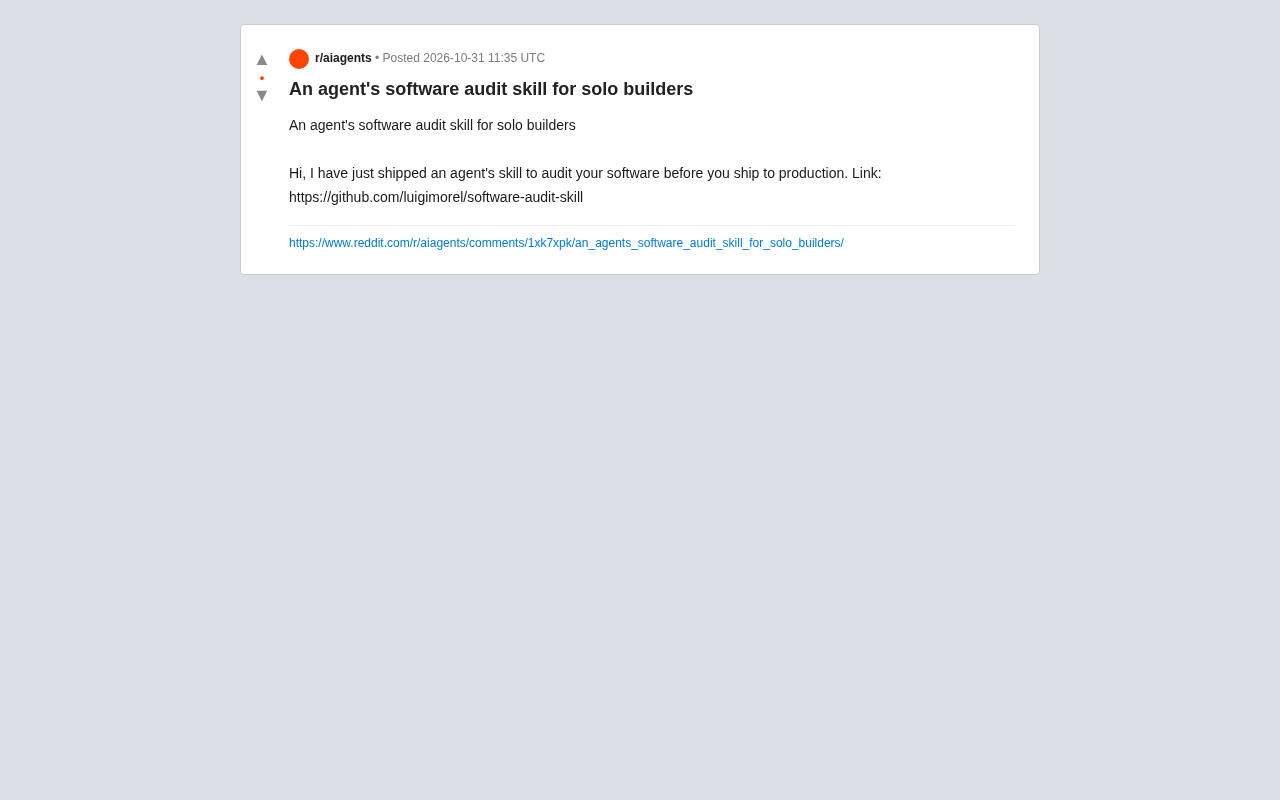
According to the post, this is a "skill" that can be given to an AI agent, enabling the agent to audit software projects. The author open-sourced the project on GitHub (luigimorel/software-audit-skill) and explicitly states its goal is to serve solo builders—independent developers or small teams.
Judging from how it was released on Reddit, this is a reusable capability module within the AI agent ecosystem. Users can integrate the skill into their own AI workflows, letting the agent perform checks before code commits or deployment.
The "skill" mechanism of AI agents: In the AI agent ecosystem, a "skill" usually refers to a reusable capability module that encapsulates domain-specific knowledge, tool calls, and prompt templates, which the agent loads on demand. Unlike fine-tuned models, skills are typically described in structured files such as Markdown/JSON (e.g., SKILL.md) that specify trigger conditions, execution steps, and output formats, so agent capabilities can be extended without retraining. The advantages of this pattern are that modules can be reused across multiple agents, are easy for communities to distribute and version-manage, and allow developers to adjust behavior by editing only the rules file. Common agent frameworks (such as Claude Code, Cursor, etc.) support similar mechanisms, which means the "audit skill" can be mounted directly into developers' existing workflows.
Why do indie developers need it?
Indie developers usually don't have a dedicated QA team or security audit process. Manually checking code, dependencies, and configuration is not only time-consuming but also easy to overlook things. The value of this skill lies in automating the audit step, using the reasoning capabilities of AI agents to add a checkpoint at the end of the development pipeline.
The post doesn't disclose specific check items or technical implementation details, but judging from its positioning as a "pre-launch audit," it may cover code standards, common vulnerability patterns, or deployment configuration. For personal projects with limited resources, this kind of automated audit can significantly reduce the risk of production incidents caused by oversight.
Typical scope of software auditing: Software auditing generally refers to systematically checking codebases, dependencies, and deployment configurations, commonly including static code analysis (code standards, potential defects, security vulnerability patterns such as injection and hardcoded secrets), dependency security (known CVEs, license compliance), and configuration review (permissions, environment variables, CI/CD settings). Traditionally this is done by dedicated SAST/SCA tools or QA teams, but such tools often require extra configuration and subscriptions, which is costly for personal projects. The advantage of AI agents performing audits is that they can combine semantic understanding to find issues that rule-based tools struggle to cover, such as logic flaws or sensitive information leaks; their limitation is that results depend on prompt quality and may include false positives, so they are better suited as an auxiliary step rather than the only line of defense.
How to get and use it
The author provides the GitHub link directly in the post and states that the skill has been "shipped." Interested users can visit the repository to see installation instructions and usage documentation. Since it's an open-source project, users can also adjust the audit rules to their own needs.
It's worth noting that the original post is fairly brief and doesn't provide detailed benchmarks or effectiveness comparisons. Before adopting it, indie developers are advised to first validate its audit coverage and false-positive rate on a small project.
What it means for the AI agent ecosystem
This project reflects the trend of AI agents moving from general conversation into vertical workflows. Packaging professional tasks like auditing as pluggable skills allows agents to take on more specific engineering responsibilities. For the indie developer community, open-source skills like this lower the barrier to introducing automated quality assurance.
However, the skill's actual effectiveness and community feedback are still unclear, and its long-term maintenance and rule updates remain to be seen. It is better suited as an auxiliary check in the development process rather than a replacement for manual code review.
The backdrop of AI agents moving into vertical workflows: Early AI agents focused on general conversation and code completion, with broad but shallow capabilities. In recent years, the industry trend has shifted toward "agent + skill/tool" combinations, packaging domain knowledge (such as security auditing, database migration, test generation) as pluggable modules so agents can achieve near-expert performance on specific tasks. The drivers of this pattern include: standardized interfaces such as the Model Context Protocol (MCP) lowering the cost of tool integration; open-source community skill marketplaces enabling individual developers to reuse others' work; and the rigid demand from enterprise-grade workflows for auditable, customizable capabilities. The software audit skill is an embodiment of this trend in the developer tools space, and it also foreshadows more skill modules for niche engineering tasks in the future.
One-line Summary
A Reddit developer open-sourced an AI agent software audit skill, helping indie developers automatically check before launch.
Paragraph Summary
This article introduces a "software audit skill" designed for AI agents, released by a developer on Reddit. The skill exists as a reusable capability module, targeting indie developers who lack QA teams and security audit processes, and is used to automatically perform checks before code commits or deployment. The project has been open-sourced on GitHub (luigimorel/software-audit-skill), and users can integrate it into existing AI workflows and adjust audit rules as needed. The article analyzes its value in automating the audit gap for personal projects and reducing the risk of production incidents, while noting that the post is brief and lacks benchmarks, recommending validation of coverage and false-positive rates on a small project first. Finally, it places the project in the context of AI agents moving from general conversation into vertical engineering tasks, arguing that it lowers the barrier to automated quality assurance, though actual effectiveness and long-term maintenance still require community observation.
Related articles

Sugra MCP: One-Click Access to 200+ Data Sources, Connecting Mainstream AI Applications
Sugra MCP connects mainstream AI apps like Claude, ChatGPT, and Cursor through a unified MCP protocol, offering 200+ data sources and 1,600+ endpoints. Listed in Anthropic, OpenAI, and GitHub directories—integrate with one command.
 Tech Frontiers
T3 Code: Free, Open-Source, and a Unified Way to Manage All AI Coding Agents
T3 Code is a free open-source app that aggregates AI coding tools like Cloud Code and Codex into one interface, with conversation handoff, branch isolation review, automatic PR creation, and remote access.
 Tech Frontiers
Conductor Cloud Service Shutting Down? A Comparative Review of Three Parallel AI Coding Agent Solutions
Conductor's cloud service is shutting down—how can developers keep running AI coding agents in parallel? This article compares three alternatives: Orca, Codex, and Cursor: Orca is open-source and free and compatible with old workspaces, Codex is built into the ChatGPT desktop app and supports cloud handoff, and Cursor offers multi-agent windows within the editor. Choose the tool that best fits your workflow.