Sugra MCP: One-Click Access to 200+ Data Sources, Connecting Mainstream AI Applications

Sugra MCP connects multiple AI apps via a unified data layer with 200+ sources, reducing migration costs but introducing single-point dependency.
Sugra MCP positions itself as a unified data connection layer, allowing Claude, ChatGPT, Codex, Cursor, Grok, VS Code, and any app supporting the MCP protocol to share the same data sources. It provides 200+ data sources, 1,600+ endpoints, and 7 directions of data coverage, with sample queries returning FRED unemployment data with source attribution. The service is listed in three distribution channels: the Anthropic Connectors Directory, the OpenAI Plugins Directory, and the GitHub MCP Registry. Integration cost is extremely low: one command for Claude Code, one button for ChatGPT. Its core value lies in moving data integration from the application layer down to the protocol layer, reducing migration costs across multiple AI tools and maintaining consistent data definitions. However, centralization also brings single-point dependency risk, and details such as pricing and rate limits have not yet been disclosed.
Why a Unified MCP Data Layer Is Needed
Switching between Claude, ChatGPT, Codex, Cursor, Grok, and VS Code every day is the norm for many developers and knowledge workers. Each application has its own way of connecting to data, resulting in repeated configuration, inconsistent formats, and high maintenance costs. Sugra MCP attempts to solve this problem: it positions itself as a unified data connection layer, allowing any application that supports the MCP protocol to share the same set of data sources.
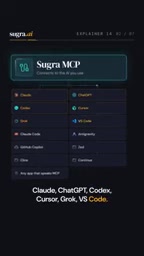
In its official introduction video, Sugra MCP emphasizes "One connection," covering Claude, ChatGPT, Codex, Cursor, Grok, VS Code, and any app that "speaks MCP." Behind this is the value of MCP (Model Context Protocol) as an open protocol—as long as an application supports the protocol, the data layer can be reused, eliminating the need to develop separate plugins for each tool.
MCP (Model Context Protocol) is a protocol proposed and open-sourced by Anthropic in late 2024, designed to provide a standardized communication method between AI applications and external data sources and tools. It can be thought of as the "USB-C port of the AI world": as long as an application implements an MCP client, it can connect to any MCP server in a consistent way, and the server side only needs to expose standard interfaces without adapting separately for each client. MCP adopts a client-server architecture and supports three primitives: Resources, Tools, and Prompts. The transport layer can be based on stdio or HTTP+SSE. The protocol has been adopted by tools such as Claude Desktop, Cursor, and Zed, and is gradually becoming one of the industry's de facto standards for connecting LLMs with external systems.
What 200+ Data Sources and 1,600+ Endpoints Mean
The scale figures disclosed by Sugra MCP are worth noting: over 1,600 endpoints, over 200 data sources, and 7 directions, all provided through Sugra Data.
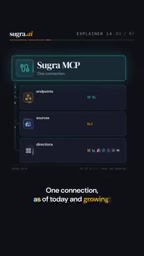
The ratio between "200+ sources" and "1,600+ endpoints" indicates that on average, each data source exposes multiple queryable interfaces. For scenarios requiring cross-domain data retrieval—such as simultaneously querying macroeconomic data, industry indicators, and real-time data—this aggregation approach can reduce the hassle of switching back and forth between multiple APIs.
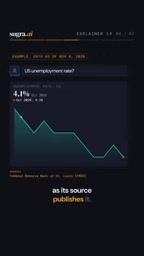
The example given in the video is a query for the U.S. unemployment rate, which returns 4.1% and notes the source as FRED (Federal Reserve Economic Data). There are two noteworthy details here: first, the data comes with source attribution for traceability; second, Sugra emphasizes "as its source publishes it," meaning the data is presented according to the original definitions published by the source, rather than being reprocessed. For research-oriented tasks, source traceability is often more important than the data itself.
FRED (Federal Reserve Economic Data) is a macroeconomic database maintained by the Federal Reserve Bank of St. Louis, containing over 800,000 economic time series covering indicators such as unemployment rate, CPI, GDP, and interest rates. Data sources include official agencies such as the U.S. Bureau of Labor Statistics and the Department of Commerce. FRED provides a free API for developers to pull data by series ID, and supports version tracking and source attribution. In AI workflows, FRED is often used as an authoritative data source for macroeconomic queries; its data definitions are consistent with official releases, making it suitable for research tasks that require traceability.
Distribution Channels: Endorsement from Three Directories
Sugra MCP states that it has been listed in the Anthropic Connectors Directory, the OpenAI Plugins Directory, and the GitHub MCP Registry.
These three channels correspond to the Claude ecosystem, the ChatGPT ecosystem, and the open-source developer community, respectively. Currently, not many MCP services are listed in all three at once, which to some extent indicates that its compatibility and compliance have passed the requirements of different platforms. For users, this means they can find and enable it directly within the corresponding applications without manually configuring the server address.
Anthropic Connectors Directory is the official connector directory maintained by Claude, listing reviewed MCP servers and external service integrations that users can enable directly in Claude settings; OpenAI Plugins Directory is the plugin/tool marketplace for ChatGPT, where developer submissions must pass OpenAI's compliance and security review; GitHub MCP Registry is GitHub's MCP server registry aimed at the open-source developer community, providing discovery and installation entry points. The three cover Claude, ChatGPT, and the open-source ecosystem respectively, and being listed in all three means the service has passed independent evaluations by different platforms in terms of interface specifications, security policies, and user experience.
Integration Cost: One Command and One Button
Sugra MCP has significantly simplified the integration experience: Claude Code requires just one command, and ChatGPT requires just one button click.
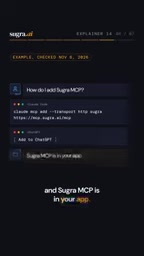
The server address is mcp.sugra.ai, and the details page is at sugra.systems.mcp. This "command-as-integration" design approach aligns with the current trend of AI tools pursuing low-friction configuration. For teams, a unified data entry point also means permission management and auditing can be centralized in one place, rather than scattered across the independent configurations of each application.
It should be noted that the video does not disclose specific pricing, rate limits, or the complete scope of the data source list. Which domains the 200+ sources cover and what the 7 directions specifically refer to can currently only be further confirmed from the official documentation.
Practical Significance for Developers
From an architectural perspective, the value of Sugra MCP lies not in being "yet another data API," but in moving data integration down from the application layer to the protocol layer. When applications like Claude, ChatGPT, and Cursor all retrieve data through the same MCP server, the migration cost of switching tools is greatly reduced, and data definitions are easier to keep consistent.
For teams building workflows with multiple AI tools, the appeal of such a unified data layer lies in composability: the same query logic can be reused across different applications without rewriting integration code for each platform. However, centralization also brings dependency risk—if the service becomes unavailable, all connected applications will be affected. Whether it is worth adopting depends on the team's trade-off between data source breadth and single-point dependency.
Related articles
 Tech Frontiers
Google Omni 1.2 Flash: 15-Second AI Video at Just $0.07 per Second
Google DeepMind releases Gemini Omni 1.2 Flash: 15-second video, 720p at $0.07/sec (30% cheaper), multi-turn editing without regeneration, draft upscaling to 4K.
 Tech Frontiers
No AI Ghostwriting: Writer's Quarter Reinvents Novel Writing with a Visual Workbench
The Writer's Quarter is an AI-free novel writing and planning tool that unifies character building, story planning, and manuscript writing in one visual workbench. This article analyzes its positioning, target users, and differentiated value amid the rise of AI writing tools.
 Tech Frontiers
Fleeep: A Unified Inspiration Collection Notes App for Creatives
Fleeep is a notes app for creatives that unifies screenshots, bookmarks, saved posts, and inspiration into one calm, cross-device, offline-capable space. This article analyzes its positioning, differentiation, and target users.