An Independent Researcher's NeurIPS Debut: The Community Culture Behind a Poster Acceptance

An independent CS graduate got accepted to NeurIPS as a solo researcher, reflecting a growing trend in AI.
A developer with a BA in Computer Science submitted research to NeurIPS as an independent researcher and earned a Poster acceptance, then took to Reddit to ask what the conference atmosphere is really like. The article explores NeurIPS's prestige, why Poster sessions are genuinely valuable, and offers practical advice for first-timers. More broadly, it reflects a structural shift in AI research: open-source frameworks, public datasets, and accessible compute are breaking institutional barriers, enabling individuals without traditional academic backgrounds to produce work recognized at the field's top venues.
A Reddit Post That Got People Thinking
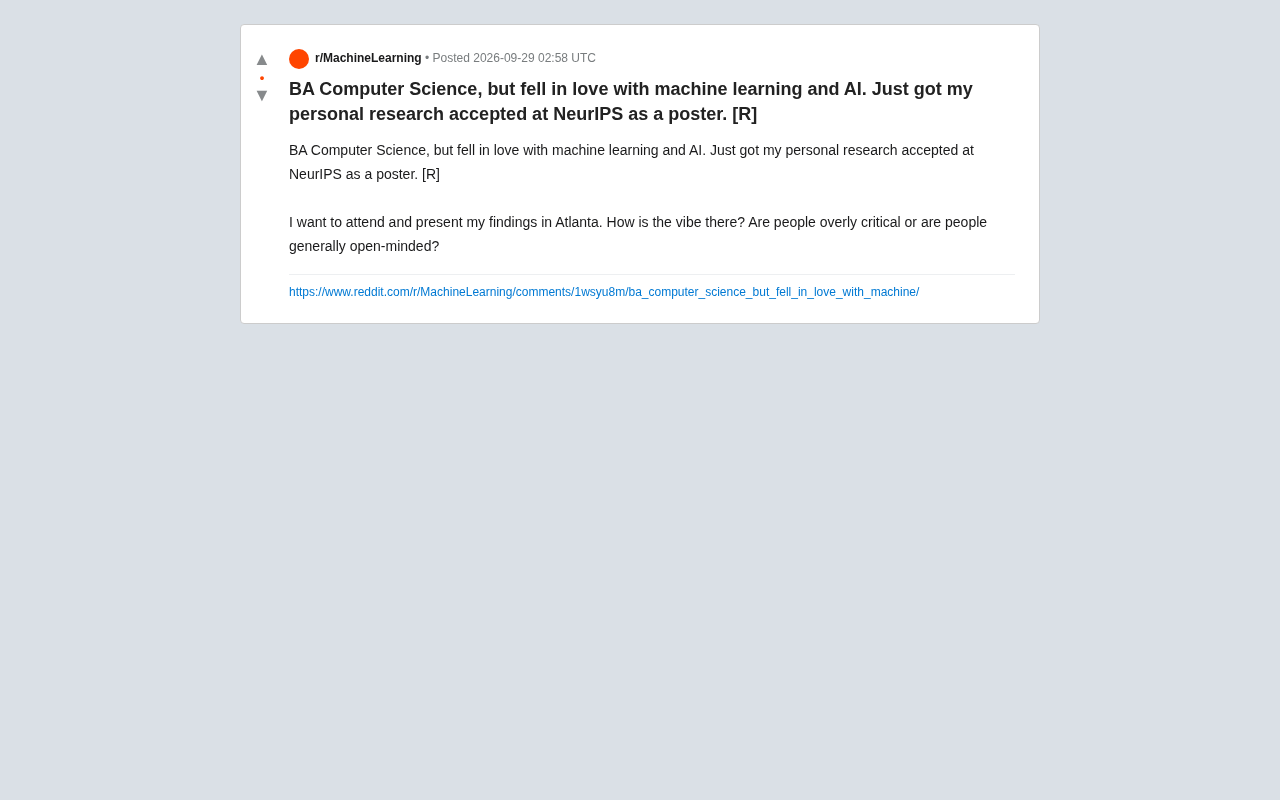
Recently, a developer with a BA in Computer Science shared some exciting news on Reddit: driven purely by a passion for machine learning and AI, he conducted research independently and submitted it to NeurIPS as a solo author — and got accepted as a Poster presentation.
The post was brief, but it touched on something worth paying attention to in today's AI research landscape: independent researchers are increasingly finding their way onto the stage of top academic conferences. The author's core question was practical: he planned to attend in Atlanta to present his work in person, but wasn't sure what to expect from the crowd — would people be overly critical, or generally open-minded?
What a NeurIPS Poster Actually Means
NeurIPS (Conference on Neural Information Processing Systems) is widely regarded as one of the premier academic venues in machine learning and computational neuroscience. Competition for acceptance is fierce, with acceptance rates historically remaining quite low. Getting accepted as a Poster means your work has passed rigorous peer review and demonstrated genuine academic merit.
For someone without a PhD background who pursued research purely out of personal interest, this is no small feat. It signals that in the AI field, the bar for academic contribution is shifting from "credentials and institutional affiliation" toward "research quality and originality". The proliferation of open-source tools, publicly available datasets, and free learning resources has made it possible for independent researchers to produce recognized work without the backing of a well-resourced lab.
Poster vs. Oral: What's the Difference?
It's worth clarifying that NeurIPS acceptances generally fall into two categories: oral/spotlight presentations and poster sessions. A Poster is not a "second-tier" acceptance — in fact, it's the most common and often the most substantively engaging format at the conference. Researchers stand beside their poster and engage in one-on-one or small-group conversations with passersby, which frequently yields more direct and actionable feedback than a stage presentation ever could.
NeurIPS was founded in 1987, originally focused on the intersection of neural networks and cognitive science. It has since grown into a comprehensive top-tier conference spanning deep learning, reinforcement learning, generative models, optimization theory, and nearly every subfield of machine learning. In recent years, submission volume has surged dramatically — over 12,000 papers were submitted in 2023, with an overall acceptance rate of roughly 26%, though the top tier (Oral/Spotlight) acceptance rate remains below 3%. Alongside ICML and ICLR, NeurIPS is considered one of the "Big Three" ML conferences, carrying significant weight in both academia and industry. Many landmark algorithmic breakthroughs — including the foundational Transformer paper Attention Is All You Need — were first presented at NeurIPS. This context is what gives any NeurIPS acceptance its considerable value.
What's the Atmosphere Actually Like at a Top Conference?
The author's central concern was about community culture: are attendees "overly critical" or "open and welcoming"?
From the general experience of the AI research community, there's no simple answer. Academic conferences are inherently built on questioning and debate — someone stopping at your poster to ask sharp, probing questions is completely normal, and it's not personal. It's just how academic exchange works. Being challenged is not the same as being dismissed — in fact, when someone takes the time to dig into your methodology and conclusions, it usually means your work has caught their attention.
At the same time, events like NeurIPS are known for their vibrant social energy. Beyond the formal academic sessions, Poster Sessions are often the most relaxed and connection-friendly part of the conference. For a first-time attendee who is an independent researcher, it's simultaneously an opportunity to showcase your work, meet potential collaborators, and get a feel for where the field is heading.
Practical Tips for First-Time Attendees
Drawing on the collective wisdom of the research community, a few practical suggestions stand out:
- Prepare a short "elevator pitch": Be able to explain in 30 seconds what problem your research addresses, what your core approach is, and what you found.
- Treat critical questions as a gift: On-the-spot challenges often surface angles you hadn't considered in the paper, pointing the way toward future work.
- Be proactive, not passive: The value of a Poster Session lies in two-way interaction. Introduce your work to researchers walking by — the returns will far exceed your expectations.
- Let go of the need to perform perfectly: Everyone at the conference understands what it's like to attend for the first time. An open attitude will serve you far better than a defensive one.
The Rise of Independent Researchers Is a Trend
This poster's story is not a one-off. With the explosion of large models, open-source frameworks, and publicly available research resources, a growing number of hobbyists and engineers without traditional academic credentials are contributing to cutting-edge research as individuals. This "decentralized" research ecosystem is enriching the diversity of the AI field.
Of course, independent research comes with real challenges — limited compute, no mentorship, difficulty sustaining focused effort over time. But NeurIPS's acceptance of individual research sends a positive signal in itself: in a field still evolving at breakneck speed, good ideas and solid execution remain the hardest currency there is.
For anyone still finding their footing in AI, this short Reddit post might be the best encouragement available — passion can be the starting point, and hard work can carry you all the way to the top.
The technical infrastructure enabling the rise of independent researchers deserves special mention. Open-source deep learning frameworks like PyTorch and JAX have abstracted away the low-level computation that once required dedicated engineering teams; platforms like Hugging Face have made accessing and fine-tuning pretrained models nearly frictionless; cloud computing environments like Google Colab and Kaggle Notebooks offer free or low-cost GPU access; and arXiv allows papers to circulate publicly before peer review, dramatically accelerating knowledge diffusion. The cumulative effect of these tools means that an individual researcher with a consumer-grade GPU can, in certain research directions, now replicate — or even surpass — experiments that would have required a large institutional lab just a few years ago. The core bottleneck for independent researchers has shifted from "can I access the tools" to "can I ask a research question worth answering."
Related articles

Workbuddy for Absolute Beginners: How a Desktop AI Agent Fits Into Real Workflows
A beginner's guide to the Workbuddy desktop AI agent: installation, claiming credits, file management, and building automated workflows—compared with CodeX for fit and cost, helping professionals shift from AI question-askers to AI managers.

OpenAI's New Agent Stack: Computer Use, Decisions API, and Ultra-Fast Workflows
OpenAI Dev Day unveiled a new agent stack: Computer Use outperforms humans, Decisions API delivers ultra-low-latency classification via Luna, Agents API opens the same Computer Use capabilities, and GPT-6.1 Sol costs only one-seventh of Astra. Core updates, benchmark data, and developer insights.

Liang Wenfeng Open-Sources DeepInfo Inference Framework, Takes On U.S. Ban
DeepSeek open-sources its DeepInfo inference framework after its models, featuring GPU/CPU cross-pipelining, small-model prediction with large-model verification, and full Huawei Ascend and NVIDIA chip support—facing the U.S. federal ban head-on. This article analyzes its significance for AI deployment and open-source strategy.