Anagnorisis: An Open-Source Local Recommendation Engine That Puts You Back in Control of the Algorithm

Anagnorisis is an open-source local recommendation engine that gives users full control over their algorithms.
Anagnorisis is an open-source project that flips the traditional client-server model by running all recommendation computations locally on the user's device. Through a rate–train–correct feedback loop, it builds a private personal interest model that keeps preference data on-device, offering privacy-first, portable, and auditable recommendations as an alternative to opaque cloud-based algorithms.
When Recommendation Algorithms No Longer Serve You
YouTube, Spotify, TikTok, Twitter (X), Facebook — the recommendation systems we use every day almost all run in the cloud, controlled by companies whose interests don't align with yours. They optimize for "user dwell time" and other proprietary metrics you can't even see. You can't audit their logic, correct their biases, or take your personalized model with you if the service shuts down.
Mainstream recommendation systems today widely employ multi-objective optimization strategies, with core metrics including dwell time, click-through rate (CTR), session depth, and more. These metrics share a common trait: they measure the platform's ability to capture commercial value, not the user's actual satisfaction or long-term well-being. Academic research has repeatedly shown that algorithms optimized for dwell time tend to promote content that triggers emotional reactions — especially anger and anxiety — because such content more effectively drives continued browsing. More critically, the weight parameters, training data, and optimization objectives of these algorithms are completely opaque — users can neither see the recommendation logic nor ask the platform to modify their profile. This information asymmetry is precisely the structural problem Anagnorisis aims to break.
The open-source project Anagnorisis (recently updated to v0.4.10) attempts to address this problem at its root. Its core proposition is straightforward: take ownership and control of the recommendation system away from cloud vendors and return it to the user.
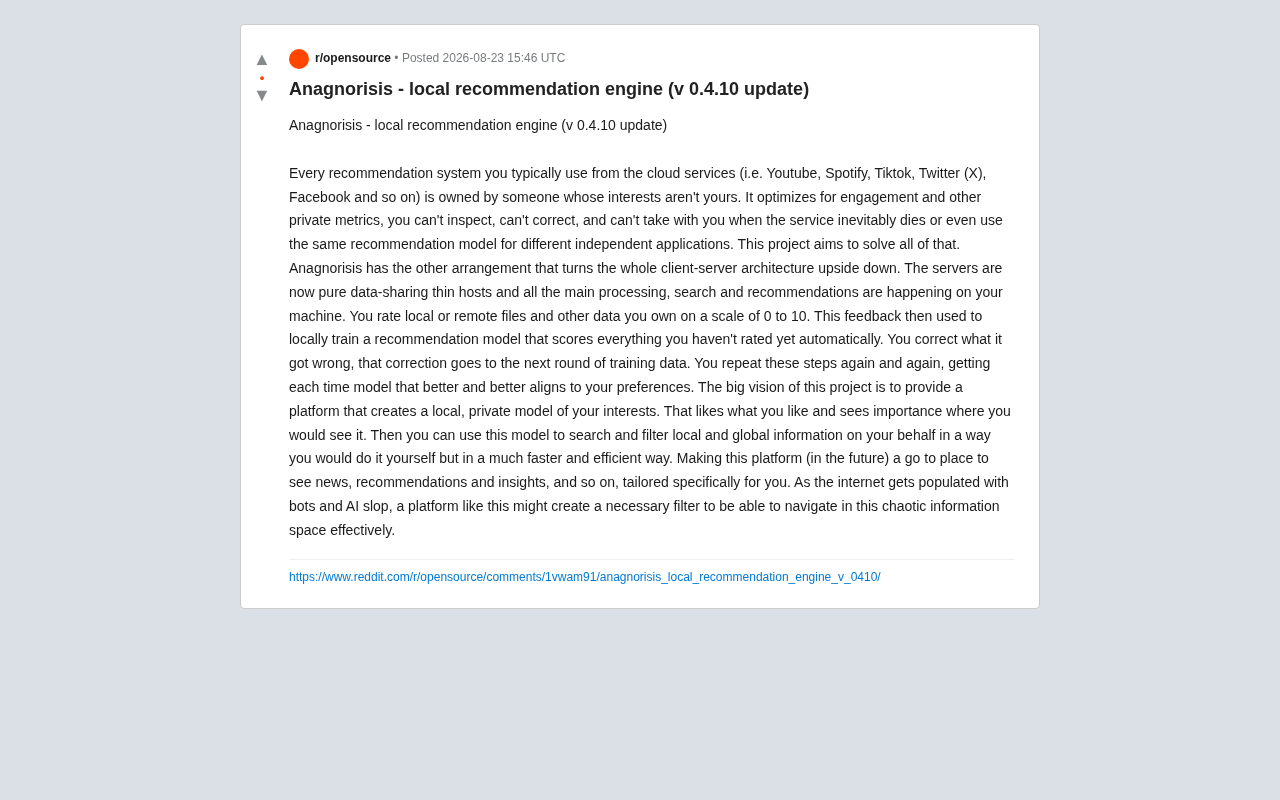
How Anagnorisis Upends the Traditional Client-Server Architecture
The most interesting thing about Anagnorisis is that it completely inverts the traditional client-server architecture.
In the typical cloud service model, the server shoulders the vast majority of the compute — search, ranking, and recommendation model training and inference all happen in the vendor's data center, while your device is merely a "thin client" passively receiving results.
In Anagnorisis's design, the server is reduced to a pure data-sharing node (thin host), responsible only for hosting and transmitting data. All major processing, search, and recommendation computations happen on your own machine. This means your preference data and interest models always stay local — never uploaded, analyzed, or monetized.
Traditional internet services follow the classic client-server architecture, where the server handles compute-intensive tasks and the client is only responsible for display and interaction. The advantage of this architecture lies in centralized management and economies of scale, but the cost is that users completely lose control over their own data and algorithmic logic. The "thin host" design philosophy adopted by Anagnorisis is essentially a modern revival of the early internet's "thick client" approach — in an era when user devices far exceed the performance of servers from a decade ago, offloading inference and training workloads to end-user devices is entirely technically feasible. This architecture shares similarities with Federated Learning, but goes further: in federated learning, model parameters still need to be aggregated at a central node, whereas Anagnorisis completes the entire loop — from training to inference — locally on the device, with data never leaving the device boundary.
Core Advantages of a Local Recommendation Engine
- Privacy first: Your ratings and interest profiles never leave your machine — no need to worry about data breaches.
- Portability: The model is your own asset; it won't be lost if a service shuts down.
- Reusability: The same preference model can serve multiple independent use cases.
The Rate–Train–Correct Feedback Loop
Anagnorisis operates on a continuously iterating feedback loop that's both logical and intuitive:
- Rate: You rate local or remote files, as well as other data you own, on a 0-to-10 scale to express your preferences.
- Local training: This feedback is used to train a recommendation model on your own machine.
- Auto-scoring: The model automatically scores all content you haven't yet rated.
- Corrective feedback: When the model gets it wrong, you make corrections — and those corrections become training data for the next round.
This loop corresponds to two well-established research directions in machine learning: Active Learning and Human-in-the-Loop (HITL). The core idea of active learning is that the model proactively selects the most informative samples to request human annotation, rather than passively waiting for large-scale labeled data, enabling the model to achieve high accuracy with very few labels. HITL emphasizes the continuous participation and correction role of human experts in model training and decision-making. When combined, every correction a user makes effectively provides a high-value supervisory signal to the model. This design is particularly well-suited for personalized recommendation scenarios — because "taste" is inherently highly subjective and dynamically changing, and no pre-trained dataset can substitute for the user's own real-time feedback.
Through round after round of iteration, the model increasingly aligns with your true tastes. This is essentially a human-centered, incremental personalization learning process — every correction makes "your model" more like you.
The Bigger Vision: Building a Private Personal Interest Model
The project creator's ambition goes beyond a simple recommendation tool. The grand vision is to build a local, private "model of your interests" — a digital twin that "likes what you like and sees importance where you would."
Once this model is sufficiently mature, it can search and filter local and global information on your behalf, in the way you yourself would approach it, but at speeds and efficiency far beyond human capacity. Ideally, Anagnorisis would become a single entry point: news, recommendations, and insights all presented and tailored to your personal preferences.
An Information Filter Against AI-Generated Junk Content
The creator raises a highly relevant observation: as the internet is increasingly flooded with bots and "AI slop" (low-quality AI-generated content), the information landscape is becoming ever more chaotic. In such an environment, a filter that truly represents your personal interests and is fully under your control may become essential infrastructure for effectively navigating the sea of information.
The concept of "AI slop" rapidly entered public discourse in 2024, referring to low-quality, low-originality content mass-produced by large language models and image generation models. The root cause is that generative AI has compressed the marginal cost of content production to near zero. Multiple studies estimate that the proportion of AI-generated content on the internet is growing exponentially, with AI-generated content already accounting for a significant share of new content on some platforms. The consequence is a dramatic deterioration of the signal-to-noise ratio: search engine result quality declines, social media feeds are diluted with filler content, and traditional information discovery mechanisms based on keyword matching or popularity ranking are becoming increasingly ineffective. In this context, "filtering capability" is indeed upgrading from a convenience tool to essential infrastructure for information survival.
This perspective is worth serious consideration. When the marginal cost of content production approaches zero, what becomes scarce is no longer information itself, but the ability to filter and judge. A local model that understands you and is accountable only to you fills precisely this gap.
Brief Commentary: The Ideal of Data Sovereignty vs. Real-World Challenges
Anagnorisis represents a technology philosophy worth endorsing — the return of data sovereignty and algorithmic transparency. At a time when recommendation algorithms are increasingly becoming "black boxes," the very attempt to return control to users has inherent value.
However, as an early-stage project still at version 0.4.x, it also faces practical challenges: local training has certain hardware requirements, the cold-start phase demands considerable manual rating effort from users, and whether the model's effectiveness can rival cloud-based recommendation systems trained on massive datasets remains an open question. The interaction cost of manual rating could also become a barrier to long-term adoption by average users.
The Cold Start Problem is one of the most classic challenges in the recommendation systems field: when a new user or new item lacks sufficient historical interaction data, the model cannot make effective recommendations. Cloud-based recommendation systems mitigate this through collaborative filtering across massive user bases — even as a new user, the system can infer your preferences based on the behavior of millions of similar users. A purely local model inherently lacks this advantage; it can only rely on a single user's rating data, meaning users must invest significant manual annotation effort early on to "feed" the model. Additionally, the hardware resource requirements for local training (CPU/GPU compute, memory, storage) also cap the model's complexity, making it difficult to directly replicate the effects of large-scale deep learning models in the cloud. This is an engineering trade-off that all decentralized recommendation approaches must face.
But for privacy-conscious tech enthusiasts who value data autonomy, Anagnorisis offers a rare, self-hostable, auditable, and portable alternative. In an age where algorithms dominate attention, the ability to "own your own recommendation engine" is something worth paying attention to in its own right.
Key Takeaways
Related articles

Python 3.15 New Feature: Is the sentinel Type Better Than None?
Python 3.15 adds the sentinel type, using named unique sentinel objects to replace None and bare object(), resolving confusion among missing values, explicit emptiness, and invalid input while avoiding type hint failures.

Deep Learning's Three Architectures and the Universal Approximation Theorem: A Complete Guide to MLPs, CNNs, and Transformers
Explaining the inductive bias differences among MLP, CNN, and Transformer, the existence meaning of the Universal Approximation Theorem (UAT), and the role of Taylor expansion in approximation analysis, while clearing up common misconceptions.

GitLab Emergency Patch Release: Analysis of Critical Security Fixes
GitLab releases critical patch 19.5.1, sparking 355 points of discussion on Hacker News. This article analyzes the background, upgrade steps for self-hosted instances, and verification points to help DevOps teams respond quickly to security updates.