Analyze Your Chess Games with a Claude Code Skill

A Claude Code Skill pairs Stockfish's calculation power with LLM explanations to turn chess game data into human-readable coaching.
A developer posted a Claude Code Skill-based chess analysis tool on Hacker News, combining Stockfish's precise move evaluation with an LLM's ability to translate cold numerical scores into actionable, plain-language insights. The pairing neatly covers both tools' weaknesses — engines can't explain themselves, and LLMs can't do deep search. More broadly, the project illustrates how pluggable Skill mechanisms are lowering the bar for vertical AI applications, letting developers skip building full systems from scratch and focus on task logic and tool integration.
Turning an AI Assistant into a Chess Coach
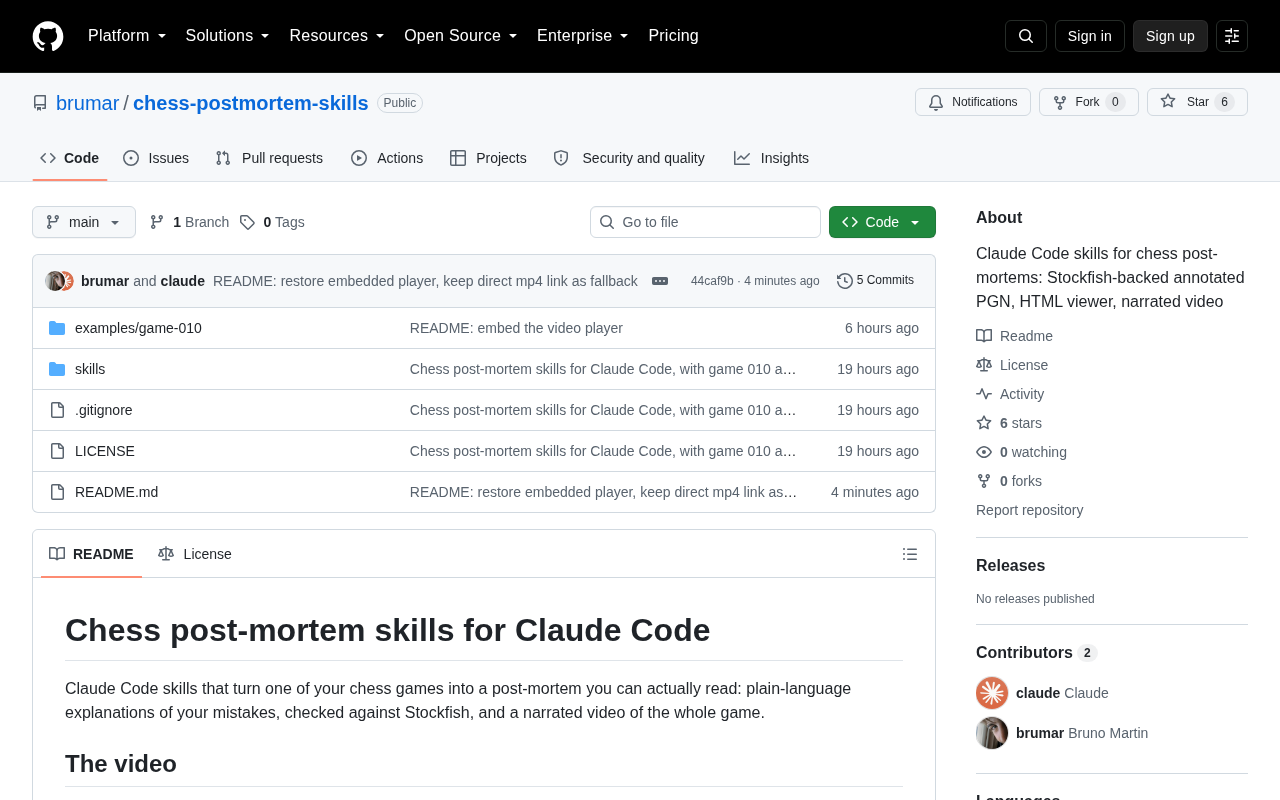
A developer recently shared an interesting project on Hacker News's Show HN section: a skill built on Claude Code specifically designed to analyze users' chess games. While the post hasn't gone viral (9 upvotes and 2 comments at time of writing), it reflects a rapidly growing trend — using extensible Skill mechanisms to give general-purpose AI coding assistants the ability to handle specialized, domain-specific tasks.
For chess enthusiasts, game review (or post-game analysis) has always been one of the core methods for improving. Traditionally, this meant relying on specialized engines like Stockfish to score each move, or having a coach walk through the game move by move. This project attempts to combine the best of both worlds: the objective evaluation power of an engine, paired with the natural language fluency of a large language model.
What Is a Claude Code Skill?
To appreciate what this project offers, it helps to understand the underlying capability it builds on. Claude Code is Anthropic's command-line AI coding tool aimed at developers, and the Skill mechanism lets users extend it with domain-specific capabilities. In essence, a Skill is a set of predefined instructions, tool calls, and contextual conventions that allow the AI to behave like a domain expert when handling specific tasks.
Applying this to chess analysis is fairly straightforward in concept: the user provides a game record (typically in PGN format), and the Skill handles calling a chess engine to calculate positions, identify critical moments, and flag mistakes — then has Claude summarize the findings in natural language, producing insights like "Your move on turn 18 gave up control of the center."
Why This Combination Makes Sense
A pure chess engine is precise but outputs cold numerical evaluations that most casual players can't interpret — knowing a position is "-1.5" doesn't tell you much. A pure LLM, on the other hand, tends to make errors in concrete move calculation; it simply isn't built for deep tree search. Combining the engine's computational power with the LLM's interpretive ability neatly covers each tool's blind spot. This is actually a pattern that keeps getting validated across AI applications: let the LLM handle coordination and communication, and delegate precise computation to specialized tools.
PGN (Portable Game Notation) is the standard format for recording chess games, established by the American Computer Chess Association in 1993. It stores game metadata (players, date, event) and a complete move sequence in algebraic notation — for example, 1. e4 e5 2. Nf3 Nc6 — as plain text. Nearly every major chess platform (Chess.com, Lichess) supports PGN export, making it a natural interface for AI analysis tools to tap into real user data. Open-source engines like Stockfish natively accept PGN input and can return evaluation scores for each move (measured in "pawns," with positive and negative values indicating White or Black advantage), providing the structured numerical foundation that an LLM layer can then interpret.
Stockfish is one of the strongest open-source chess engines in the world, combining Alpha-Beta pruning search with neural network evaluation (the NNUE architecture). On ordinary consumer hardware, it can search tens of millions of positions per second. Its evaluations are expressed in centipawns (100 centipawns = 1 pawn's worth of advantage) and it can identify the "best move" in any given position. This numerical system is intuitive for serious players but opaque to casual enthusiasts — "-150cp" conveys far less than "your queen is exposed on the rook's file and you'll lose a piece within three moves." It's precisely this interpretive gap that creates genuine user value for an LLM explanation layer.
What This Reflects About the Broader AI Landscape
This small project may be modest in scope, but the direction it points in is worth paying attention to. Over the past year, the ecosystem around AI coding assistants has been evolving from "write code" to "do tasks." Developers are no longer satisfied with AI generating code snippets — they want AI packaged as an agent capable of independently completing an entire workflow.
Pluggable extension mechanisms like Skills significantly lower the barrier to building vertical AI applications. A chess analysis tool used to require building a frontend, backend, engine integration, and UI from scratch. Now, with an existing AI assistant framework, a developer can define task logic and tool calls and have a working prototype up quickly.
The Real Limitations
That said, this type of project has clear ceilings. As a Show HN entry, it's more proof-of-concept than polished product. The depth of analysis, the efficiency of engine calls, and whether the LLM will occasionally hallucinate in its explanations are all challenges that require sustained iteration. Serious players also already rely on mature analysis platforms — Chess.com and Lichess both have excellent built-in engine analysis — and competing with those on experience and accuracy is a long road.
Both Lichess and Chess.com already include free Stockfish-powered analysis features: they visualize the evaluation curve for every move, flag "Mistake" and "Blunder" categories, and show optimal continuations. These platforms have been refined over years and set a high industry benchmark for analysis accuracy and user experience. For a Claude Code Skill to carve out differentiation, the more realistic angle probably isn't replacing these specialized tools — it's building a "second layer" on top of their output. Think: identifying systematic weaknesses across a user's long-term game history, or answering conversational questions like "why does the engine think that move was a mistake?"
What Developers Can Take Away
For developers interested in exploring AI applications, this project offers a low-cost reference model: pick a vertical domain you know well that has clear evaluation criteria, use the AI assistant as a coordination layer, plug in specialized tools for precise computation, and use natural language output as the user interface. Chess is an ideal testbed for this — it has clear rules, mature engines, and a large community of players eager to improve.
Zooming out, the "AI assistant + domain Skill" pattern may be how a large number of long-tail applications come into existence going forward. Not every idea needs a complete system built from scratch. Standing on the shoulders of general-purpose AI capabilities and extending vertically is becoming an increasingly efficient path to innovation.
Related articles

Velocity Ambiguity Profiles: A New Tool for Time-Resolved Bayesian Risk Diagnostics
Velocity Ambiguity Profiles (VAP) is a time-resolved Bayesian risk diagnostic tool for flow matching models that distinguishes intrinsic ambiguity from data-limited loss, validated on CIFAR-100.

Creative Ways to Use Claude to Improve Your Quality of Life: Beyond Hacking TV Ads
Explore creative ways Reddit users use Claude: from automated bill organization and travel planning to smart home control and creative assistance, and how to integrate AI into daily life.

Escaping the "Human Router": A Practical Guide to Multi-Claude Code Agent Orchestration
A developer managing 11 projects with Claude Code manually relayed 257 prompts in a week, taking 11 minutes on average to notice completion. This article analyzes multi-agent orchestration pain points, the trade-offs of single agent + subagents, and three automation approaches—script monitoring, agent communication, and supervisor pattern—to help you go from human router to CEO.