Anbernic's New Dual-Screen Handheld Leaks: Can It Replace the Aging 3DS?

Anbernic's new dual-screen handheld leaks, capable of emulating 3DS, Xbox, and PS3, but whether it can replace the aging 3DS remains to be seen.
Anbernic showcased its upcoming dual-screen handheld via video, capable of emulating 3DS, Xbox, and PS3 games, marking its formal entry into the dual-screen handheld arena. The dual-screen form factor naturally suits 3DS/DS games but places higher demands on SoC performance, cooling, and emulator compatibility, with PS3 emulation especially taxing hardware. As a latecomer to brands like Ayaneo, Anbernic enters with supply chain and cost-effectiveness advantages, but the dual-screen handheld market is niche, and software ecosystem and community support are key. Replacing the aging 3DS may hit nostalgic players' pain points, but glasses-free 3D, touch feedback, and first-party optimization are hard to replicate, plus the legal gray area of emulation—actual competitiveness will depend on post-launch reputation.
Anbernic's New Dual-Screen Handheld Leaks: Can It Replace the Aging 3DS?
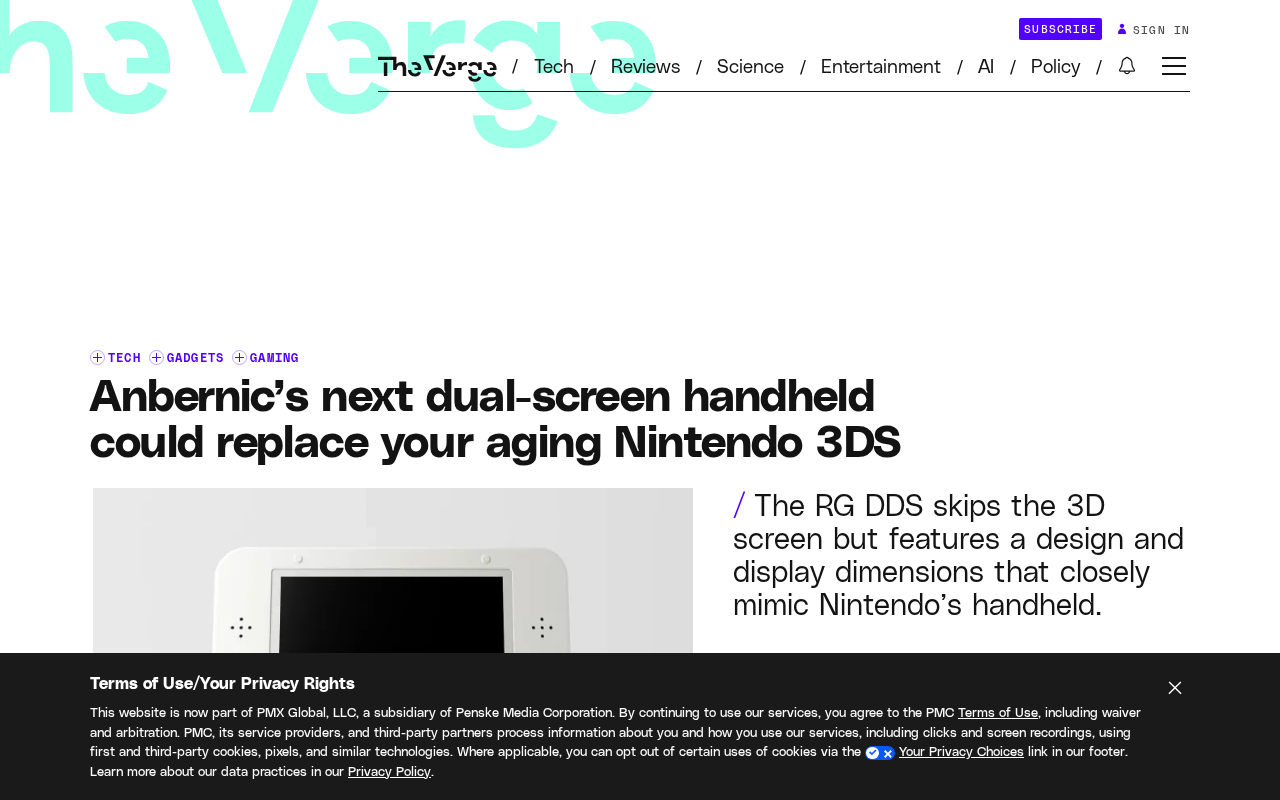
Anbernic recently showcased its upcoming dual-screen handheld in a video, a device capable of running 3DS, Xbox, and PS3 games via emulators. Competitors like Ayaneo have been toiling in the dual-screen handheld space for years, while Anbernic only recently launched its own dual-screen lineup, including the RG DS and RG DS Plus. The debut of this new device has prompted many players to wonder: is it enough to replace the aging Nintendo 3DS?
A New Player in the Dual-Screen Handheld Market
Anbernic has built a solid reputation in the handheld emulator space, but dual-screen designs have long been a gap in its product line. Brands like Ayaneo attempted dual-screen form factors years earlier, with mixed market feedback. Anbernic's entry this time clearly aims to carve out a slice of the pie by leveraging its strengths in emulator optimization and cost-effectiveness.
From the official video, the new dual-screen handheld continues a clamshell or dual-screen folding design philosophy, with the top and bottom screens serving distinct roles. This form factor naturally suits 3DS and DS games—after all, many titles on these platforms inherently rely on dual-screen interaction. For Xbox and PS3 emulation, the second screen could display maps, status bars, or touch-assisted controls.
Emulating 3DS, Xbox, and PS3: Balancing Performance and Experience
The game lineup demonstrated in the video spans three generations of console platforms, placing significant demands on the handheld's SoC performance. 3DS emulation is relatively mature, with emulators like Citra already performing well on Android devices; Xbox and PS3 emulation, however, are far more hardware-intensive, especially given the PS3's complex architecture, which requires strong single-core CPU performance even on PCs.
Anbernic's choice to showcase all three platforms in its promotional video carries a certain "flexing" undertone. But whether real-world performance is smooth depends on the final production unit's cooling, driver optimization, and emulator compatibility. The dual-screen design also presents operational challenges: players must shift their gaze between two screens, and if the UI layout is unreasonable, it can actually increase fatigue.
Citra and Android 3DS Emulation
Citra is the most mainstream Nintendo 3DS emulator in the open-source community, supporting Windows, macOS, Linux, and Android. Its core difficulty lies in simultaneously emulating the 3DS's ARM11 dual-core CPU, PICA200 GPU, and dual-screen output, thus demanding high single-core performance and graphics driver compatibility from devices. On Android, Citra's official version ceased maintenance in 2024, with community forks (such as Lime3DS and Citra MMJ) taking over updates. Through Vulkan backend and shader cache optimization, flagship SoCs like the Snapdragon 8 Gen series can run most 3DS titles relatively smoothly. However, for weaker handheld SoCs, frame rate fluctuations, texture errors, and audio desync remain common issues, so there's a clear gap between "can run" and "runs well."
The Hardware Barrier for Xbox and PS3 Emulation
Original Xbox emulation is represented by Xemu, while PS3 emulation is benchmarked by RPCS3. Both rely on dynamic recompilation (JIT) to translate original console instructions into x86/ARM instructions, making them extremely CPU single-core dependent and demanding high Vulkan support from GPUs. Although RPCS3 can already run thousands of PS3 games, blockbusters like Uncharted and The Last of Us require fine-tuning to maintain a stable 30 fps even on desktop-grade i5/Ryzen 5 processors. On Android, only a few experimental PS3 emulation solutions exist, not yet mature enough for daily use. If Anbernic claims PS3 emulation support on a handheld, it's likely limited to select lightweight titles or reduced-resolution play—players should keep cautious expectations about "full-speed emulation."
Realistic Considerations for Replacing the 3DS
The Nintendo 3DS has been discontinued for years, yet second-hand prices remain firm, and issues like screen aging and battery degradation are increasingly common. A modern handheld capable of emulating the 3DS game library could indeed hit a pain point for some nostalgic players. If Anbernic's new dual-screen handheld can find a balance between price, feel, and emulation compatibility, it has a chance to become a "budget alternative" to the 3DS.
However, replacement is no easy task. The 3DS's glasses-free 3D, precise dual-screen touch feedback, and optimized first-party Nintendo games are all difficult for emulators to fully replicate. Additionally, the legal and ethical gray areas of emulation remain an unavoidable topic for such products.
The Irreplaceability of Glasses-Free 3D and Dual-Screen Touch
The 3DS's glasses-free 3D relies on parallax barrier technology, allowing the left and right eyes to see different pixel columns, creating a stereoscopic effect without glasses, and supporting face tracking to adjust the parallax angle. Emulator handhelds generally use standard LCD/OLED screens and cannot reproduce this physical optical effect, so titles like Super Mario 3D Land and The Legend of Zelda: A Link Between Worlds that depend on 3D depth will see noticeably diminished experiences. Furthermore, the 3DS's bottom screen uses resistive touch, offering high stylus precision and low latency, ideal for gameplay requiring continuous swiping like The Legend of Zelda: Phantom Hourglass; modern capacitive screens, while offering better feel, lack the original's stylus feedback. These hardware-level characteristics are the fundamental reason emulators struggle to fully replicate the 3DS experience.
Competitive Landscape and Market Prospects
Brands like Ayaneo have already tested the dual-screen handheld market, and Anbernic's entry will make this niche segment even more lively. Anbernic's advantage lies in supply chain integration and cost control, with products typically priced more affordably. If the new dual-screen handheld can maintain this positioning while ensuring emulator experience, it could attract price-sensitive players eager to try dual-screen emulation.
But dual-screen handhelds are inherently a niche demand with limited market capacity. Anbernic needs to continuously invest in software ecosystem and community support, or the device could easily become a "dust collector." From the RG DS to the new dual-screen handheld, Anbernic is filling out its product matrix, but whether it can truly win over players depends on post-launch reputation.
The Software Ecosystem Dilemma for Dual-Screen Handhelds
The biggest difference between dual-screen Android handhelds and regular handhelds is the need for system-level support for coordination between two screens. Android natively has limited support for multi-screen heterogeneous display, so manufacturers often need custom firmware to let emulators correctly identify primary and secondary screens, allocate rendering output, and handle touch coordinate mapping. Pioneering products like the AYANEO Pocket DS have been criticized by players for issues with screen ratios, rotation orientation, and emulator compatibility. If Anbernic cannot provide stable dual-screen APIs and preset configurations at the firmware level, users will have to tinker themselves, and the barrier will deter a significant portion of casual players. This is also one of the key reasons dual-screen handhelds struggle to form a mass market—hardware form factors can be quickly copied, but software and community adaptation require long-term investment.
Conclusion
The leak of Anbernic's new dual-screen handheld adds new intrigue to the handheld emulator market. It can emulate 3DS, Xbox, and PS3 games, and its dual-screen form factor suits the needs of certain nostalgic platforms. But replacing the aging 3DS requires not just adequate hardware performance, but also finding a balance between operational experience, compatibility, and price. For players on a budget who don't want to tinker with a second-hand 3DS, this device is worth watching; for those seeking an authentic experience, emulator handhelds are still unlikely to fully replace the original hardware.
One-line Summary
Anbernic's new dual-screen handheld leaks, capable of emulating 3DS, Xbox, and PS3, but whether it can replace the aging 3DS remains to be seen.
Paragraph Summary
Anbernic showcased its upcoming dual-screen handheld via video, capable of emulating 3DS, Xbox, and PS3 games, marking its formal entry into the dual-screen handheld arena. The dual-screen form factor naturally suits 3DS/DS games but places higher demands on SoC performance, cooling, and emulator compatibility, with PS3 emulation especially taxing hardware. As a latecomer to brands like Ayaneo, Anbernic enters with supply chain and cost-effectiveness advantages, but the dual-screen handheld market is niche, and software ecosystem and community support are key. Replacing the aging 3DS may hit nostalgic players' pain points, but glasses-free 3D, touch feedback, and first-party optimization are hard to replicate, plus the legal gray area of emulation—actual competitiveness will depend on post-launch reputation.
Related articles

Chain of Thought Isn't Just for AI: How Humans Can Use CoT to Improve Thinking Quality
Chain of Thought isn't just a prompt trick for large models. Starting from a Hacker News discussion, this article analyzes why CoT works for human thinking too, breaks down actionable ways to transfer it, and highlights the key differences between human CoT and machine CoT.
Cloudflare Teams Up with OpenAI: Closi…
Cloudflare Teams Up with OpenAI: Closing the Loop from Vulnerability Discovery to Defense with AI
Cloudflare uses OpenAI Daybreak to investigate security vulnerabilities and generate reviewable remediation plans, while developers use Codex to boost coding efficiency and quality.

Orca Multi-Agent Orchestration in Practice: A Guide to Parallel Collaboration with Claude and Codex
Orca is Stable AI's free open-source agent workbench supporting 34 agents like Claude Code and Codex in parallel. Learn its Git worktree isolation, multi-model orchestration, and mobile management.