Andrew Ng's New Course: Revolutionizing Code Development with Gemini CLI Open-Source Agents

Andrew Ng and Google launch a course on Gemini CLI, an open-source agentic coding assistant.
Andrew Ng and Google have jointly launched a Gemini CLI course that systematically covers this fully open-source intelligent coding assistant from installation to advanced automation. Using an AI conference planning scenario as a practical case study, the course covers core skills including context engineering, MCP multi-tool orchestration, and GitHub Actions automated code review, demonstrating the trend of intelligent coding assistants evolving from pure code tools into general-purpose digital work assistants.
Andrew Ng and Google have jointly launched a brand-new course — Gemini CLI: Code and Create with an Open-Source Agent. Taught by Google Developer Advocate Jack Wetherspoon, the course systematically covers how to leverage Gemini CLI, an open-source intelligent coding assistant, from installation and configuration to advanced automated workflows, comprehensively boosting development efficiency. Andrew Ng himself admits that he now barely writes code by hand, letting AI coding systems do the work instead.
The Era of Intelligent Coding Assistants Has Arrived
Andrew Ng states plainly at the beginning of the course: "Experienced developers are using intelligent coding assistants, and these tools are dramatically accelerating our work." He mentions that Gemini CLI, like Cloud Code and OpenAI Codex, belongs to the new generation of Agentic Coding Systems.
These systems are fundamentally different from traditional code completion tools. Early AI coding assistance (like GitHub Copilot's initial auto-completion mode) mainly predicted the next line of code based on context, whereas Agentic systems possess autonomous planning, tool invocation, and multi-step reasoning capabilities. They can understand high-level task descriptions, autonomously decompose them into subtasks, invoke external tools such as file systems, terminal commands, and APIs, and dynamically adjust strategies based on execution results. This "agent" paradigm originates from the Agent architecture concept in AI — enabling large language models not only to generate text but also to serve as decision-making hubs driving a series of real-world operations.
The core value of these systems lies in their ability to access your local machine and execute various commands with authorization — whether it's pip install, Playwright, npx, or git operations. With just a small set of tools, these intelligent coding systems can set up development environments and rapidly build complete applications or functional modules.
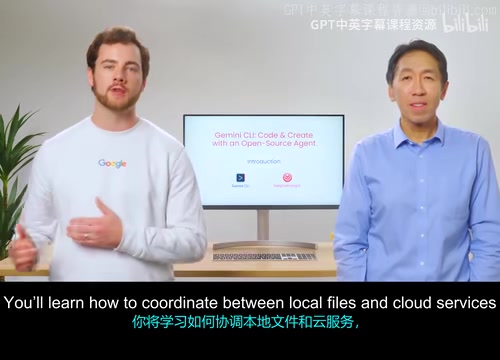
Andrew Ng particularly emphasizes: "Prototyping has never been this fast." This isn't just his personal feeling — it's an efficiency revolution the entire developer community is experiencing.
Course Content: From Getting Started to Advanced Automation
This course is designed in a highly systematic manner, covering the complete range of Gemini CLI use cases. The course uses organizing an AI developer conference as an end-to-end practical case study, enabling learners to master various skills in a real-world scenario.
Core Learning Modules
The course covers the following key topics:
- Installation and Basic Usage: Installing Gemini CLI from scratch, mastering common tasks, built-in tools, and community usage patterns
- Context and Memory Engineering: Learning how to optimize Gemini CLI's context and memory configuration for best output
- Multi-Tool Orchestration: Organizing and coordinating multiple tools and MCP servers to build automated workflows
- Advanced Automation: Automating routine tasks like code review using GitHub Actions and other tools
Context Engineering: The Core Competency of AI Development in 2025
The course teaches "Context and Memory Engineering" as a standalone module, reflecting the industry's high regard for this capability. Context Engineering is one of the core concepts in AI development in 2025, popularized by figures like Shopify CEO Tobi Lütke. It refers to carefully designing and managing the contextual information fed to large language models to maximize output quality.
In the context of Gemini CLI, context engineering operates on several levels: First is the "system instructions" layer, where configuration files like GEMINI.md define project-level rules and preferences, similar to setting roles and behavioral guidelines for the AI. Second is the "session memory" layer, which allows the AI to maintain understanding of project state across multiple interactions, avoiding repeated context explanations. Finally, there's the "retrieval augmentation" layer, which provides the model with precise reference information by citing specific files, code snippets, or documentation. Since large language models have limited context windows (even Gemini 2.5 Pro with its 1-million-token ultra-long context), how you place the most relevant information within that limited window directly determines the accuracy and utility of AI output.
MCP Servers: A Standardized Protocol for AI Tool Orchestration
The MCP (Model Context Protocol) frequently mentioned throughout the course is a standardized protocol proposed and open-sourced by Anthropic in late 2024, designed to provide large language models with a unified way to access external tools and data sources. In the MCP architecture, an "MCP server" is a lightweight service responsible for exposing the capabilities of specific tools or data sources to AI models through standardized interfaces.
For example, the Canva MCP server used in the course allows Gemini CLI to directly call Canva's design API to create marketing materials, while the Google Workspace MCP server enables the AI to read and write Google Docs and Calendar. The core value of this protocol lies in decoupling — developers don't need to write integration code for each AI tool individually; they just deploy servers compliant with the MCP standard, and any AI client supporting MCP can automatically discover and use these capabilities. The "multi-tool orchestration" in the course refers to simultaneously connecting multiple MCP servers, allowing Gemini CLI to seamlessly invoke design, document, database, and other external services within a single workflow.
Practical Project Highlights
Centered around AI conference preparation, the course features several highly practical projects:
- Conference Website Development: Using Gemini CLI's native Google Workspace extensions, collaborating with Docs and Calendar to build core website functionality
- Marketing Material Creation: Creating conference marketing materials through the Canva MCP server
- Data Dashboard: Integrating attendee data with existing company databases to build visual data panels
- Multimedia Content Processing: Transforming conference podcasts into social media short videos and posts

GitHub Actions Automation: From Personal Assistant to Team Infrastructure
The advanced automation module focuses on the integration of Gemini CLI with GitHub Actions. GitHub Actions is GitHub's continuous integration/continuous deployment (CI/CD) platform that allows developers to define automated workflows through YAML configuration files, automatically executing preset tasks when triggered by events like code pushes or Pull Request creation.
Embedding Gemini CLI into GitHub Actions means the AI coding assistant can be integrated into a team's standard development workflow. For example, when a team member submits a Pull Request, GitHub Actions can automatically trigger Gemini CLI to review the code, check for potential bugs, security vulnerabilities, and code style issues, and leave comments and modification suggestions directly in the PR. This pattern elevates AI from a "developer's personal assistant" to "team-level automation infrastructure," achieving 24/7 uninterrupted code quality gatekeeping. This is also an important direction in the development of current AI coding tools — moving from interactive assistance to unattended automated pipelines.
Additionally, the course includes a bonus — demonstrating how to use Gemini CLI to organize and search through messy course materials for more efficient learning.
Fully Open Source: Transparency and Community Co-Creation
One of Gemini CLI's most exciting features is that it's fully open source. Jack Wetherspoon particularly emphasizes this in the course: every line of code is public on GitHub, including the actual instructions and System Prompts.
This transparency is especially valuable in an era of rapid AI tool iteration. Developers can not only understand how the tool works but also directly participate in improvements. Currently, Gemini CLI has merged thousands of Pull Requests from community members, including widely popular features such as session management.
What Open Source Means for AI Coding Tools
Both Andrew Ng and Jack encourage learners to consider contributing to Gemini CLI or other open-source projects after completing the course. As Jack puts it: "Open-source software is critical to innovation, especially in the age of AI. These contributions create value for everyone."

For developers wanting to deeply understand the internal mechanisms of AI coding tools, Gemini CLI's open-source nature provides an excellent learning opportunity — you can directly examine the system prompts to understand how agents are designed and tuned. System Prompts are key configurations that define AI behavior boundaries and capability scope, determining under what circumstances the AI should request user confirmation, how to handle ambiguous instructions, and what recovery strategies to adopt when encountering errors. Most commercial AI coding tools treat system prompts as core trade secrets, while Gemini CLI's complete transparency allows developers to learn how Google engineers design efficient agent behavioral specifications — invaluable reference material for building your own AI applications.
Why This Course Deserves Your Attention
The value of this course lies not just in learning a specific tool, but in mastering the methodology and best practices of intelligent coding. Google sharing its internally accumulated intelligent coding experience with external developers through this course is itself an important signal.
From a course design perspective, it cleverly combines coding tasks with non-coding tasks — from web frontend development to social media content creation — demonstrating the broad applicability of AI agents. This reflects a clear trend: intelligent coding assistants are evolving from pure code tools into general-purpose digital work assistants.
Gemini CLI's Position in the Competitive Landscape
The current AI coding assistant market features diverse competition. Cursor is an AI-native IDE built on a deep modification of VS Code, known for its smooth in-editor AI interaction experience. GitHub Copilot started with code completion and has gradually expanded into a full-featured coding assistant supporting Agent mode. Claude Code is Anthropic's terminal AI coding tool, known for its powerful reasoning capabilities. Gemini CLI's differentiated positioning rests on three points: first, being fully open source, allowing developers to audit every line of code and system prompt — particularly important in enterprise environments focused on security and compliance; second, deep integration with the Google ecosystem, natively supporting Google Workspace, Google Cloud, and other services; third, the strong performance of the Gemini 2.5 series models on code generation benchmarks, especially the large codebase comprehension capability enabled by ultra-long context windows.
For developers already using Cursor, GitHub Copilot, or similar tools, understanding Gemini CLI's open-source implementation and Google's best practices can help you better understand and leverage various AI coding tools. For developers new to intelligent coding, this course provides a systematic entry path.
The course is offered on the DeepLearning.AI platform, and interested developers can visit the platform to access the full content.
Key Takeaways
- Andrew Ng and Google jointly launched the Gemini CLI course, systematically covering intelligent coding assistant usage methods and Google's internal best practices
- Gemini CLI is fully open source, with all code and system prompts publicly available on GitHub, having merged thousands of community Pull Requests
- The course uses organizing an AI conference as a practical case study, covering scenarios including website development, data dashboards, multimedia processing, and automated code review
- Intelligent coding assistants are evolving from pure code tools into general-purpose digital work assistants; Andrew Ng says he barely writes code by hand anymore
- The course emphasizes advanced usage including MCP server orchestration, context engineering, and GitHub Actions automation
Related articles
 Tech Frontiers
A Rare Quiet Day in AI: Recursive Self-Improvement Stirs Beneath the Surface
A rare quiet day in AI sees multiple sources go silent simultaneously. Behind the calm, Recursive Self-Improvement (RSI) research continues. What this means for the industry.
 Tech Frontiers
Reve 2 vs. Ideogram 4: A Deep Dive into Layout Control in AI Image Generation
A deep comparison of Reve 2 and Ideogram 4's layout control capabilities, covering technical approaches, real-world use cases, and industry trends for designers and creators.
 Tech Frontiers
In the Weights: Check Your Influence Score in the AI World
In the Weights is an AI influence search engine that quantifies your presence in the AI world with a score. Explore how it evaluates practitioners and what it means for digital identity.