Andrew Ng Teaches Python: The Programming Course Everyone Should Take in the AI Era
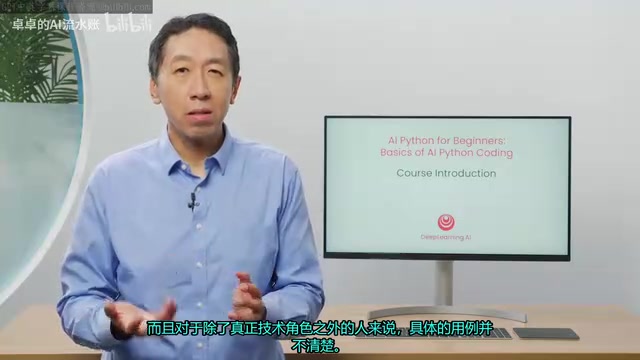
Andrew Ng changes his stance: generative AI means everyone should learn a little programming, with a focus on human-AI collaboration.
Ten years ago, Andrew Ng believed not everyone should learn to program, reasoning that it required significant effort and had unclear uses for non-technical roles. The spread of generative AI has changed this judgment: knowledge workers in marketing, business research, and investment analysis can significantly boost efficiency by writing a little code, because programming ability lets people mobilize AI more fully. His 35-lesson Python introductory course introduces a learning method of collaborating with a chatbot from the first lesson, likening AI to a coding partner always at your side—lowering the barrier to entry while serving as an ongoing productivity tool. Positioned from zero base to hands-on AI automation and aimed at knowledge workers and beginners, the course emphasizes both practicality and fun. This shift in stance reflects that the barrier to programming education is being redefined by AI, with teaching focus moving from syntax training to cultivating human-AI collaboration skills.
Why Should Everyone Learn a Little Programming Now? Andrew Ng Has a New Answer
Ten years ago, if someone had asked Andrew Ng whether "everyone should learn to program," his answer would have been no. The reasoning was practical: learning to program requires considerable effort, and for people in non-technical roles, the concrete uses of programming weren't clear.
But the rise of generative AI has changed the equation. In the opening of this Python introductory course published on Bilibili, Andrew Ng states plainly that with the spread of tools like ChatGPT, he has seen practitioners in marketing, business research, investment analysis, administrative decision-making, and other fields significantly boost their work efficiency by writing a bit of code.
The core logic behind this judgment: AI affects nearly all knowledge work, and programming ability lets you mobilize AI's capabilities more fully. Even if you only master a little coding, you can get AI to do more for you.
Chatbot Companion: The Way We Learn Programming Has Already Changed
The biggest difference between this course and most programming tutorials on the market is that from the very first lesson it introduces a learning method of "collaborating with a chatbot." Andrew Ng uses a vivid analogy: you never have to code alone—it's like always having a partner who is very good at coding, ready to help whenever you're writing code.
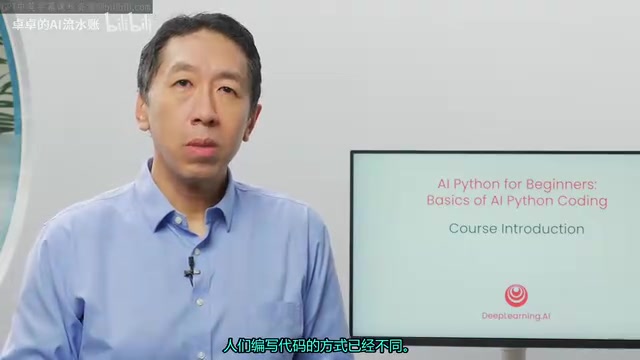
This model brings changes at two levels. During the learning phase, the chatbot can answer questions anytime, explain error messages, and demonstrate examples, greatly lowering the barrier to entry; once you get going, it becomes an ongoing productivity tool that helps you get feedback at every step of your work. Andrew Ng concludes from this: these new tools significantly reduce the cost and effort required to learn programming.
He emphasizes that the course deliberately chooses this future-oriented teaching approach because it better matches the actual trends in professional coding today—developers collaborating with AI has become the norm, not the exception.
"Collaborating with a chatbot" is usually called AI pair programming in professional development contexts. This model isn't an entirely new concept; early tools like GitHub Copilot already provided code completion and suggestions within the IDE, and conversational models like ChatGPT expanded it into a multi-turn collaborative partner that can explain concepts, diagnose errors, refactor code, and generate tests. For beginners, the key difference is that the feedback loop shortens from "check docs → trial and error → ask others" to "describe the problem → get an explanation → verify immediately," significantly reducing frustration. It's worth noting that chatbots can generate plausible but actually incorrect code (i.e., "hallucinations"), so learners still need to maintain the habit of verification and understand what the code is doing rather than blindly copying and pasting.
The Content Positioning and Target Audience of the 35-Lesson Course
This complete 35-lesson tutorial is positioned as going from zero-base introduction to hands-on AI automation. From the message conveyed in the course opening, it doesn't assume learners want to become AI developers or software engineers. Andrew Ng states clearly that regardless of your work role and career direction, the course aims to show you that coding is useful, fun, and can help you in your daily work and life.
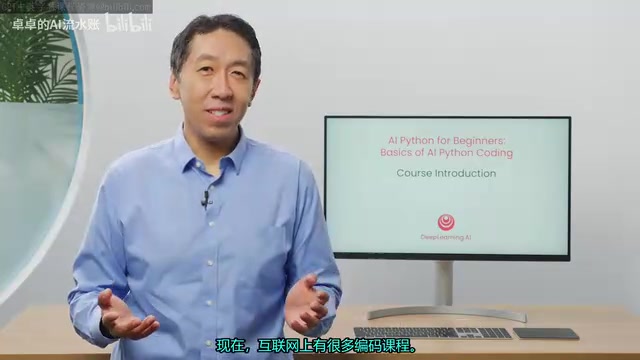
The target audience includes knowledge workers who want to use code to boost efficiency, professionals who want to use AI tools to enter the automation field, and beginners with no programming experience at all who want to understand the logic of AI applications. The course emphasizes both practicality and fun, and Andrew Ng readily admits he doesn't want to underestimate the joy of programming itself—once you learn to write a little code, many things that were previously out of reach become accessible.
"Hands-on AI automation" in the course title usually refers to task-oriented applications such as using Python to call large model APIs, orchestrate workflows, and process documents and data—not training models themselves. Such practice relies on several foundational skills: sending HTTP requests with requests or official SDKs, parsing JSON responses, processing tabular data with pandas, and organizing repetitive tasks with loops and functions. For non-technical roles, the most common applications are batch text processing, report generation, information extraction, and simple scraping. Understanding the boundaries of these components helps you judge how much prior knowledge the "automation" part of the course actually requires, and which environment setup and debugging skills zero-base learners need to fill in additionally.
From "Should I Learn" to "How to Learn": A Shift in Industry Signals
Andrew Ng's change of stance reflects, to some extent, a consensus in the AI education field: the barrier to programming education is being redefined by AI tools, but the value of programming itself hasn't weakened—rather, thanks to AI's amplifying effect, it has become more accessible.
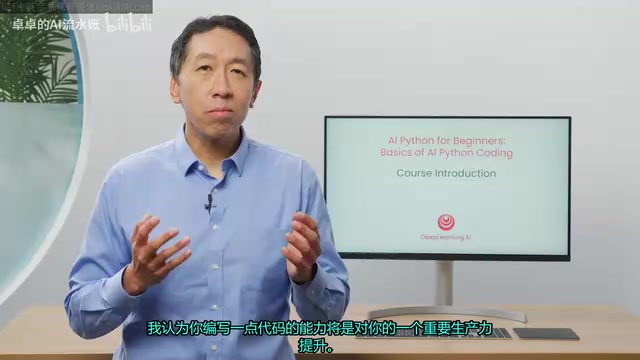
For content creators and knowledge workers, the key message this course conveys isn't "how important Python syntax is," but that "the programming habit of collaborating with AI" is becoming a foundational skill. Andrew Ng makes this the core selling point of the course in the opening, which also shows that top AI educators have shifted their teaching focus from syntax training to cultivating human-AI collaboration skills. Whether this course can deliver on its promise of "from zero base to hands-on AI automation" is worth watching as subsequent chapters unfold.
As a foundational skill, "human-AI collaboration ability" is often broken down in education research into three components: prompt design, result evaluation, and iterative correction. Compared with traditional syntax training, it places more emphasis on breaking problems down into machine-executable steps and maintaining critical examination of outputs. This shift also brings new assessment challenges: learners may over-rely on generated results without underlying understanding, leaving them helpless when encountering problems the model can't solve. Therefore, the compromise adopted by most AI educators is "first use AI to lower the barrier to entry, then consolidate core concepts through small projects," letting collaboration habits and programming fundamentals grow together rather than replace each other.
Related articles

FastAPI Learning Path: From Beginner to AI Project Practice
A Bilibili creator recommends *FastAPI Web Development: From Beginner to Advanced with Practical Projects*. This article outlines the FastAPI learning path: target audience, the 15-chapter six-part structure, project-driven learning, and practical directions from web backend to AI Agents, helping beginners avoid detours.

Reverse-Engineering Taobao's sign Signature Parameter with AI in 10 Minutes: A Practical Walkthrough
Based on a Bilibili hands-on demo, this article explains how to combine DeepSeek with vision models to automatically reverse-engineer Taobao's sign signature parameter, track dynamic titter and token values, and successfully scrape product data within ten minutes—while analyzing the capability boundaries and compliance risks of AI Agents in crawler reverse engineering.

LangChain+MCP from Beginner to Practice: A Deep Dive into the Bilibili Tutorial
A deep dive into a Bilibili LangChain+MCP tutorial: framework positioning, agent abstraction, and MCP protocol basics. Why not hand-build frameworks, and how beginners can follow the code-practice path.