Reverse-Engineering Taobao's sign Signature Parameter with AI in 10 Minutes: A Practical Walkthrough

AI Agent combining DeepSeek and vision models automates Taobao sign parameter reverse engineering and product scraping in ten minutes.
This article recaps using an AI Agent (DeepSeek plus vision models) to reverse-engineer Taobao's sign signature parameter. Traditional reverse engineering requires manual JS debugging and environment patching—tedious and slow; with AI taking over, it autonomously plans tasks, invokes a real browser for environment validation, identifies MD5-type hashes, tracks the dynamic titter value in cookies, and completes token concatenation and request construction. The demo successfully scraped the first ten product entries in about ten minutes. Yet boundaries remain: login state is required for complete data, titter must be re-acquired each session, and the AI may need multiple iterations. The article notes AI's value lies in automating the capture—locate—validate—concatenate—verify chain, not replacing algorithm understanding, and reminds developers of compliance boundaries.
In web security and crawler development, Taobao's sign signature parameter has always been a hurdle that's hard to avoid. Traditional reverse engineering requires repeatedly debugging JavaScript, extracting code, and patching the environment—a tedious and time-consuming process. Now, with AI Agents, this workflow can be compressed to under ten minutes. Based on a hands-on demonstration by a Bilibili creator, this article recaps how to combine DeepSeek with vision models to automatically locate the sign parameter and scrape product data.
The Reverse-Engineering Target: Why Is the sign Signature Parameter So Hard?
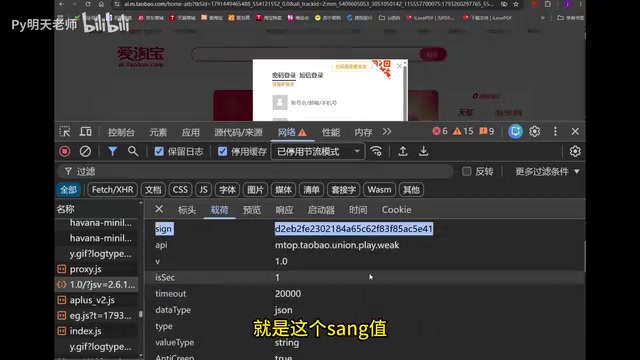
Open a Taobao page, press F12 to enter DevTools, refresh, and filter XHR requests in the Network panel—you'll see the API endpoint carrying the sign parameter. This parameter is dynamically generated by front-end JavaScript; if it's missing or incorrect, the server will outright refuse to return product data.
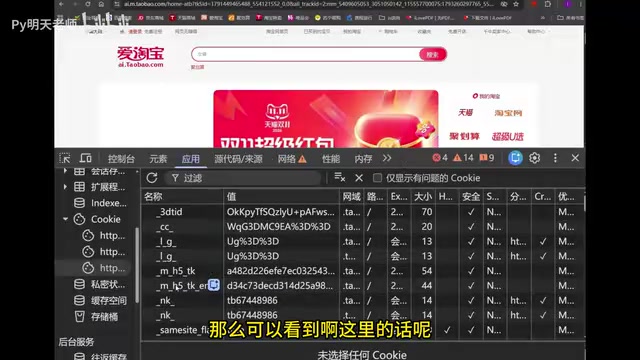
According to observations in the demo, besides sign, the request headers also contain a dynamically changing titter value (spoken as "titter" in the demo, likely corresponding to some token field) as well as timestamps and other elements. The titter value is stored in cookie data and changes with every session; the token value is composed of a leading string concatenated with a timestamp. This means simply copying parameters from a single request is meaningless—you must genuinely understand the generation logic.
The traditional approach is manual breakpoint debugging, keyword searching, locating the encryption function, then determining whether it's MD5 or another hash algorithm. In the demo, the AI detected that an MD5-type hash algorithm was being used for testing, but that's only one piece of the puzzle—the real difficulty lies in the dependencies between parameters and browser environment validation.
MCP (Model Context Protocol) is a protocol that enables standardized connections between large language models and external tools and data sources. In reverse-engineering scenarios, MCP essentially provides the AI with an interface layer for capabilities like "operating a browser," "reading cookies," and "executing JS," freeing the model from being limited to generating text so it can actually drive the toolchain to complete tasks. The "skills and MCP capabilities" mentioned in the demo refer to the AI invoking browser automation tools through preset skill modules to achieve environment detection and parameter extraction.
Browser fingerprinting is another barrier in platform anti-scraping. The server collects browser type, version, plugin list, Canvas rendering characteristics, WebGL parameters, and other information to generate a unique identifier. If the request comes from a headless browser or an anomalous environment, it may be rejected even if the sign is correct. That's why the AI in the demo first opens a real browser to verify the runtime environment—precisely to pass fingerprint validation and ensure subsequent requests are accepted by the server.
How the AI Agent Takes Over the Reverse-Engineering Workflow
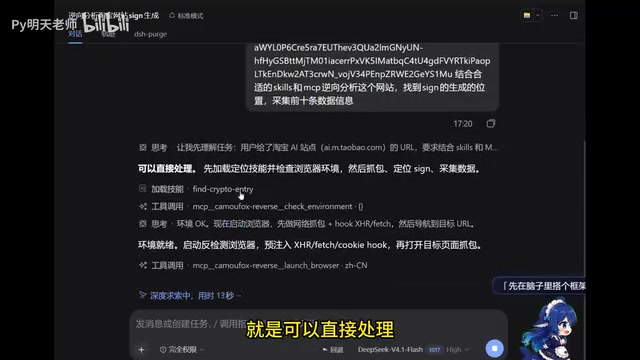
The demo hands the entire task directly to the AI: submit the target link with instructions to combine sign-related skills and MCP capabilities, analyze where sign is generated, and extract the first ten product data entries. Upon receiving the task, the model begins autonomous planning, locates the skill modules, and checks the browser environment.
The key here is that the AI invokes a real browser environment for detection rather than performing pure static code analysis. It opens the browser interface, verifies whether the runtime environment meets the page's requirements, and then runs algorithm tests on that basis. This combination of "environment validation + algorithm identification" maps precisely to the two common barriers in Taobao's anti-scraping: JS logic obfuscation and browser fingerprint detection.
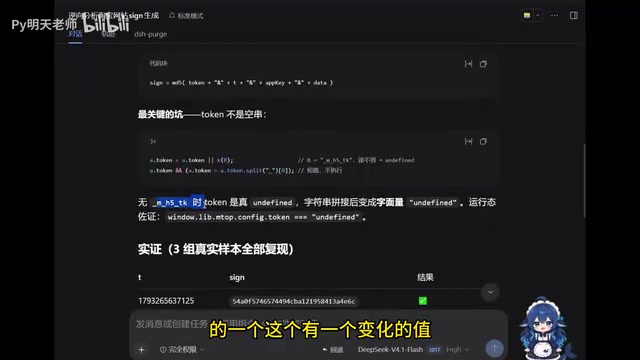
From the demo process, the AI can automatically discover dynamically changing values and trace them to the corresponding fields in cookies. In the logged-out state, some data cannot be fully obtained—which is why the demo requires logging into an account first. After logging in, the token structure becomes complete: the first half is a fixed identifier and the second half is a timestamp, based on which the AI completes parameter concatenation and request construction.
Cookies and login state play a central role in Taobao's authentication system. After a user logs in, the server issues cookies containing identity identifiers (such as _tb_token_, cookie2, etc.), and subsequent requests must carry these cookies to obtain complete data. The titter value mentioned in the demo is stored in cookies and changes with the session. When not logged in, some APIs return only desensitized or empty data, so the AI needs to complete the login flow first to make the token structure complete (fixed identifier in the first half + timestamp in the second half) before it can construct valid request parameters. This also explains why login state is an unavoidable prerequisite.
Practical Results and Capability Boundaries
Once the environment was ready, the AI re-acquired the titter value and ran through the entire workflow, successfully obtaining the first ten product data entries, covering household categories such as laser printing, alcohol wipes, and toilet paper. The entire process was compressed to the ten-minute range—a significant efficiency gain compared to manual reverse engineering.
That said, we need to view this approach objectively—it still has boundaries. The demo explicitly notes that complete data cannot be obtained in the logged-out state, indicating that login-state validation remains an unavoidable prerequisite; the dynamic nature of the titter value also means it must be re-acquired for every session. Additionally, during its first analysis, the AI did not immediately locate the parameter information passed within the small frame—it still required multiple iterations to converge.
From a methodological perspective, the value of AI Agents is not in replacing an understanding of encryption algorithms, but in automating the chain of "packet capture—location—environment validation—parameter concatenation—verification," freeing human effort from repetitive debugging. For crawler projects that require long-term maintenance, distilling the sign generation logic into a reusable skill has more engineering value than one-off reverse engineering.
Implications for Crawler Developers
This kind of demo reflects a trend: AI is evolving from a code-completion tool into a task executor capable of operating browsers and invoking toolchains. Reverse engineering—work that is highly experience-dependent—is being broken down into orchestration-ready skill combinations. Developers need to reposition their core competencies—from "knowing how to extract code" to "knowing how to design task workflows and validate AI output."
At the same time, pay attention to compliance boundaries. Product data scraping involves platform terms of service and data usage regulations; technical feasibility does not equal legitimate use. In actual projects, official APIs and authorized channels should be prioritized.
One-line Summary
AI Agent combining DeepSeekAd and vision models automates Taobao sign parameter reverse engineering and product data scraping within ten minutes.
Paragraph Summary
This article recaps the practical process of using an AI Agent (DeepSeek plus vision models) to reverse-engineer Taobao's sign signature parameter. Traditional reverse engineering requires manual JS debugging and environment patching—tedious and time-consuming; with AI taking over, it can autonomously plan tasks, invoke a real browser for environment validation, identify MD5-type hash algorithms, track the dynamic titter value in cookies, and complete token concatenation and request construction. In the demo, the AI successfully scraped the first ten product data entries, compressing the process to the ten-minute range. However, the approach still has boundaries: login state is a prerequisite for obtaining complete data, the titter value must be re-acquired each session, and the AI's first analysis may require multiple iterations. The article points out that AI's value lies in automating the "packet capture—location—environment validation—parameter concatenation—verification" chain rather than replacing an understanding of encryption algorithms, and reminds developers to pay attention to compliance boundaries.
Related articles
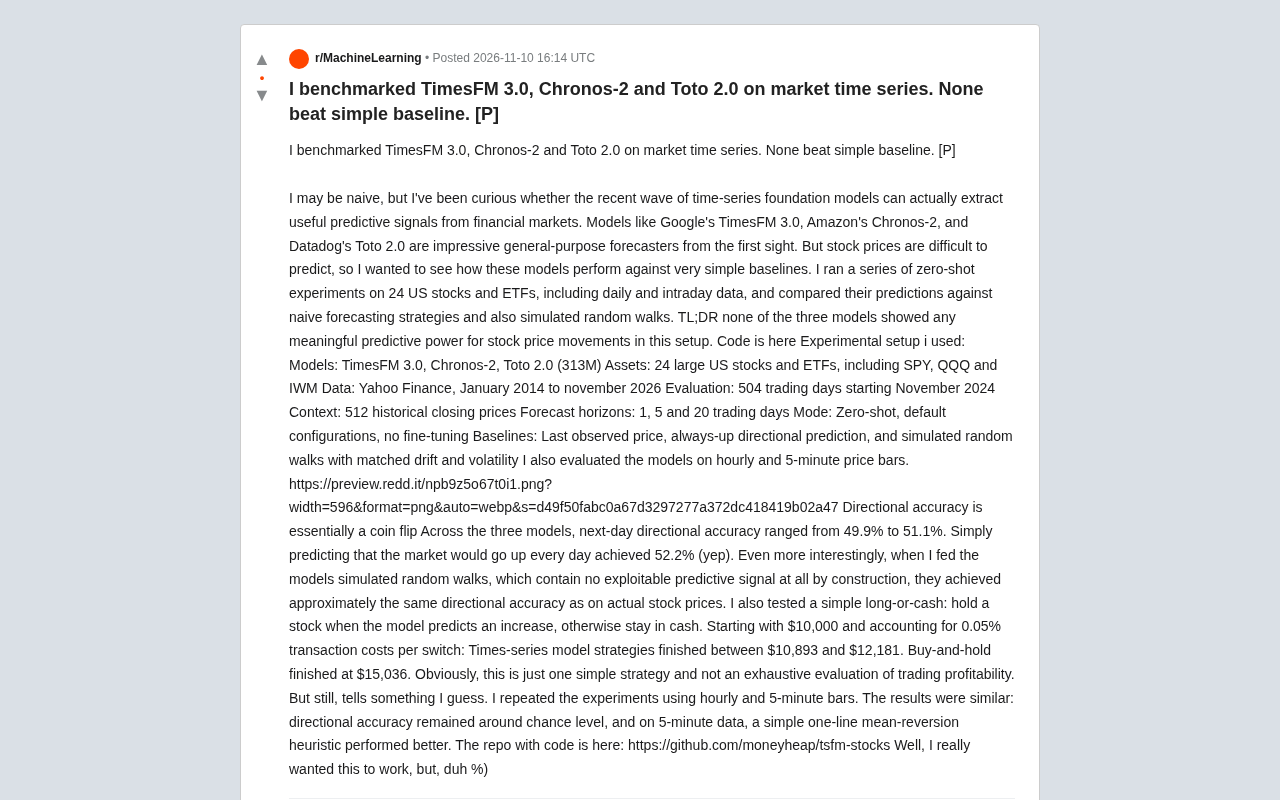
Putting TimesFM 3.0, Chronos-2, and Toto 2.0 to the Test: Time-Series LLMs Can't Beat Simple Baselines
A developer's zero-shot benchmark of TimesFM 3.0, Chronos-2 and Toto 2.0 on 24 U.S. stocks and ETFs: directional accuracy of just 49.9%-51.1%, and simulated trading underperformed buy-and-hold. Time-series foundation models show no edge over simple baselines on financial data.
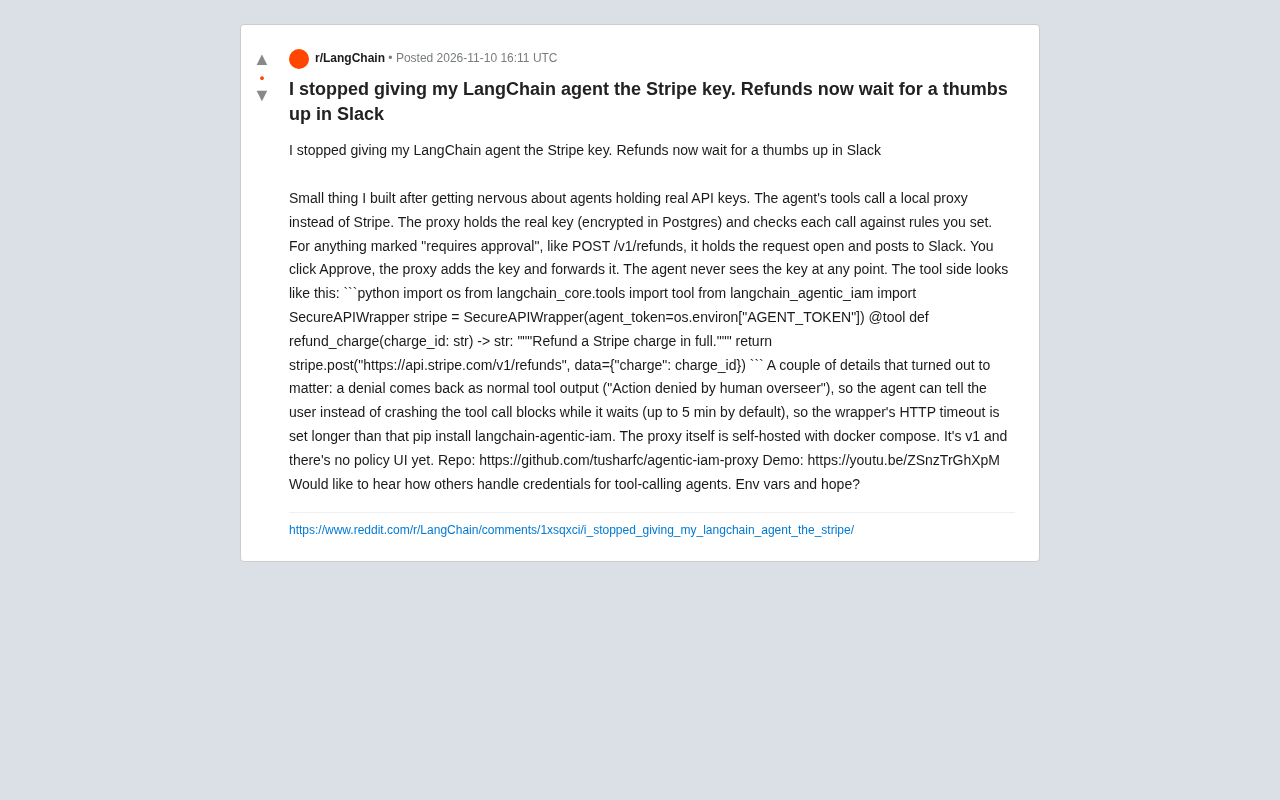
LangChain Agents No Longer Hold Stripe Keys: Refunds Require Slack Approval
A developer shares a credential management approach for LangChain agents: agents don't hold Stripe keys, and sensitive operations like refunds are forwarded through a local proxy and only executed after human approval in Slack, with code examples and engineering details.
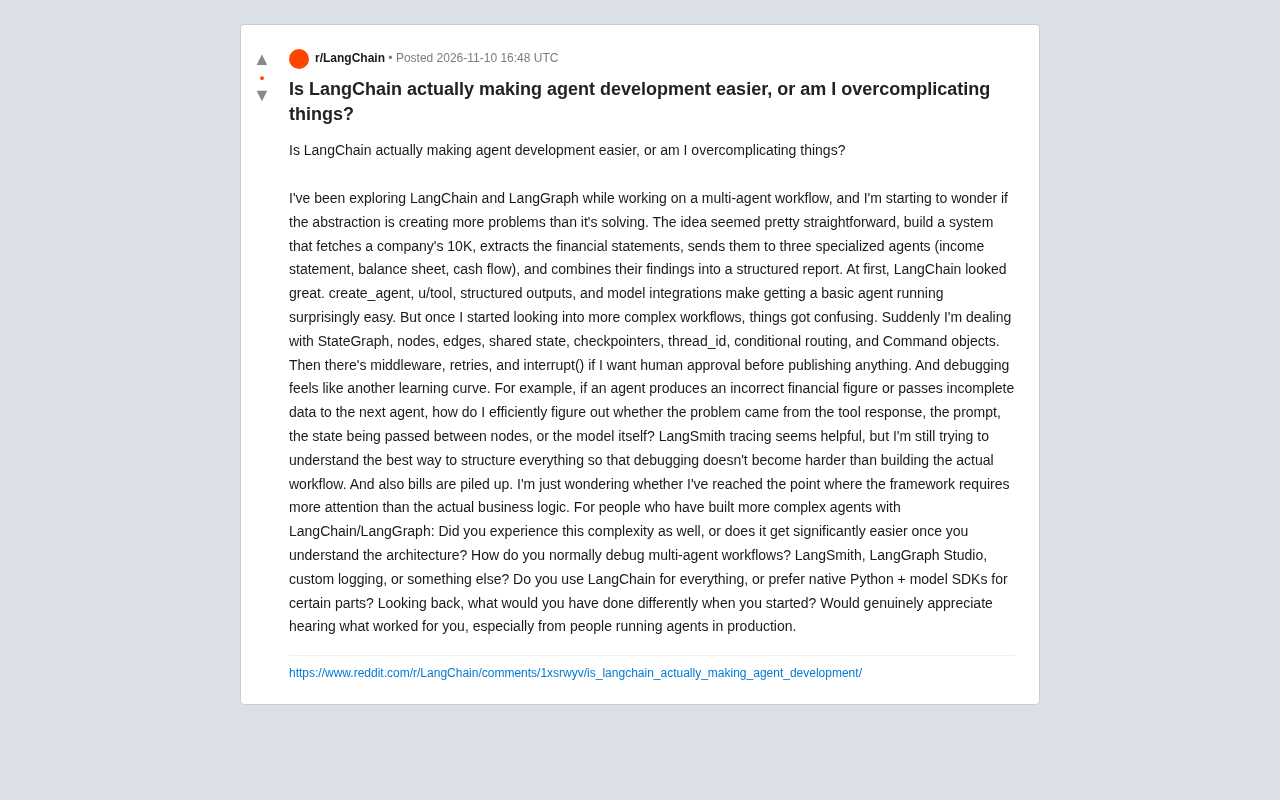
Does LangChain Really Make Agent Development Easier? A Developer Reflects on the Cost of Abstraction
A Reddit developer reflects on the abstraction cost of LangChain and LangGraph in multi-agent workflows: easy to start, but StateGraph, state management, debugging, and cost control add new complexity. The discussion covers debugging methods, whether to mix native Python + model SDKs, and production trade-offs.