Andrew Ng Teams Up with Anthropic: A Practical Guide to the Claude Code Course
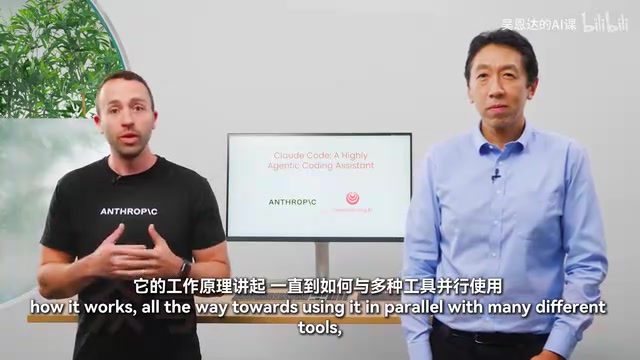
Andrew Ng and Anthropic's Claude Code course teaches best practices from context management to multi-instance parallel orchestration.
This article summarizes Andrew Ng and Anthropic's short course on Claude Code, taught by an Anthropic engineer. The course positions Claude Code as a highly agentic coding assistant and emphasizes that its effective use hinges on clear context — pointing to relevant files, describing requirements precisely, and extending capabilities via MCP. Three hands-on projects (a full-stack RAG chatbot, Jupyter e-commerce analysis, and a Figma-to-frontend build) bring these best practices to life. On the architecture side, the course reveals a counterintuitive fact: Claude Code uses no semantic embeddings or indexes, relying instead on file search and regex tools to read the codebase agentically and take notes — keeping the design simple and the code entirely local.
Andrew Ng's short course on Claude Code, developed in collaboration with Anthropic, has quickly become a go-to resource for developers looking to level up from beginner to advanced. Taught by Elie, an engineer at Anthropic, the course covers everything from how the tool works under the hood to orchestrating multiple parallel instances — and all the best practices in between that truly separate productive users from the rest. This article breaks down the core ideas and key technical concepts from the course.
The Evolution of AI-Assisted Coding: From Autocomplete to Highly Autonomous Agents
In his opening remarks, Andrew Ng positions Claude Code as a "highly agentic coding assistant" and openly calls it his personal favorite coding tool right now — one that has meaningfully boosted his productivity and that of many other developers.
Looking back at the trajectory of AI-assisted coding over the past few years: it started with developers occasionally asking LLMs a few coding questions, then came GitHub-style autocomplete, followed by increasingly autonomous tools. The release of Claude Code marks a noticeable leap in autonomy — it can take on a task and work independently for minutes at a time, or even longer. Some developers are no longer running a single Claude instance, but orchestrating multiple instances simultaneously to handle different parts of a codebase in parallel.
The course emphasizes that this kind of parallel collaboration is backed by a set of best practices that aren't widely known. Even experienced users who haven't been exposed to near-optimal usage patterns stand to gain significantly once they learn them.
The Core of Using Claude Code Well: Providing Clear Context
One principle that comes up repeatedly throughout the course is the importance of giving Claude Code clear context so it can efficiently accomplish the task at hand. This breaks down into three key points:
- Point Claude Code toward the relevant files to narrow its working scope;
- Clearly describe the functionality and features you want, minimizing ambiguity;
- Properly extend Claude Code's capabilities through MCP servers and other tools in the ecosystem.
These three points may seem straightforward, but they're the dividing line between an agent that delivers reliably and efficiently and one that doesn't. The clearer the context, the closer the model's autonomous decisions will align with the developer's true intent — and the lower the cost of rework.
Three Hands-On Projects: From RAG Chatbot to Figma Frontend
The course uses three progressively challenging projects to put these best practices into concrete scenarios.
Project 1: Full-Stack RAG Chatbot Development
The first project is building a RAG (Retrieval-Augmented Generation) chatbot with a complete frontend and backend implementation, including refactoring code, writing tests, and using GitHub integration to handle Pull Requests and fix issues. This process draws on several core Claude Code features: planning, thinking modes, creating parallel sessions, and managing Claude's memory.
RAG (Retrieval-Augmented Generation) is an architectural pattern that combines large language models with external knowledge bases. The core idea is: when a user asks a question, the system first retrieves relevant passages from a vector database or document store, then injects those passages as context into the prompt, enabling the model to generate answers grounded in real source material rather than relying solely on what it learned during training. This significantly reduces model hallucinations and allows the knowledge base to be updated at any time without retraining. A typical RAG system involves five stages: document chunking, vector embedding, similarity retrieval, prompt assembly, and model generation. The RAG chatbot was chosen as the first teaching project because it spans frontend and backend development, database operations, and API calls — making it an ideal showcase for Claude Code's planning and coordination abilities across multi-layer, multi-file tasks.
Project 2: Jupyter Notebook and E-Commerce Data Exploration
The second project shifts to a data analysis context, using Jupyter Notebook to explore e-commerce data. The course demonstrates how to use Claude Code to refactor notebooks, remove redundant code, and build a powerful data dashboard complete with a web application.
Project 3: Figma Design to Frontend Application
The final project focuses on turning designs into working code: starting from a Figma mockup, the course combines Claude Code, a Figma MCP server, and another MCP server to import the design and iteratively build, test, and ship a fully functional frontend application in an agentic workflow. This section highlights the value of the MCP ecosystem in extending tool capabilities.
MCP (Model Context Protocol) is an open protocol proposed by Anthropic to standardize how AI models interact with external tools and data sources. Think of it as the "USB port" for the AI tooling ecosystem — as long as a tool exposes its services according to the MCP specification, Claude Code can call it without needing a custom integration layer for each tool. There are already dozens of MCP servers available today, including integrations for Figma, GitHub, database clients, and browser automation. For developers, the value of MCP lies in dramatically extending what an AI assistant can do: Claude Code is no longer limited to reading and writing local files — it can query design assets, interact with version control, execute SQL queries, and form end-to-end automated workflows.
A Surprisingly Simple Architecture
The second half of the course reveals Claude Code's underlying architecture — and Andrew Ng warns the audience: it's probably simpler than you think.
Claude Code relies on just a handful of tools to operate: searching for patterns in code files, listing directories, viewing files, and executing regex matches. It does not rely on semantic embeddings of code, nor does it convert the codebase into some kind of searchable index structure.
What actually makes it effective is its ability to agentically read through code layer by layer, write its understanding into a .md file as notes, independently figure out what's happening in the codebase, and then drive subsequent development decisions based on that understanding.
This design choice carries an important engineering advantage: because no index needs to be built from the codebase, the code can always stay local. The course also touches on a number of security considerations worth keeping in mind.
Semantic code embedding is the mainstream technical approach used by many code intelligence tools: code snippets are converted into high-dimensional vectors and stored in a vector database, then retrieved at query time via cosine similarity to find semantically related code segments. The upside is fast retrieval and cross-file semantic matching, but the drawbacks are significant — embedding indexes require continuous maintenance, incremental updates are needed whenever code changes, and code often has to be uploaded to a cloud service to build the index, introducing privacy and compliance risks. Claude Code deliberately opts out of this approach, instead relying on the model's long-context understanding capabilities to "read" through the codebase progressively and record insights in Markdown notes. In essence, it replaces vector retrieval infrastructure with the model's own reasoning ability. This trade-off dramatically simplifies the overall system architecture and keeps the code entirely within the local environment.
Conclusion
For developers who haven't yet tried Claude Code, this course can significantly accelerate how they approach building complex systems. For those with existing experience, Elie's systematic walkthrough offers plenty of new techniques to try right away. From context management and MCP extensions to multi-instance parallel orchestration, these best practices are exactly what's behind the productivity gains many developers are reporting.
Related articles

How Big Can Stars Really Get? The Physical Limits of the Largest Stars
Red supergiants are the largest stars by volume, with radii up to 2,000 times the Sun, engulfing the inner solar system. But there is no precise upper limit on stellar size—models predict up to 15,000 solar radii. The most massive blue stars are far smaller than red supergiants—biggest and heaviest are two different things.

Apple HomeView Smart Display Full Feature Breakdown: Wall-Mount or Desktop, $299
Apple launches HomeView, a $299 smart display with wall-mount and desktop options, 12MP camera for facial recognition, smart home control, music playback, and recipe step-by-step cooking. Full breakdown of watch faces, apps, privacy, and cooking integration.

Where Did the Promised New Studio Go? Craft Computing Answers After Five Years
Craft Computing's host responds to viewer questions: the new studio promised five years ago was shelved as construction costs soared from $30,000 to $75,000, and was replaced by a 168-square-foot garage conversion.